
Introduction
Power installed capacity in North India reached significant levels in May 2026, reflecting the region's growing energy infrastructure. This article analyzes the May 2026 power installed capacity data for the Northern Region, covering states such as Jammu and Kashmir, Ladakh, Himachal Pradesh, Punjab, Uttarakhand, Delhi, Haryana, Uttar Pradesh, and Rajasthan. Readers will learn about state-wise capacity distribution, source-wise generation mix, and the regional leadership in renewable and conventional energy. Understanding North India power installed capacity is vital for policymakers, investors, and energy planners tracking the transition toward cleaner power.
What Does the Data Reveal About This Topic?
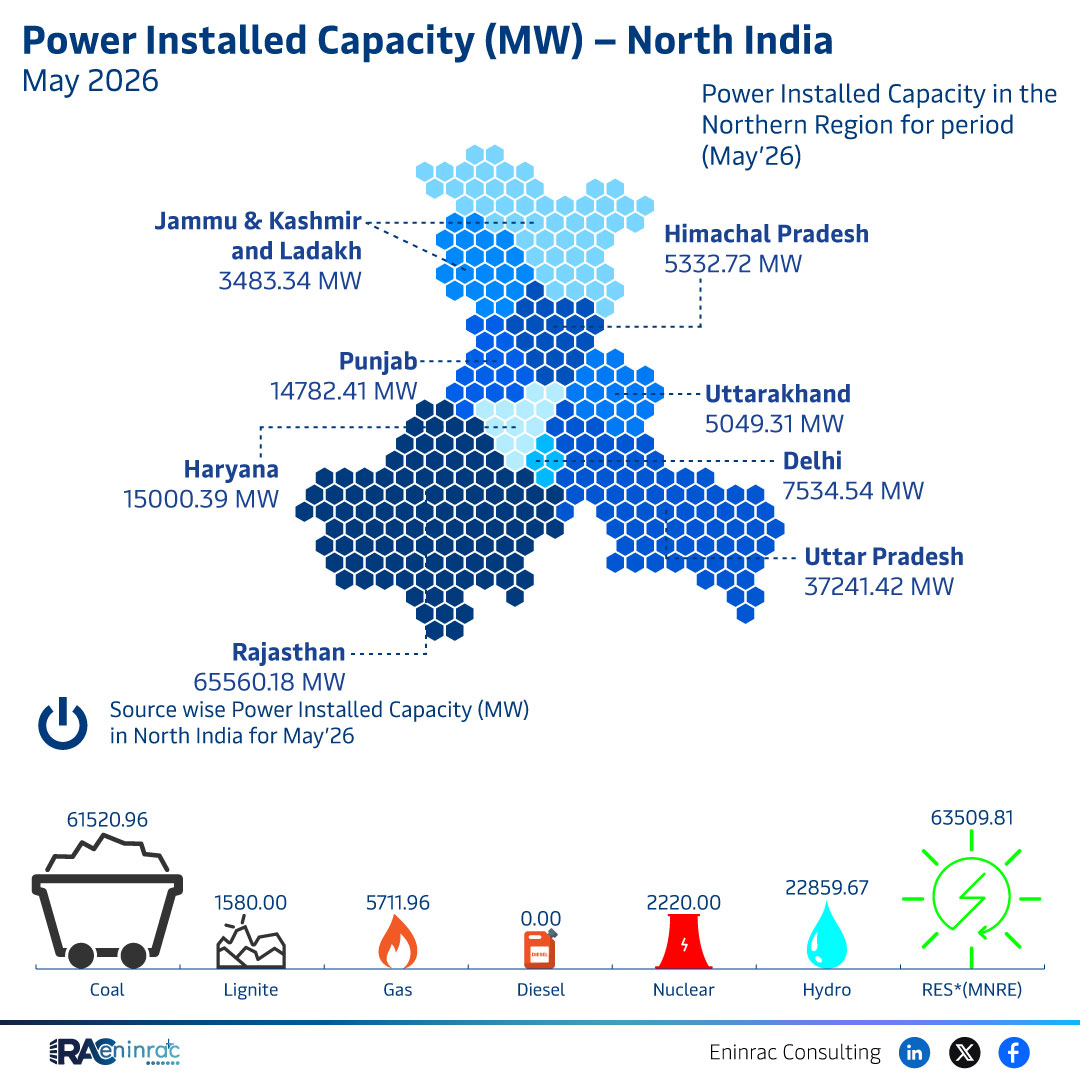
What is the total power installed capacity in North India for May 2026? The raw data indicates that Rajasthan leads with 65560.18 MW, followed by Uttar Pradesh at 37241.42 MW, Haryana at 15000.39 MW, Punjab at 14782.41 MW, Delhi at 7534.54 MW, Uttarakhand at 5049.31 MW, and the combined region of Jammu and Kashmir, Himachal Pradesh and Ladakh at 3483.34 MW. The source-wise breakdown shows coal and lignite at 61520.96 MW, gas at 63509.81 MW, hydro at 1580.00 MW, nuclear at 5711.96 MW, and RES (MNRE) around 5000 MW with diesel at 0.00 MW. This reveals a heavy reliance on thermal sources with growing renewable integration across the northern grid.
State Wise Capacity Leadership in North India
A comparative interpretation of the May 2026 data shows Rajasthan dominates North India power installed capacity with 65560.18 MW, more than the combined capacity of Uttar Pradesh and Haryana. Uttar Pradesh follows as the second largest with 37241.42 MW, driven by coal and gas plants. Haryana and Punjab maintain similar scales near 15000 MW, supporting industrial demand. Delhi's 7534.54 MW serves a dense urban load. Himalayan states including Uttarakhand and the J and K, Ladakh, HP cluster show lower totals of 5049.31 MW and 3483.34 MW, where hydro potential remains underutilized per the listed 1580 MW hydro figure. The source mix highlights gas at 63509.81 MW and coal lignite at 61520.96 MW as the backbone, while RES at roughly 5000 MW signals early-stage renewable expansion.
Impact on Sectors and Industries
The May 2026 North India power installed capacity data impacts multiple sectors. Utilities and distribution companies must manage a thermal-heavy mix with 123030.77 MW from coal, lignite and gas. Renewable developers see opportunity as RES MNRE capacity is still small versus potential. Investors tracking energy transition can identify Rajasthan and Uttar Pradesh as core markets. Policymakers in Delhi and Haryana face urban supply challenges. Consumers benefit from stable capacity but face emission concerns. The data guides grid planning, open access pricing, and new energy bids across the Northern Region.
Key Takeaways
- Rajasthan leads North India with 65560.18 MW installed capacity in May 2026.
- Uttar Pradesh is second with 37241.42 MW of power installed capacity.
- Gas and coal lignite together exceed 125000 MW in the region source mix.
- Hydro installed capacity is only 1580.00 MW despite Himalayan states presence.
- RES under MNRE is about 5000 MW showing renewable growth headroom.
- Nuclear adds 5711.96 MW while diesel based capacity is zero MW.
FAQs
Which state has highest power installed capacity in North India May 2026?
Rajasthan has the highest with 65560.18 MW as per the May 2026 Northern Region data.
What is the source wise split of North India capacity?
Coal lignite 61520.96 MW, gas 63509.81 MW, nuclear 5711.96 MW, hydro 1580.00 MW, RES 5000 MW, diesel 0 MW.
How much capacity in Uttar Pradesh and Haryana?
Uttar Pradesh has 37241.42 MW and Haryana has 15000.39 MW of installed power capacity.
Why is hydro low in northern hilly states?
Listed hydro is 1580.00 MW, suggesting limited reporting or development versus theoretical potential in HP and Uttarakhand.
What does this mean for renewable energy?
RES MNRE near 5000 MW indicates early stage, with large room for solar and wind growth in Rajasthan and UP.