
Introduction
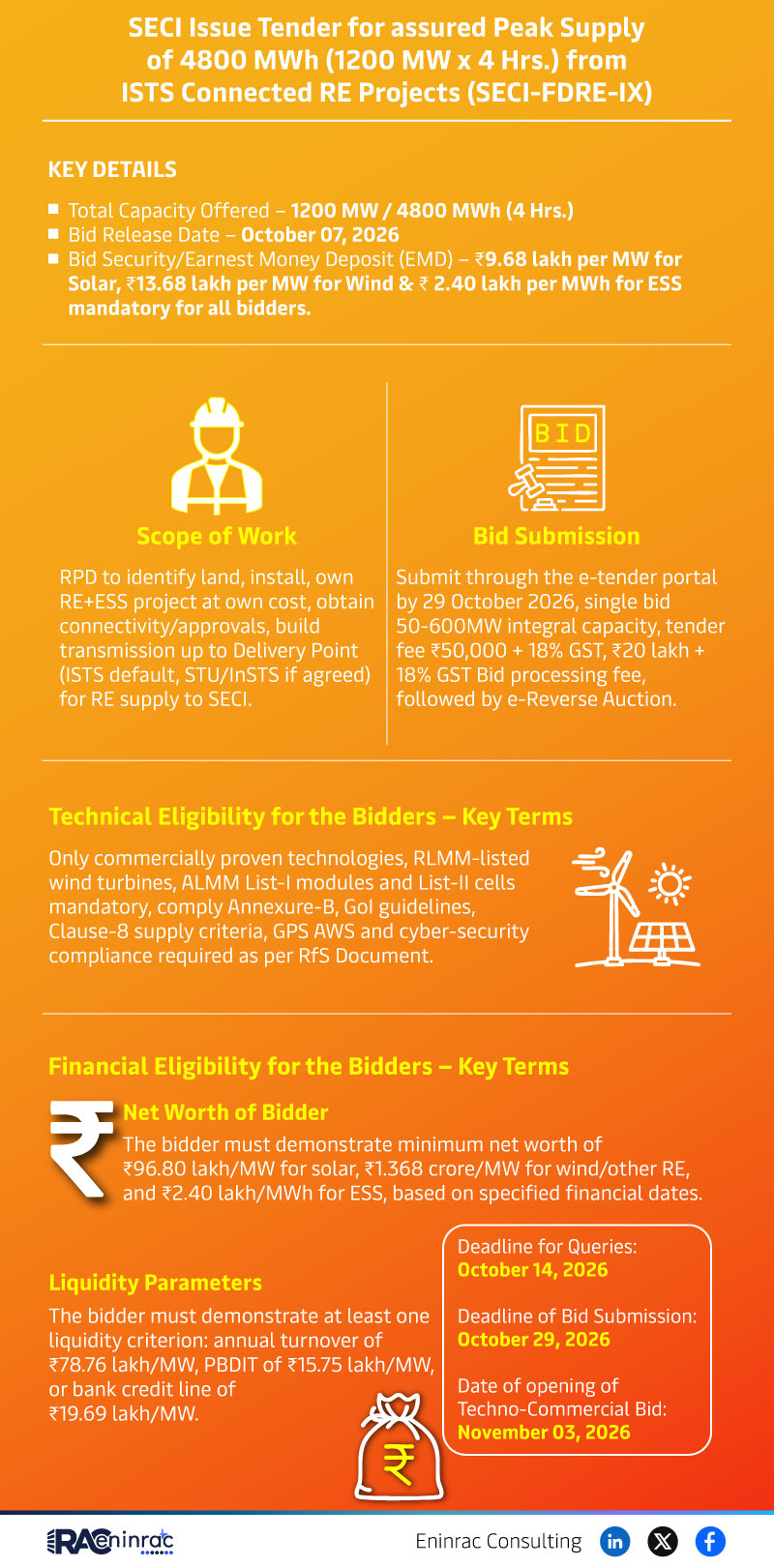
The South Eastern Coalfields Limited (SECI) has launched a high‑visibility tender for an assured peak supply of 4800 MWh, equivalent to 1200 MW delivered over four hours, from ISTS‑connected renewable energy (RE) projects. This opportunity is critical for developers of solar, wind and energy storage systems (ESS) looking to secure long‑term contracts with a major Indian utilities buyer. The tender outlines precise capacity, financial security, technical standards and a competitive e‑reverse auction process. Readers will learn the key dates, eligibility thresholds, bid fees and the strategic importance of this supply in India’s clean‑energy transition.
What Does the Data Reveal About This Topic?
The raw data shows that SECI is seeking a single integrated bid ranging from 50 MW to 600 MW, with a mandatory tender fee of INR 50,000 plus 18 % GST and an additional processing fee of INR 20 lakh plus GST. Bidders must submit their proposals by 29 October 2026, after which a techno‑commercial evaluation will be opened on 3 November 2026. Financial eligibility is tied to net‑worth and liquidity parameters per megawatt, while technical eligibility mandates RLMM‑listed wind turbines, ALMM‑listed solar modules and stringent cyber‑security compliance. In essence, the data confirms a tightly regulated, financially backed, and technically stringent procurement framework.
Tender Specifications and Financial Requirements
The capacity offered—1200 MW delivering 4800 MWh over four hours—represents a substantial infusion of renewable power into SECI’s portfolio. Bid security or Earnest Money Deposit (EMD) is set at INR 9.68 lakh per MW for solar projects, INR 13.68 lakh per MW for wind, and INR 2.40 lakh per MWh for ESS, ensuring serious participation. Financial eligibility demands a minimum net‑worth of INR 96.80 lakh per MW for solar and INR 21.368 crore per MW for wind or other RE, while ESS must meet INR 2.40 lakh per MWh. Liquidity can be proven through any one of three criteria: an annual turnover of INR 278.76 lakh per MW, PBDIT of INR 215.75 lakh per MW, or a bank credit line of INR 219.69 lakh per MW. These thresholds are designed to filter out under‑capitalised players and guarantee project delivery.
Impact on Sectors and Industries
The SECI peak supply tender is poised to influence several sectors simultaneously. Renewable generators gain a secure market for large‑scale solar, wind and storage assets, encouraging further investment in green infrastructure. Transmission operators will need to coordinate grid upgrades to accommodate the 1200 MW influx, while ancillary services providers may see increased demand for reactive power and frequency regulation. Financial institutions will monitor the tender for loan‑pipeline opportunities, and policy makers can cite this as evidence of India’s accelerating commitment to renewable dispatchability and peak‑shaving capabilities.
Key Takeaways
- SECI seeks 4800 MWh (1200 MW × 4 hrs) of assured peak supply from ISTS‑connected RE projects.
- Bid submission deadline is 29 October 2026; techno‑commercial opening is 3 November 2026.
- Financial eligibility requires high net‑worth and liquidity per MW, with distinct thresholds for solar, wind and ESS.
- EMD is mandatory: INR 9.68 lakh/MW (solar), INR 13.68 lakh/MW (wind), INR 2.40 lakh/MWh (ESS).
- Technical compliance includes RLMM wind turbines, ALMM solar modules, Annexure‑B, GPS‑AWS and cyber‑security standards.
- The tender will drive renewable capacity expansion, grid reinforcement and financing activity across the Indian energy ecosystem.
FAQs
What is the total capacity offered in the SECI tender?
The tender offers 1200 MW of capacity, delivering a peak supply of 4800 MWh over four hours.
When must bidders submit their proposals?
Bids must be submitted through the e‑tender portal by 29 October 2026.
What financial guarantees are required for solar developers?
Solar bidders must provide an Earnest Money Deposit of INR 9.68 lakh per MW and demonstrate a net‑worth of at least INR 96.80 lakh per MW.
Which technical standards must wind turbine manufacturers meet?
Wind turbines must be listed on the RLMM (Recognised List of Minimum Materials) and comply with Annexure‑B, GPS‑AWS and cyber‑security guidelines.
How is the final contract awarded after bid submission?
After the deadline, bids undergo a techno‑commercial evaluation, followed by an e‑reverse auction, with the winning bidder signed on after meeting all eligibility criteria.