
Introduction
In April 2026 the southern states of India reported their energy power requirements and actual supply in megawatts units (MU). Understanding this data is crucial for policymakers, utilities, investors and consumers who need to gauge regional power balance, identify shortfalls and plan future capacity. This article breaks down the figures for Telangana, Andhra Pradesh, Karnataka, Kerala and Tamil Nadu, highlights key trends and explains the broader impact on the energy sector.
What Does the Data Reveal About This Topic?
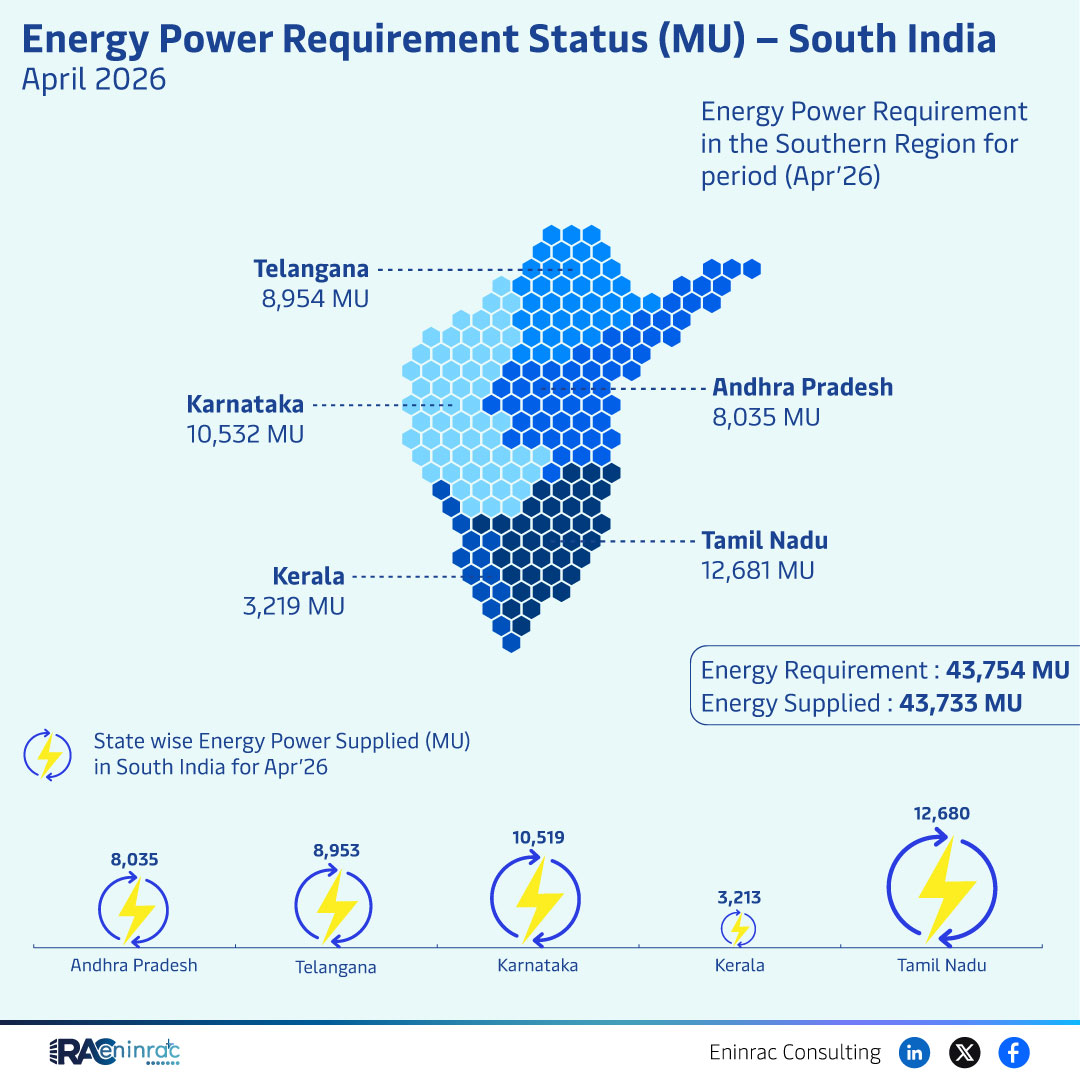
The raw numbers show a total regional requirement of 43,754 MU and a supplied amount of 43,733 MU, leaving a marginal deficit of 21 MU. Telangana contributed 8,954 MU, Andhra Pradesh 10,532 MU, Karnataka 12,680 MU, Kerala 3,219 MU and Tamil Nadu 12,681 MU. The data answers the question: Is the southern region meeting its power demand? The answer is largely yes, with supply matching demand almost exactly, indicating effective load management for April 2026.
State‑wise Supply Performance in April 2026
When comparing each state, Karnataka and Tamil Nadu each supplied over 12,600 MU, making them the largest contributors to regional power availability. Telangana’s supply of 8,954 MU, while lower in absolute terms, represents a high fulfillment rate relative to its demand. Kerala supplied 3,219 MU, the smallest figure, reflecting its lower demand base. The near‑perfect alignment between requirement and supply across all states suggests robust transmission and distribution networks during the reporting month.
Impact on Sectors and Industries
Accurate matching of power supply to demand supports industrial operations, agricultural activities and residential consumption across South India. Manufacturing units benefit from reduced risk of outages, while the agricultural sector relies on reliable electricity for irrigation pumps. Investors view the tight supply‑demand balance as a sign of stable market conditions, encouraging further investment in renewable generation and grid upgrades. Policymakers can use these insights to prioritize infrastructure projects in states with tighter margins.
Key Takeaways
- Overall regional power demand of 43,754 MU was almost fully met with 43,733 MU supplied.
- Karnataka and Tamil Nadu each supplied more than 12,600 MU, leading the region.
- Telangana’s supply of 8,954 MU covered its demand with a high fulfillment ratio.
- Kerala’s lower demand of 3,219 MU reflects its smaller industrial base.
- The marginal deficit of 21 MU indicates efficient load management for April 2026.
- Stable supply supports manufacturing, agriculture and residential sectors, attracting further investment.
FAQs
What was the total power requirement for South India in April 2026?
The total requirement was 43,754 megawatt units (MU).
Which state supplied the most power in the region?
Karnataka and Tamil Nadu each supplied the highest amount, around 12,680 MU.
Was there any power shortage in the southern region?
Only a minimal shortfall of 21 MU was recorded, indicating virtually no shortage.
How does Kerala’s power demand compare to other states?
Kerala’s demand of 3,219 MU is the lowest among the five states, reflecting its smaller consumption base.
Why is matching supply to demand important for investors?
It signals grid reliability, reduces outage risk and creates a stable environment for new energy projects and capital allocation.