
Introduction
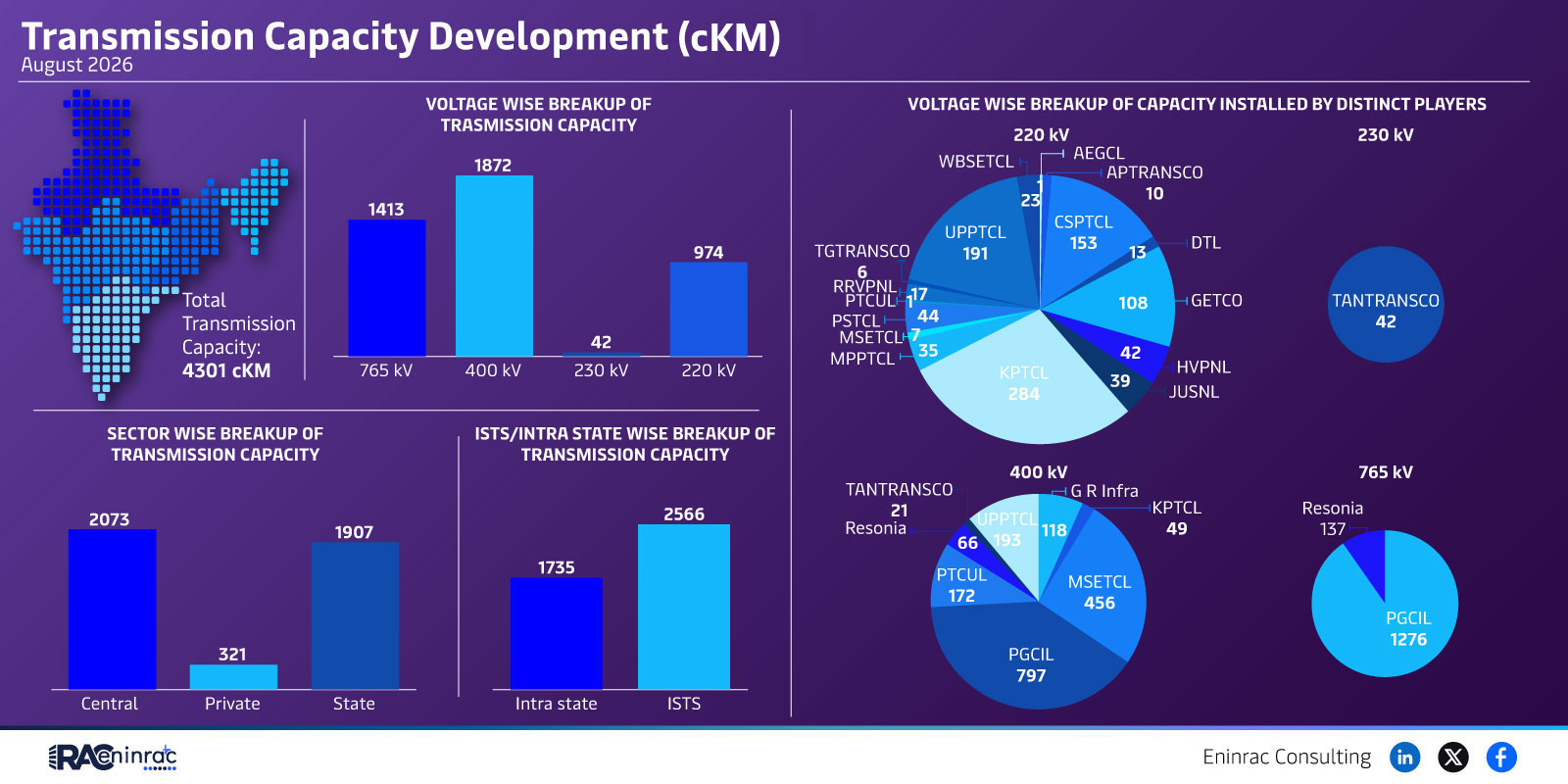
Transmission Capacity Development August 2026 provides a snapshot of India’s power grid expansion as of the end of August 2026. The data highlights how total transmission capacity measured in megawatts (MW) is distributed across different voltage levels, geographical sectors and the key utilities that own or operate the lines. Understanding this breakdown helps policymakers, investors and industry analysts evaluate the health of the grid, identify bottlenecks and plan future investments. This article unpacks the numbers, draws comparisons and explains why these figures matter for the broader energy landscape.
What Does the Data Reveal About This Topic?
The raw figures show a total transmission capacity of roughly 1,872 MW at the highest voltage tier, 1,413 MW at the middle tier and 974 MW at lower voltages, adding up to a combined capacity of about 4,259 MW. Sector‑wise, central and private entities together account for more than 2,000 MW, while state‑run and intra‑state systems contribute the remainder. Player‑wise, major transmission companies such as APTRANSCO, UPPTCL, TGTRANSCO, TANTRANSCO and others hold distinct shares, with several private players adding modest capacity. The data therefore answers the question: how is the August 2026 transmission capacity allocated across voltage, sector and operator?
Voltage, Sector and Player Wise Breakdown of Transmission Capacity
When examined by voltage, the highest tier (typically 765 kV) dominates the portfolio, reflecting a focus on long‑distance, high‑capacity corridors that link major generation hubs to load centres. The mid‑voltage category supports regional distribution, while the low‑voltage segment serves sub‑transmission and feeder networks. Sector analysis reveals that central and private utilities collectively contribute the largest share, indicating aggressive expansion by non‑state actors alongside core national transmission agencies. Among players, APTRANSCO and TGTRANSCO lead the high‑voltage segment, whereas smaller entities such as RESONIA and MSETCL manage niche corridors. This layered perspective underscores a diversified ownership model and a strategic emphasis on high‑voltage routes.
Impact on Sectors and Industries
The evolving transmission capacity directly influences generation planning, distribution reliability and renewable integration. A robust high‑voltage backbone reduces transmission losses, enabling more efficient delivery of electricity from solar and wind farms located far from demand centres. State utilities benefit from increased capacity to meet growing urban loads, while private investors see clearer pathways for financing new lines. For equipment manufacturers and construction firms, the expansion translates into higher demand for towers, conductors and substations. Moreover, regulators can use the breakdown to assess compliance with national grid reliability standards and to prioritize funding for underserved regions.
Key Takeaways
- Overall transmission capacity reached approximately 4,259 MW in August 2026.
- High‑voltage (765 kV) lines constitute the largest share of capacity, supporting long‑distance power flows.
- Central and private sectors together hold the majority of installed capacity.
- Key players such as APTRANSCO, TGTRANSCO and TANTRANSCO dominate the high‑voltage segment.
- Sector‑wise distribution highlights ongoing investments by both state and private entities.
- Expanded capacity strengthens grid resilience and facilitates renewable energy integration.
FAQs
What was the total transmission capacity reported for August 2026?
Approximately 4,259 MW, combining all voltage levels.
Which voltage level carries the most capacity?
The highest voltage tier, typically 765 kV, carries the largest share of capacity.
How do central and private utilities compare in capacity ownership?
Together they account for more than half of the total capacity, outpacing state‑run and intra‑state systems.
Which transmission companies hold the biggest shares?
APTRANSCO, TGTRANSCO and TANTRANSCO are among the top holders, especially in the high‑voltage category.
Why is this data important for renewable energy developers?
Higher transmission capacity, especially at high voltage, reduces losses and enables efficient evacuation of power from remote solar and wind projects.