
Introduction
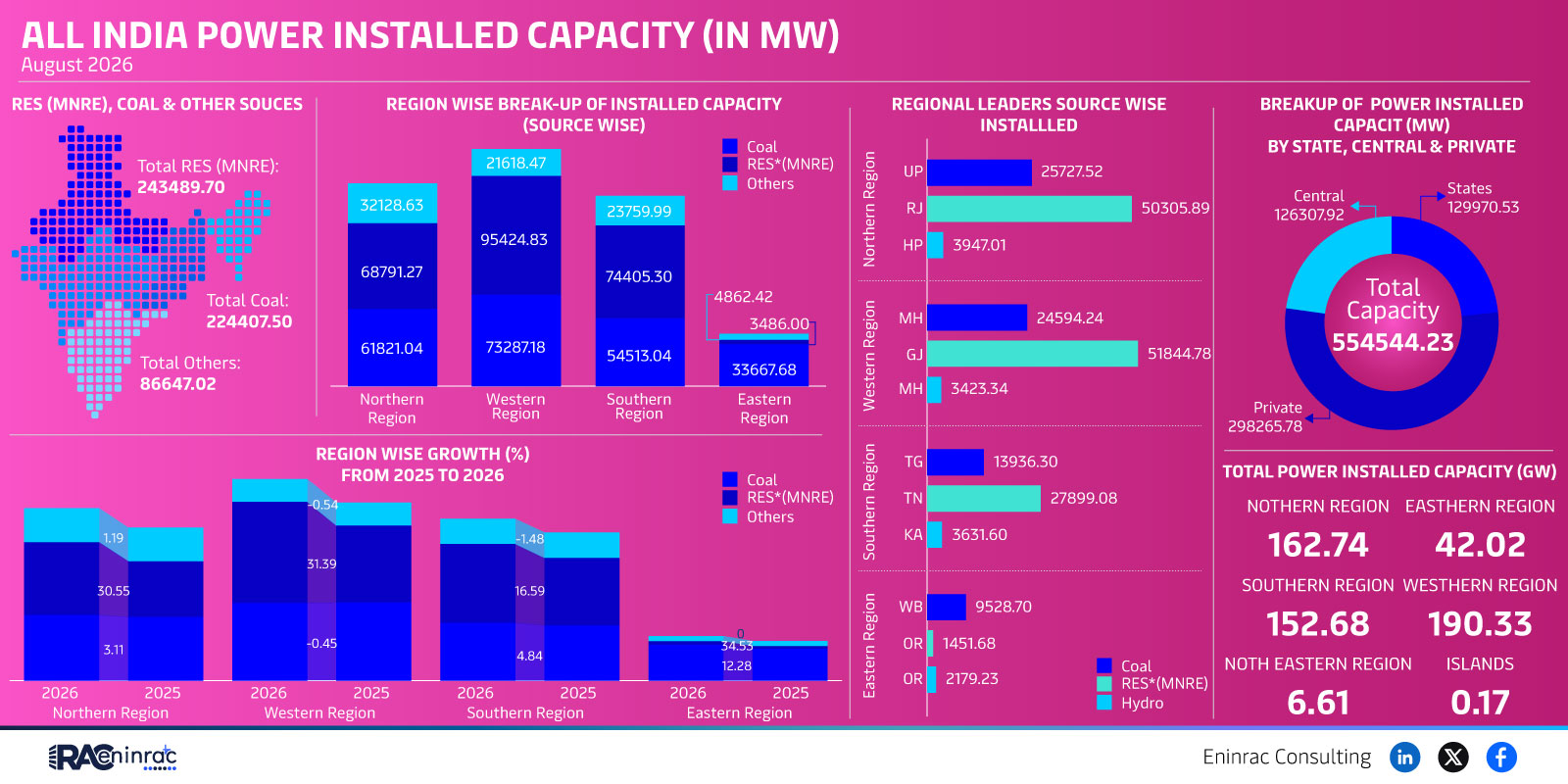
India’s power sector reached a significant milestone in August 2026, with a total installed capacity of 554,544.23 MW across renewable, coal and other sources. The data, sourced from MNRE and industry reports, breaks down capacity by region, state, and ownership, highlighting the growing contribution of renewable energy alongside traditional coal plants. Readers will gain insight into regional performance, source‑wise distribution, and the implications for policymakers, investors, and energy consumers across the country.
What Does the Data Reveal About This Topic?
The primary question is how the installed capacity is distributed among regions and energy sources in 2026. The answer shows that renewable energy (RES) contributed 243,489.70 MW, while coal accounted for 224,407.50 MW and other sources added 86,647.02 MW. Regionally, the Southern and Western zones together hold the highest capacity at 152.68 GW and 190.33 GW respectively, whereas the Northern and Eastern regions report lower figures of 162.74 GW and 42.02 GW. This distribution underscores a shift toward renewable growth in specific zones.
Regional and Source‑Wise Capacity Comparison
Analyzing the numbers reveals clear regional strengths. The Western region leads with 190.33 GW, driven mainly by large private and state projects, while the Southern region follows with 152.68 GW supported by both hydro and solar installations. The Northern region, despite having a sizable coal base, records 162.74 GW, indicating balanced development between coal and renewables. The Eastern region trails at 42.02 GW, reflecting slower infrastructure expansion. On a state level, Maharashtra dominates with 245,942.4 MW, Rajasthan contributes 50,305.89 MW, and Tamil Nadu adds 27,899.08 MW, illustrating concentration of capacity in key industrial states.
Impact on Sectors and Industries
The evolving capacity mix influences multiple sectors. Renewable growth encourages investment in solar panel manufacturing, wind turbine services, and grid‑integration technology. Coal‑centric regions face pressure to adopt cleaner practices and diversify energy portfolios. Utilities must upgrade transmission networks to handle variable renewable output, while private developers gain opportunities in emerging markets such as offshore wind and battery storage. Policymakers can leverage the data to design region‑specific incentives, and consumers benefit from a more reliable and greener power supply.
Key Takeaways
- India’s total installed capacity reached over 554 GW in August 2026, marking robust sector expansion.
- Renewable energy accounts for roughly 44 % of the total capacity, outpacing coal growth in several regions.
- The Western region holds the highest installed capacity at 190.33 GW, driven by private and state projects.
- Maharashtra remains the leading state with more than 245 GW, followed by Rajasthan and Tamil Nadu.
- Eastern region capacity lags behind, indicating potential for future infrastructure investment.
- The mix of public and private ownership underscores a collaborative approach to meeting India’s energy demand.
FAQs
What was the total renewable installed capacity in August 2026?
The renewable (RES) installed capacity stood at 243,489.70 MW, representing a substantial portion of the overall power mix.
Which region had the lowest power installed capacity?
The Eastern region recorded the lowest capacity at 42.02 GW, highlighting a need for accelerated development.
How does private sector capacity compare to public capacity?
Private entities contributed 298,265.78 MW, while public (central and state) installations amounted to 129,970.53 MW, showing strong private participation.
What are the implications of rising renewable capacity for coal plants?
Increasing renewable capacity encourages coal plants to improve efficiency, adopt emission controls, or diversify into hybrid energy models.
What policy actions can support balanced regional growth?
Targeted subsidies, grid reinforcement, and streamlined approvals for renewable projects can help boost capacity in under‑served regions like the East.