
Introduction
Small hydro power generation India is a critical component of the nation’s renewable energy mix, offering flexible, low‑impact electricity to remote and mountainous regions. The May 2026 report highlights the capacity distribution across states, recent quarterly additions, and the momentum driving further investments. Understanding which states lead in installed capacity and growth helps policymakers, investors, and industry stakeholders make informed decisions. This article explores the key data points, compares state performances, and examines the broader implications for the energy sector.
What Does the Data Reveal About This Topic?
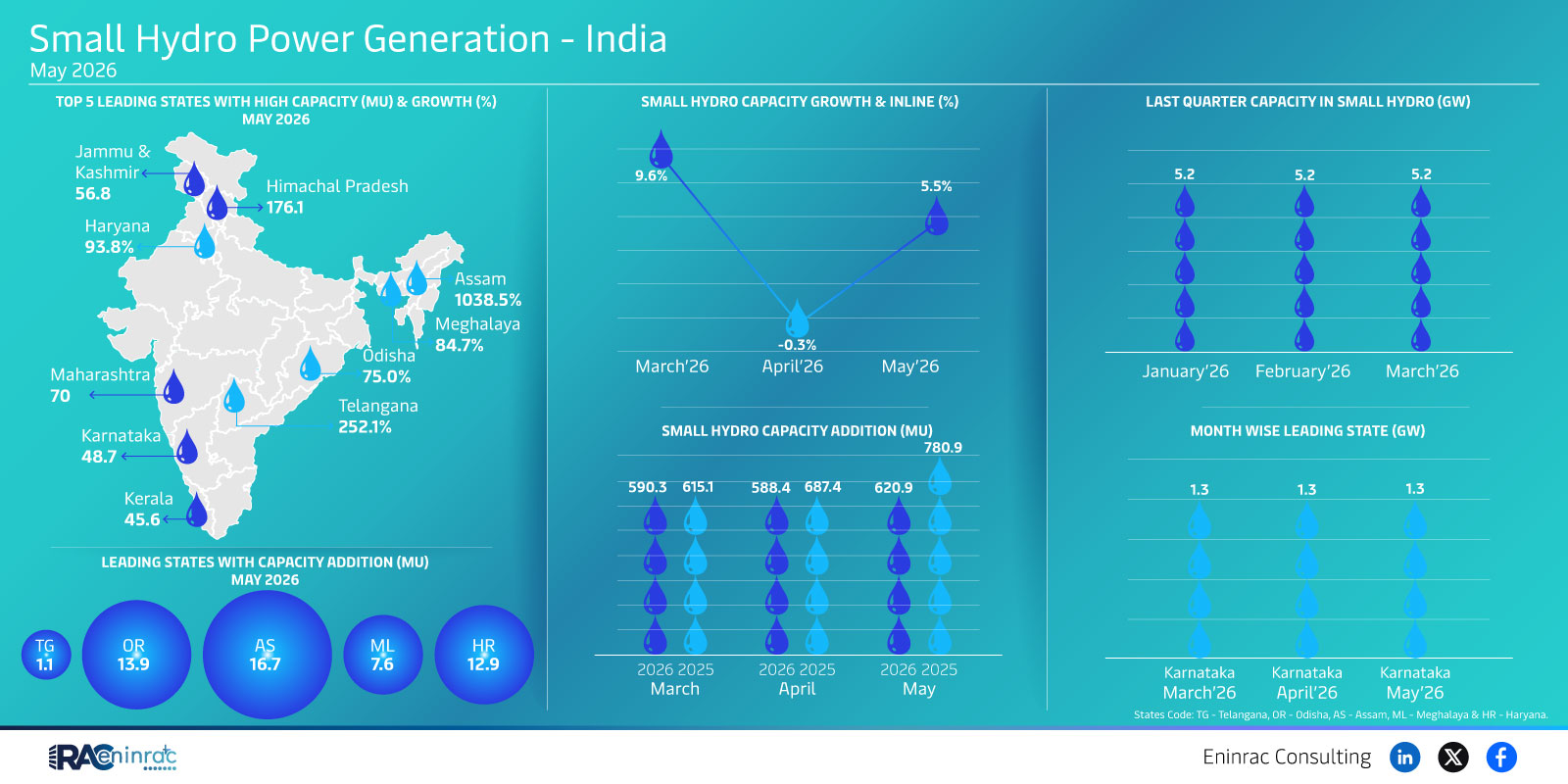
The data shows that Assam leads with a massive 1,038.5 MU of small hydro capacity, followed by Himachal Pradesh at 176.1 MU and Telangana at 252.1 MU. Growth trends indicate that several states are adding capacity each quarter, with a noticeable upward shift from March to May 2026. The question arises: which states are accelerating the fastest and what does this mean for national renewable targets? By answering this, we gain insight into regional priorities and the effectiveness of state‑level initiatives.
Top States by Capacity and Growth in 2026
Assam’s dominance is evident, yet Himachal Pradesh and Telangana also demonstrate strong capacity additions, reflecting targeted state policies and favorable geography. Haryana, though smaller at 93.8 MU, shows consistent growth, while Maharashtra and Meghalaya contribute to diversification across the country. The quarterly data reveals a modest but steady increase of 0.3 MU from March to April, continuing into May, suggesting a stable expansion pattern rather than a sudden surge. This comparative view underscores the importance of localized planning and resource allocation.
Impact on Sectors and Industries
Small hydro power generation India influences multiple sectors. For investors, the clear state‑wise growth trajectory presents low‑risk opportunities aligned with government incentives. Policymakers can leverage the data to refine subsidy schemes and streamline approval processes, especially in high‑potential regions like Assam and Himachal Pradesh. Grid operators benefit from the predictable addition of megawatts, enabling better load balancing and reducing reliance on fossil fuels. Moreover, local communities experience improved energy access, fostering economic development and supporting ancillary industries such as tourism and agriculture.
Key Takeaways
- Assam leads with over 1,000 MU of small hydro capacity.
- Himachal Pradesh and Telangana show significant growth rates.
- Quarterly additions indicate steady, incremental expansion.
- State policies directly affect capacity and investment attractiveness.
- Renewable targets are reinforced by consistent small hydro development.
- Improved grid stability benefits both consumers and industries.
FAQs
Which state has the highest small hydro capacity in 2026?
Assam holds the top position with 1,038.5 MU of installed capacity.
What is the trend in quarterly capacity addition?
Capacity rose modestly by 0.3 MU from March to April, continuing into May.
How does small hydro power affect renewable energy goals?
It contributes measurable megawatts, supporting India's commitments to increase renewable share.
Are there investment incentives for small hydro projects?
Yes, many states offer subsidies and streamlined approvals to attract investors.
What role do policymakers play in small hydro growth?
Policymakers shape regulations, incentives, and infrastructure planning that drive capacity expansion.