
Introduction
The July 2026 East India power requirement report provides a detailed snapshot of electricity demand across key states in the eastern region of India. Understanding this data is crucial for utilities, regulators, and investors because it highlights where capacity is needed, where supply meets demand, and where shortfalls may emerge. In this article we break down the state‑wise MU (million units) requirements, compare them to the actual supply recorded for the same period, and discuss the broader implications for the regional power market.
What Does the Data Reveal About This Topic?
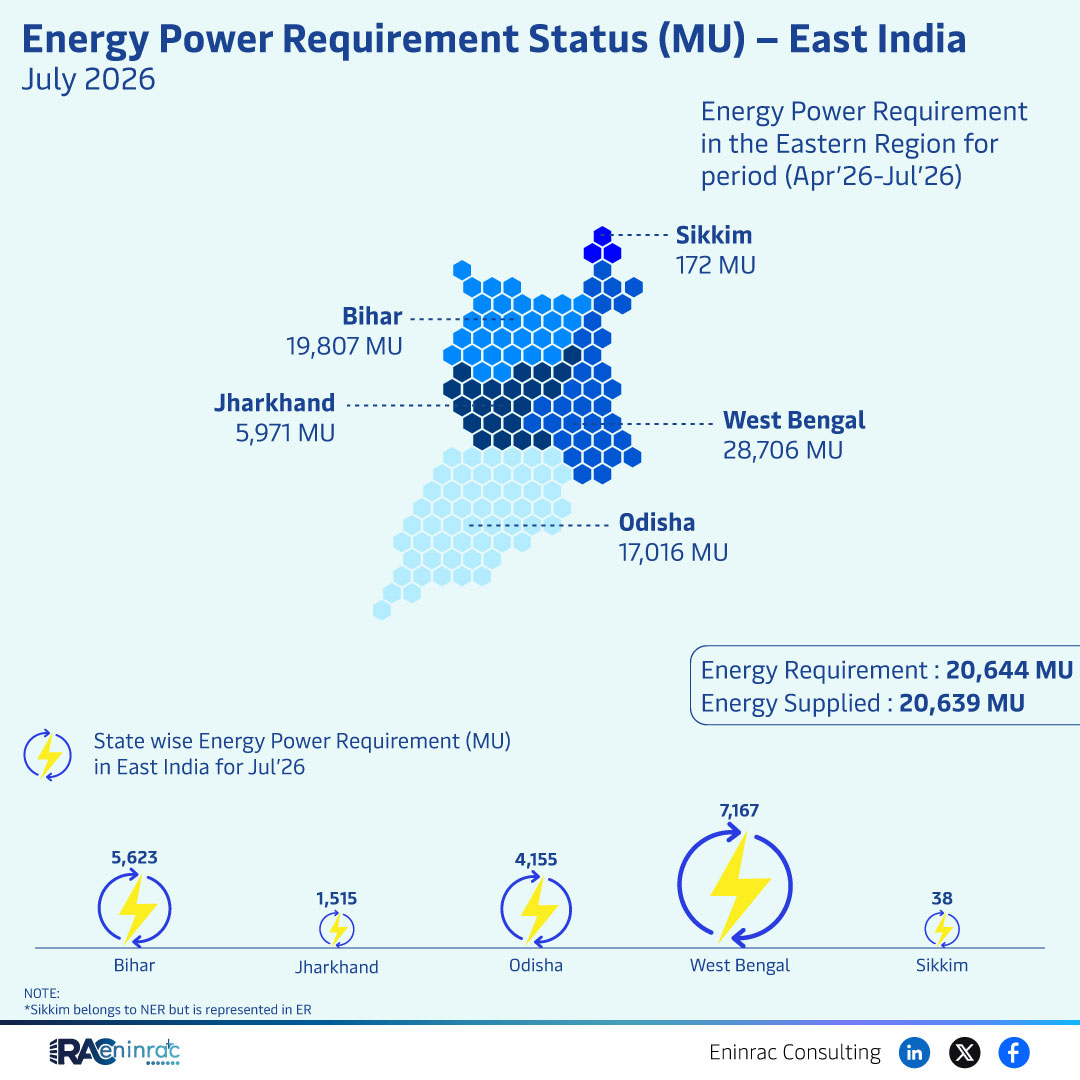
The data reveals that West Bengal recorded the highest power requirement at 28,706 MU, followed by Bihar with 19,807 MU and Odisha with 17,016 MU. Jharkhand’s figure is missing from the excerpt, indicating a possible data gap, while Sikkim, although technically part of the North‑Eastern Region, is listed with an unclear value. The total regional requirement stands at 20,644 MU, while the supplied electricity for July 2026 was 20,639 MU, indicating a marginal shortfall of just five MU across the entire eastern bloc.
State‑wise Power Requirement Comparison for July 2026
When the numbers are placed side by side, West Bengal’s demand eclipses that of its neighbours by more than a third, underscoring its industrial and urban load. Bihar’s demand is roughly 30 % lower than West Bengal’s but still significantly higher than Odisha’s, which trails by about 2,700 MU. The near‑balance between total regional requirement (20,644 MU) and supply (20,639 MU) suggests that the grid is operating close to equilibrium, yet the five‑unit deficit could become critical if unexpected outages occur. Sikkim’s ambiguous entry highlights the challenge of integrating smaller states into a unified eastern data set, and the missing Jharkhand figure points to the need for more comprehensive reporting.
Impact on Sectors and Industries
Accurate power requirement data drives investment decisions in generation, transmission, and distribution infrastructure. For utilities, knowing that West Bengal leads in demand may justify new plant commissioning or upgrades to existing thermal and renewable assets. Policymakers can use the narrow supply‑demand gap to fine‑tune load‑dispatch schedules and to plan emergency reserves. Investors looking at the eastern market will see a relatively balanced outlook, but the five‑unit shortfall serves as a cautionary signal for risk‑adjusted pricing. Consumers in high‑demand states may face higher tariffs if additional capacity is not secured promptly.
Key Takeaways
- West Bengal leads with 28,706 MU demand.
- Bihar’s requirement is 19,807 MU, second highest.
- Odisha records 17,016 MU, indicating lower demand.
- Total regional demand (20,644 MU) nearly matches supply.
- Five MU shortfall highlights a marginal supply gap.
- Missing Jharkhand data stresses need for complete reporting.
FAQs
What is the total power requirement for East India in July 2026?
The total requirement is reported as 20,644 million units (MU).
Which state has the highest electricity demand?
West Bengal, with a requirement of 28,706 MU, has the highest demand.
Is the electricity supply sufficient to meet the demand?
Supply is 20,639 MU, just five MU short of the total requirement, indicating a very small deficit.
Why is Jharkhand’s data missing?
The excerpt does not include Jharkhand’s figure, suggesting incomplete reporting for that state.
How can policymakers use this data?
Policymakers can adjust load‑dispatch plans, plan reserve capacity, and prioritize infrastructure investments based on the near‑balance and identified shortfall.