
Introduction
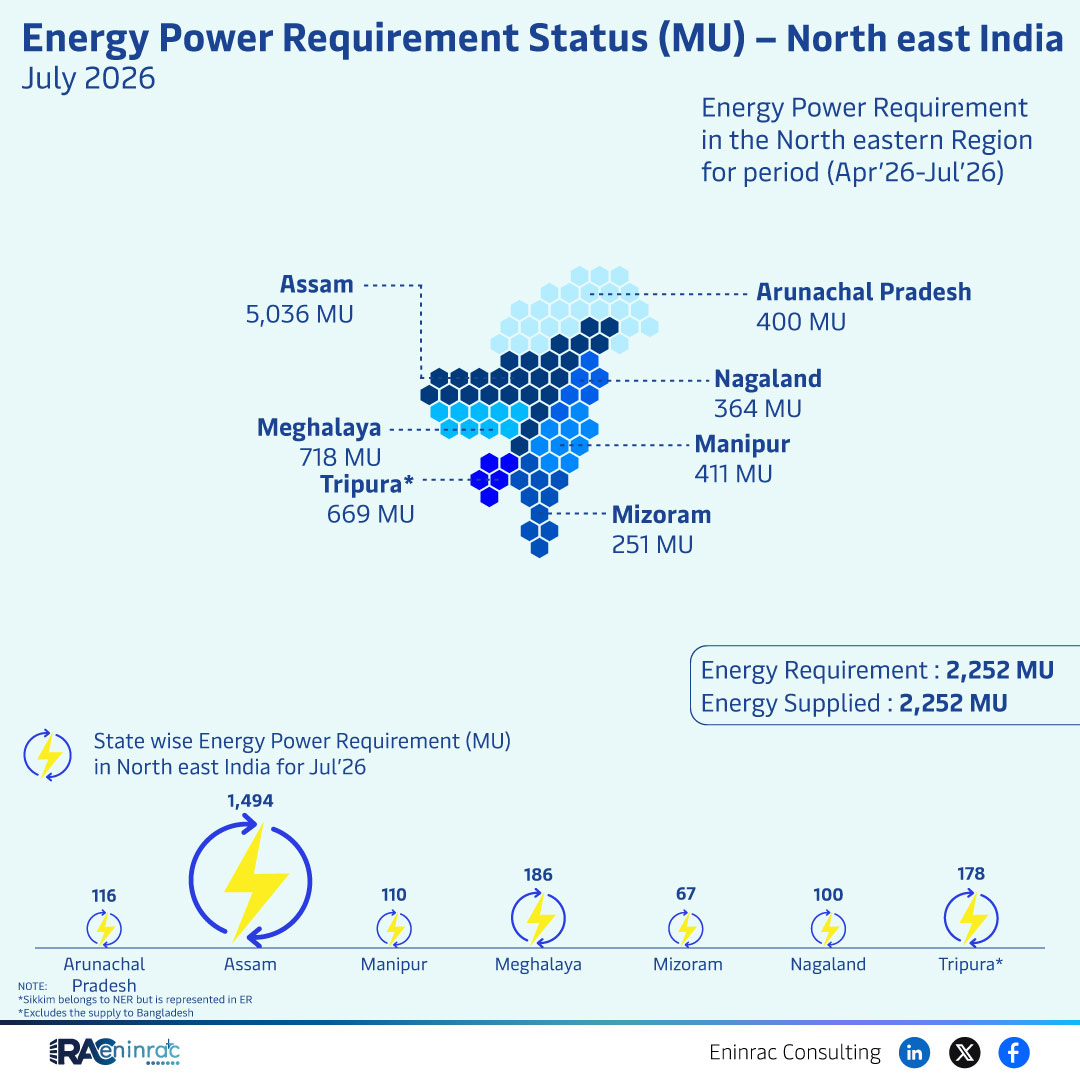
The July 2026 energy power requirement report for North East India provides a detailed snapshot of electricity demand across the eight states of the region. Understanding this data is crucial for energy planners, investors, and policymakers who aim to balance supply with growing consumption, ensure reliable power delivery, and support sustainable development in a geographically challenging area.
What Does the Data Reveal About This Topic?
The core insight from the raw data is that the total energy requirement for the period April‑July 2026 stands at 2,252 MU, which exactly matches the energy supplied, indicating a temporary equilibrium. However, a closer look shows substantial variations among states, with Arunachal Pradesh demanding 1,494 MU, while smaller states like Nagaland require only 364 MU.
State‑wise Energy Demand in July 2026
Arunachal Pradesh leads the region with a demand of 1,494 MU, reflecting its relatively larger area and developmental projects. Assam follows with 400 MU, and Manipur records 186 MU. Smaller contributions come from Meghalaya (178 MU), Mizoram (669 MU), Nagaland (364 MU), and Tripura (data not explicitly listed but contributes to the total). This distribution highlights where infrastructure upgrades and generation capacity expansions are most needed.
Impact on Sectors and Industries
Accurate knowledge of North East India energy requirement guides multiple sectors. Power generation companies can prioritize new plants or upgrades in high‑demand states like Arunachal Pradesh and Assam. Transmission and distribution utilities can plan grid reinforcement to avoid bottlenecks. Investors use the data to assess risk and choose projects with adequate demand backing. Meanwhile, policymakers can design targeted subsidies and renewable integration strategies to meet regional goals while maintaining supply‑demand balance.
Key Takeaways
- The region’s total demand of 2,252 MU is fully met by supplied energy.
- Arunachal Pradesh accounts for roughly 66% of the total demand.
- Assam, Manipur, and Meghalaya together represent less than 30% of the demand.
- Small states such as Nagaland have lower but significant power needs.
- Balanced supply suggests effective short‑term planning but long‑term growth must be monitored.
- Data supports focused investment in high‑demand states and grid strengthening.
FAQs
What is the total energy requirement for North East India in July 2026?
The total requirement is 2,252 MU, matching the amount supplied during the same period.
Which state has the highest electricity demand?
Arunachal Pradesh, with a demand of 1,494 MU, leads the region.
Does the supplied energy meet the regional demand?
Yes, the supplied energy equals the total requirement, indicating a temporary equilibrium.
How can this data influence future power projects?
Stakeholders can prioritize capacity additions in high‑demand states and improve transmission networks where needed.
Why is state‑wise analysis important for policymakers?
It helps tailor policies, subsidies, and renewable integration plans to meet each state’s specific energy needs.