
Introduction
The July 2026 energy power requirement data for North India provides a detailed snapshot of electricity demand across the region’s key states. Understanding this information is crucial for utilities, policymakers, investors, and researchers who need to align generation, transmission, and distribution resources with actual consumption patterns. This report explains the figures, highlights state‑wise variations, and discusses the broader implications for the power sector.
What Does the Data Reveal About This Topic?
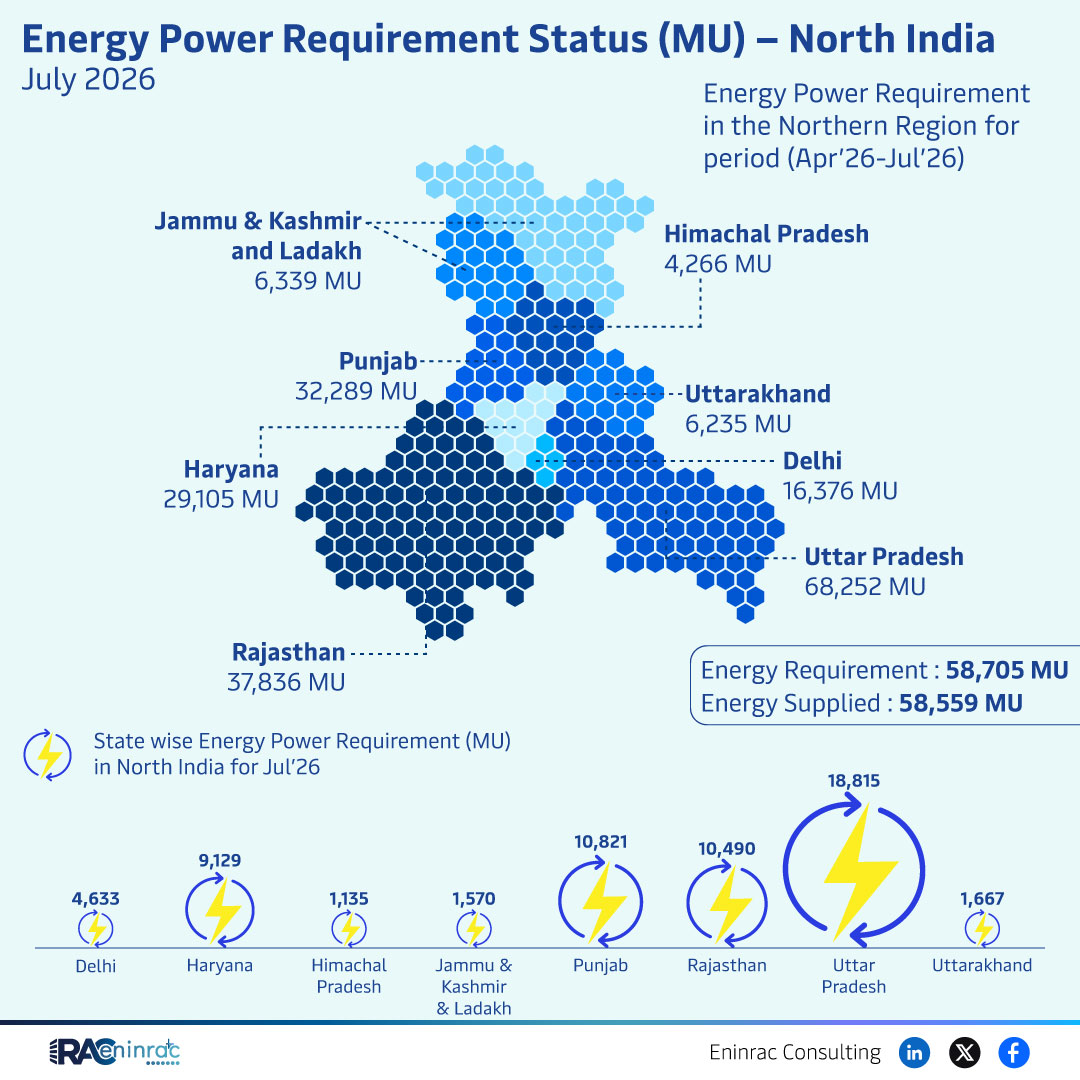
Does the July 2026 dataset indicate a balance between demand and supply in North India? The data shows a total energy requirement of 58,705 MU and an actual supply of 58,559 MU, leaving a marginal shortfall of 146 MU. This narrow gap suggests that the region is operating near equilibrium, yet state‑level disparities reveal where additional capacity or demand‑side management may be needed.
State‑wise Demand Comparison for July 2026
Analyzing the numbers state by state uncovers significant differences. Uttar Pradesh leads with a demand of 68,252 MU, followed by Rajasthan at 29,105 MU, and Haryana at 16,376 MU. Smaller states such as Himachal Pradesh (4,266 MU) and Jammu & Kashmir‑Ladakh (6,339 MU) show lower demand but still contribute to the overall regional profile. Uttarakhand reports 32,289 MU, while Delhi’s demand stands at 6,235 MU. These variations reflect population density, industrial activity, and seasonal consumption patterns across the northern corridor.
Impact on Sectors and Industries
The near‑balanced demand‑supply scenario influences several sectors. Power generators must fine‑tune capacity planning to avoid over‑production, while transmission operators need to ensure reliable inter‑state links, especially between high‑demand states like Uttar Pradesh and neighboring supply hubs. Distribution companies face the task of managing peak loads and minimizing outages. For investors, the data signals opportunities in renewable integration and grid modernization in states where demand growth outpaces current supply.
Key Takeaways
- Total North India demand in July 2026 was 58,705 MU, with supply at 58,559 MU.
- Uttar Pradesh recorded the highest demand, exceeding 68,000 MU.
- Rajasthan and Haryana together account for over 45,000 MU of the region’s requirement.
- Smaller states like Himachal Pradesh and Jammu & Kashmir‑Ladakh have modest demand below 7,000 MU.
- The demand‑supply gap is narrow at 146 MU, indicating efficient overall planning.
- State‑wise disparities highlight where additional generation or demand‑side interventions are needed.
FAQs
What is the unit MU used in the report?
MU stands for million units of electricity, a standard measure for large‑scale power demand.
Which state has the lowest energy requirement?
Jammu & Kashmir‑Ladakh registers the lowest reported demand at 6,339 MU.
Is the overall demand‑supply gap significant?
The gap of 146 MU is minimal, suggesting that the region’s power system is closely matched to current demand.
How can policymakers address the demand gaps in high‑consumption states?
They can promote renewable projects, improve grid infrastructure, and encourage energy‑efficiency measures to balance demand.
What trends are expected for future quarters?
Analysts anticipate modest growth in demand driven by industrial expansion and seasonal temperature changes, requiring proactive capacity planning.