
Introduction
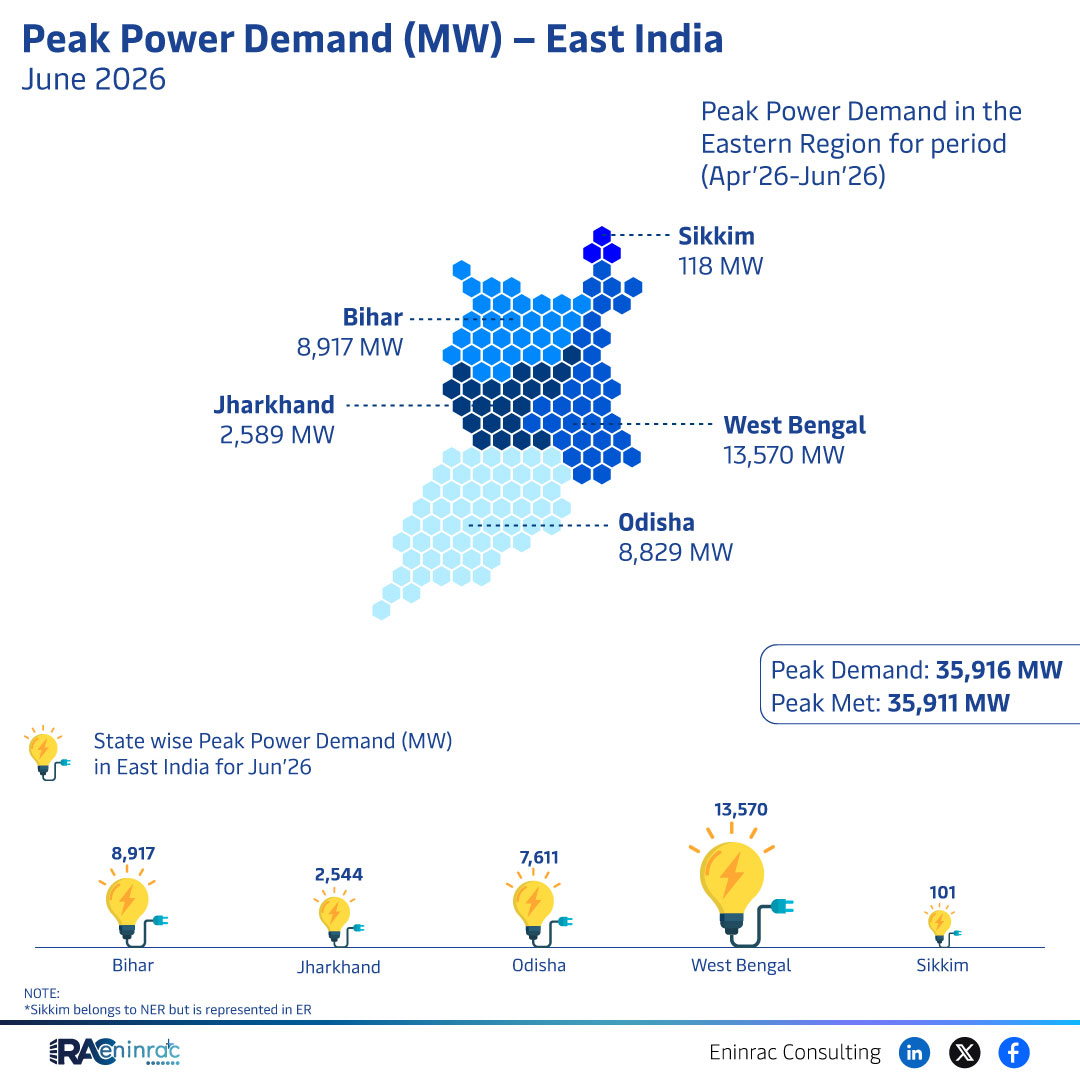
The East India power grid recorded a record‑high peak demand of 35,916 MW in June 2026. Understanding how each state contributed to this figure is essential for policymakers, utilities, investors, and industry analysts who monitor load trends, plan capacity upgrades, and assess reliability. This article breaks down the state‑wise demand, highlights the leading regions, and explains why these numbers matter for the broader Indian electricity market.
What Does the Data Reveal About This Topic?
What does the June 2026 data tell us about East India peak power demand? It shows that the region almost met its projected requirement of 35,911 MW, leaving a marginal shortfall of only 5 MW. West Bengal contributed the largest share at 13,570 MW, Bihar followed with 8,917 MW, Odisha delivered roughly 7,611 MW, Jharkhand posted 2,589 MW, and Sikkim’s demand was a modest 18 MW. The aggregate underscores a balanced supply‑demand scenario, yet also points to concentration in a few high‑load states.
State‑wise Comparison of June 2026 Peak Demand in East India
Comparing the six states reveals stark differences. West Bengal’s demand accounts for about 38 % of the total, driven by its industrial hubs and dense urban population. Bihar, with a largely agricultural economy, still ranks second, reflecting rapid electrification and rising commercial activity. Odisha’s demand, while lower than Bihar, is significant due to its mining and steel sectors. Jharkhand’s load is modest, and Sikkim’s contribution is negligible, highlighting regional disparities. These variations guide where new generation or transmission projects are most needed.
Impact on Sectors and Industries
The peak demand profile influences several sectors. Power generators must align capacity additions, especially in thermal and renewable plants, to meet West Bengal’s and Bihar’s high loads. Transmission operators focus on reinforcing corridors serving these states to prevent bottlenecks. Investors see opportunities in renewable integration where demand spikes occur. Policymakers can target demand‑side management in high‑consumption zones, while consumers benefit from improved reliability and potential price stability as supply meets demand closely.
Key Takeaways
- East India’s total peak demand in June 2026 was 35,916 MW, just 5 MW above the met target.
- West Bengal led with 13,570 MW, representing the largest single‑state share.
- Bihar’s 8,917 MW demand highlights rapid growth despite its agrarian base.
- Odisha’s demand of roughly 7,600 MW underscores the importance of mining and heavy industry.
- Jharkhand and Sikkim together contributed less than 3,000 MW, showing regional load imbalance.
- The near‑balanced supply suggests grid stability but also signals where capacity upgrades are most urgent.
FAQs
Which state had the highest peak power demand in June 2026?
West Bengal, with a peak demand of 13,570 MW.
Did the East India region meet its projected peak demand?
Yes, the actual peak of 35,916 MW was just 5 MW above the projected 35,911 MW.
How does Bihar’s demand compare to West Bengal’s?
Bihar’s demand of 8,917 MW is about 34 % lower than West Bengal’s 13,570 MW.
Why is Sikkim’s demand so low?
Sikkim is a small, mountainous state with limited industrial activity, resulting in a modest 18 MW demand.
What implications does this data have for future power planning?
It indicates the need for targeted generation and transmission investments in West Bengal and Bihar, while encouraging demand‑side management in lower‑load states.