
Introduction
The May 2026 peak power demand report for South India provides a detailed snapshot of electricity consumption across the region’s five major states. Understanding these figures is essential for grid operators, policymakers, investors, and businesses that rely on reliable power supply. This article breaks down the statewise demand, highlights the leading consumer, and discusses the broader implications for the energy sector.
What Does the Data Reveal About This Topic?
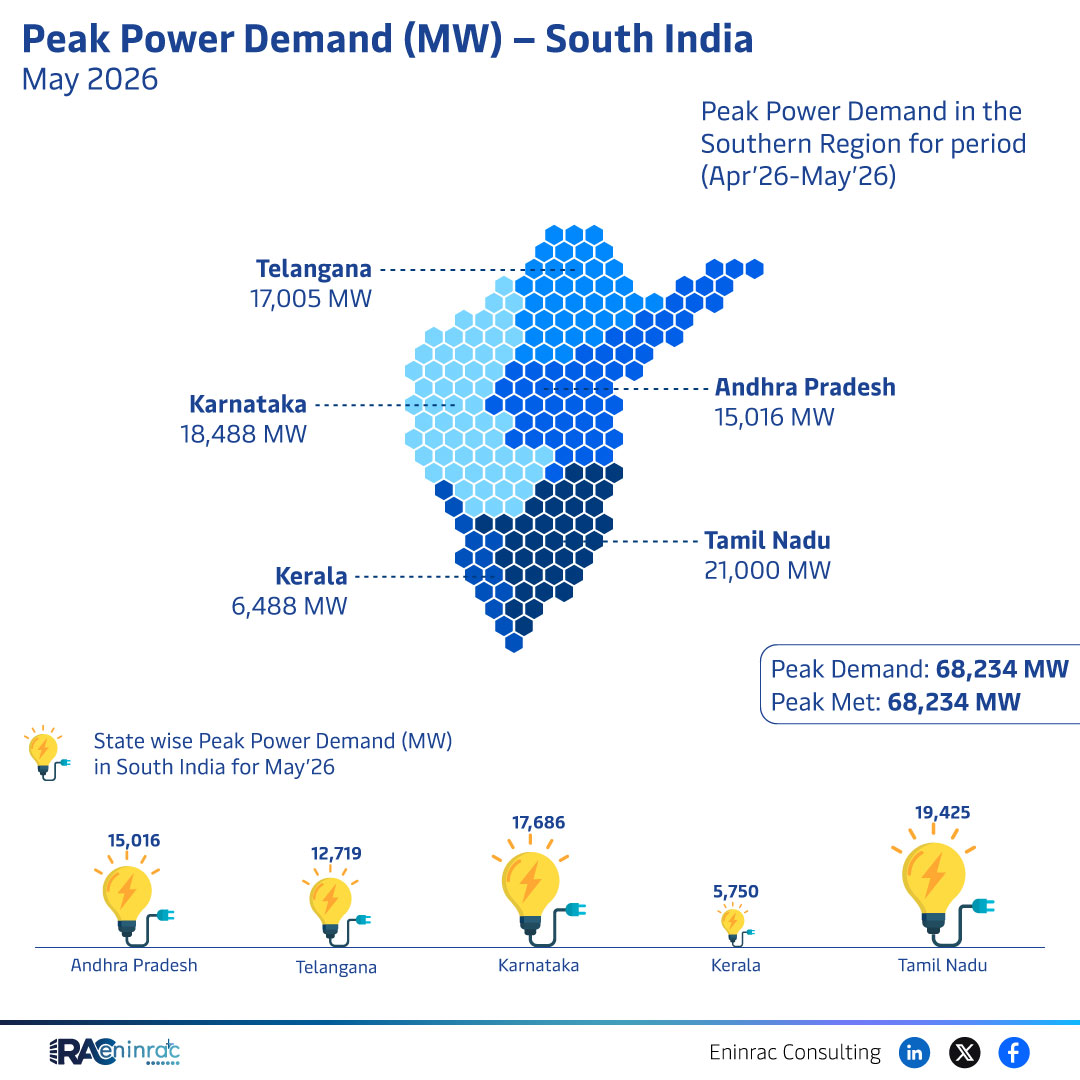
The data shows that the total peak demand for the Southern Region during the period April 2026 to May 2026 reached 68,234 MW. Kerala recorded the highest individual demand at 21,000 MW, followed by Karnataka with 18,488 MW, Andhra Pradesh at 15,016 MW, Telangana at 17,005 MW, and Tamil Nadu at 6,488 MW. The insight is clear: Kerala leads the southern power consumption peak, while Tamil Nadu contributes the smallest share during this period.
Statewise Comparison of Peak Power Demand
When comparing the five states, Kerala’s demand of 21,000 MW stands out as a significant outlier, indicating a higher load density or greater industrial activity during peak hours. Karnataka follows closely, reflecting its growing manufacturing base and urban expansion. Andhra Pradesh and Telangana show comparable levels, suggesting similar consumption patterns in residential and commercial sectors. Tamil Nadu’s lower figure may be attributed to effective demand‑side management or a different load profile during the reporting window.
Impact on Sectors and Industries
Peak power demand directly influences several sectors. Utilities must ensure sufficient generation and transmission capacity to avoid outages, prompting investments in new plants and grid upgrades. Industrial users, especially in Kerala and Karnataka, may face higher electricity tariffs during peak periods, affecting production costs. Renewable energy developers can target these high‑demand states for solar and wind projects to alleviate grid stress. Policymakers can use the data to design demand‑response programs and incentivize energy efficiency measures.
Key Takeaways
- South India’s total peak demand for May 2026 was 68,234 MW.
- Kerala recorded the highest statewise demand at 21,000 MW.
- Karnataka and Andhra Pradesh followed with 18,488 MW and 15,016 MW respectively.
- Telangana’s demand stood at 17,005 MW, slightly above Karnataka.
- Tamil Nadu contributed the lowest peak demand of 6,488 MW.
- The data highlights the need for targeted grid reinforcement and renewable integration in high‑demand states.
FAQs
Which state had the highest peak power demand in May 2026?
Kerala recorded the highest peak demand at 21,000 MW.
What was the total peak demand for South India during the reporting period?
The combined peak demand across all five states was 68,234 MW.
How does Tamil Nadu’s peak demand compare to the other states?
Tamil Nadu’s peak demand of 6,488 MW is the lowest among the five states.
Why is understanding peak demand important for investors?
Peak demand data helps investors identify regions with capacity gaps, guiding investments in generation, transmission, and renewable projects.
What actions can policymakers take based on this data?
Policymakers can promote demand‑response programs, incentivize energy efficiency, and prioritize grid upgrades in high‑demand states like Kerala and Karnataka.