
Introduction
On 15 May 2024 the Maharashtra State Electricity Distribution Company Limited (MSEDCL) released the results of its competitive tender for battery energy storage system (BESS) generators. The award covers a 2,000 MW / 4,000 MWh storage project that will support grid stability, renewable integration and peak‑shaving across the state. This article explains the key findings, compares the quoted prices of the shortlisted bidders, and analyzes the broader impact on the Indian power sector. Readers will learn which companies secured contracts, the price levels that emerged, and what the outcome signals for future energy storage investments.
What Does the Data Reveal About This Topic?
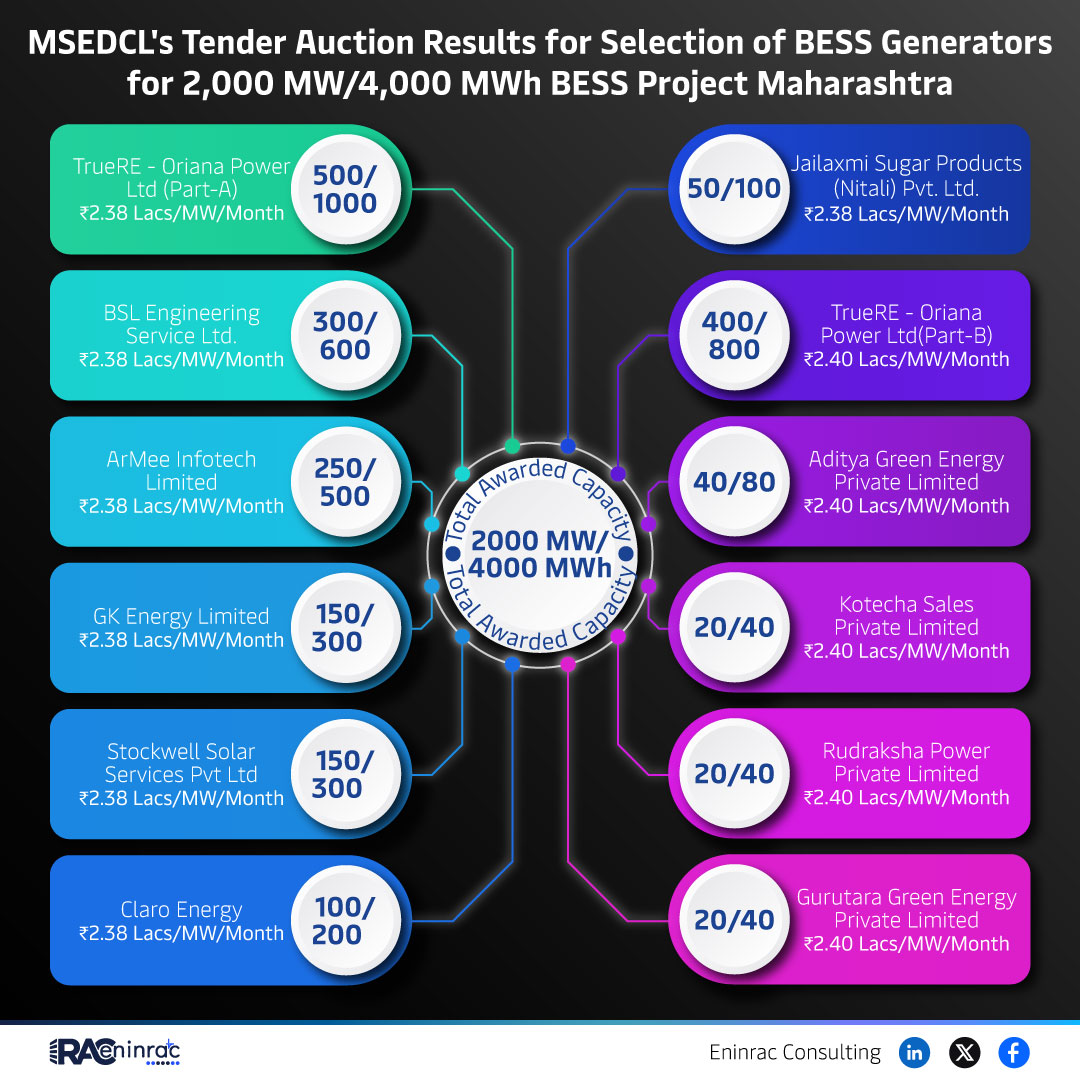
What does the disclosed data reveal about the MSEDCL BESS tender auction? The table shows eight participants with quoted rates ranging from 2.38 to 2.40 lakh rupees per megawatt per month. TrueRE‑Oriana Power and BSL Engineering both offered the lowest price of 2.38 Lacs/MW/Month, while GK Energy Limited and Stockwell Solar Services submitted the highest accepted bid of 2.40 Lacs/MW/Month. The narrow price spread of just two thousand rupees per MW indicates intense competition and a mature market for large‑scale battery storage in Maharashtra.
Bid Price Comparison Among Participants
The comparative analysis highlights three tiers of pricing. The first tier includes TrueRE‑Oriana Power, BSL Engineering and ArMee Infotech, each quoting 2.38 Lacs/MW/Month, which positions them as the most cost‑effective bidders. The second tier comprises GK Energy Limited, Stockwell Solar Services and Claro Energy, all at 2.40 Lacs/MW/Month, reflecting a modest premium for perceived reliability or additional services. A solitary offering of 2.38 Lacs/MW/Month from Claro Energy’s subsidiary (listed as 100/2.38) suggests minor variations in contract terms despite identical headline rates. Overall, the data demonstrates that price differentiation is minimal, with strategic factors likely influencing final award decisions.
Impact on Sectors and Industries
Impact on sectors and industries. The awarded BESS capacity will enable utilities to balance intermittent renewable generation, reduce reliance on fossil‑fuel peaker plants and improve power quality for industrial consumers. Renewable developers gain a stable storage partner, which can accelerate solar and wind project financing. Investors see a clear policy signal from MSEDCL that large‑scale storage is commercially viable, prompting further capital inflows into battery manufacturers and EPC firms. Policymakers can use the tender outcomes to refine tariffs, incentivize localized battery production and shape future grid‑integration standards.
Key Takeaways
- TrueRE‑Oriana Power and BSL Engineering secured the lowest quoted price of 2.38 Lacs/MW/Month.
- Price spread across all qualified bidders was only 0.02 Lacs/MW/Month, indicating tight competition.
- The 2,000 MW / 4,000 MWh project size marks one of the largest BESS deployments in India.
- Competitive rates suggest strong market confidence in battery technology and supply chain readiness.
- Successful bidders include both established EPC firms and emerging renewable service providers.
- Outcome reinforces MSEDCL’s commitment to integrating storage for grid stability and renewable support.
FAQs
What is the total storage capacity of the MSEDCL BESS project?
The project provides 4,000 MWh of battery storage combined with 2,000 MW of power output.
Which companies offered the lowest bid in the tender?
TrueRE‑Oriana Power, BSL Engineering and ArMee Infotech each quoted the lowest rate of 2.38 Lacs/MW/Month.
How does the tight price spread affect future BESS tenders?
The narrow spread signals a competitive market, encouraging more participants and potentially lower prices in subsequent auctions.
What benefits does the BESS project bring to Maharashtra’s power grid?
It enhances grid reliability, supports renewable integration, reduces peak‑load costs and improves power quality for consumers.
When will the awarded contracts be signed and implementation begin?
Contracts are expected to be finalized by Q4 2024 with project commissioning targeted for 2026.