
Introduction
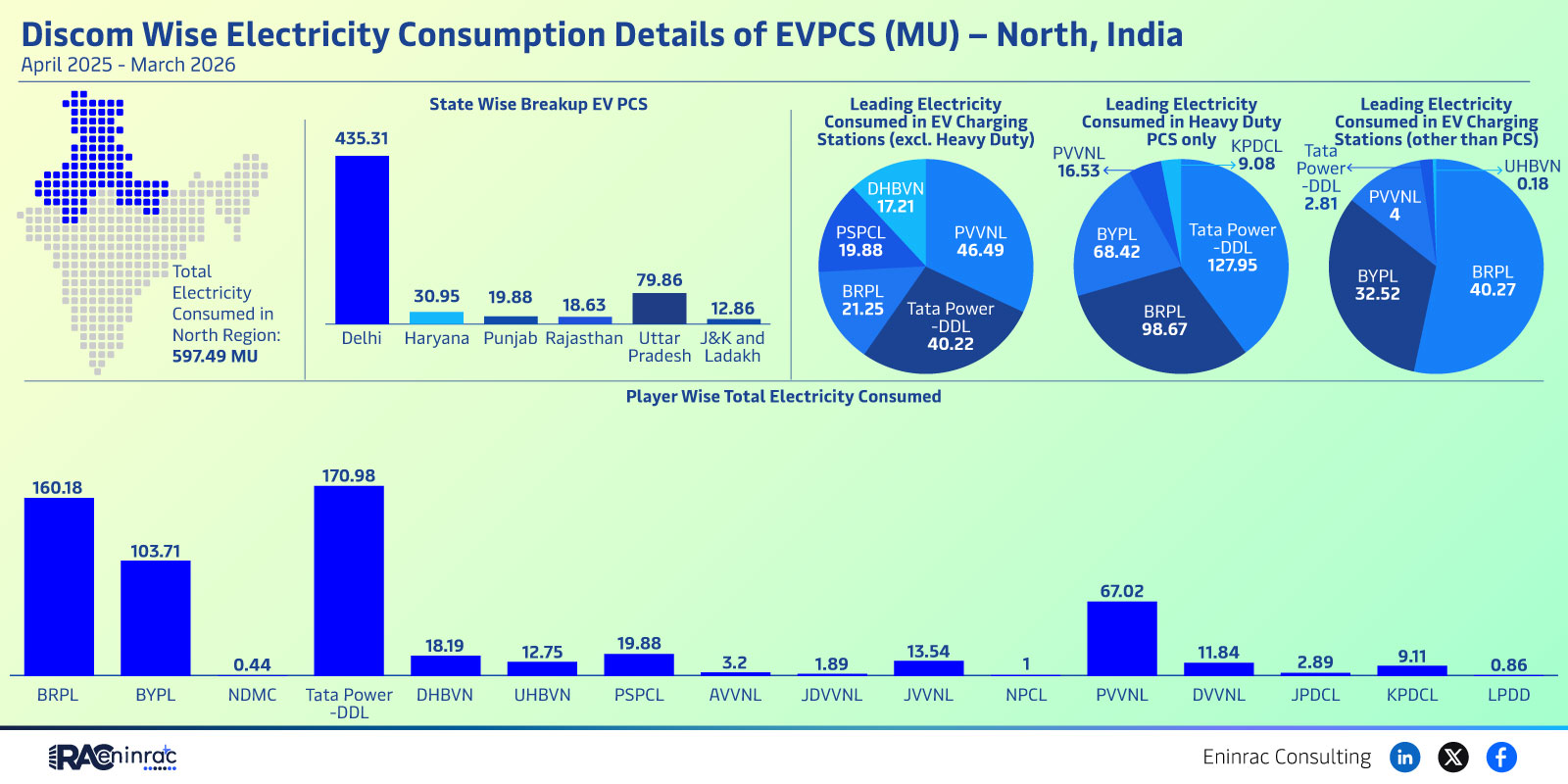
The dataset presents a detailed view of electricity consumption by distribution companies (Discoms) for electric vehicle public charging stations (EVPCS) in the northern region of India for the financial year April 2025 to March 2026. It breaks down consumption by state, by type of charging (regular EV versus heavy‑duty vehicles), and by leading players such as Tata, BRPL and others. The numbers illustrate how much power is drawn to charge passenger electric cars and commercial fleets. Understanding this information helps policymakers, investors and EV operators gauge demand trends, plan infrastructure, evaluate the performance of specific Discoms and anticipate future load growth on the grid.
What Does the Data Reveal About This Topic?
The data reveal that EV charging electricity consumption in the north totals roughly 435.31 megawatt‑hours for standard stations while heavy‑duty charging accounts for about 9.08 megawatt‑hours. Individual Discoms such as UHBVN report modest figures of 0.18 megawatt‑hours, whereas larger utilities like BRPL and BYPL together contribute close to 16,018 megawatt‑hours across all categories. These numbers show a clear dominance of regular EV charging over heavy‑duty usage and highlight the disproportionate share captured by major players. The figures also suggest that the overall charging load remains a small fraction of the total regional electricity demand, indicating significant potential for growth as electric vehicle adoption speeds up. The gap between regular and heavy‑duty consumption mirrors the current market where passenger EVs far outnumber commercial electric trucks.
State and Discom Performance in Northern EV Power Usage
The state‑wise breakdown lists Haryana, Punjab, Rajasthan, Uttar Pradesh, Delhi, Jammu & Kashmir and Ladakh as the primary jurisdictions within the north. Among them, Haryana and Punjab together account for the largest share of regular EV charging, while Rajasthan shows a modest contribution of 19.88 megawatt‑hours. Delhi’s consumption stands at 30.95 megawatt‑hours, reflecting its dense urban charging network. Heavy‑duty charging remains low across all states, with the highest recorded value of 9.08 megawatt‑hours in Punjab. Discoms such as NDMC, Tata Power and PSPCL appear as key providers, each reporting varying levels of consumption that align with regional vehicle density and infrastructure rollout. The data also indicate that states with higher industrial activity, such as Punjab, display modest heavy‑duty charging, while urban centers like Delhi prioritize passenger EV charging. The presence of multiple Discoms in a single state, for example NDMC and Tata Power in Delhi, points to competitive service provision and diversified infrastructure ownership.
Impact on Sectors and Industries
The rising electricity consumption for EV charging stations directly influences the power distribution sector, prompting investments in grid upgrades and renewable integration. Heavy‑duty vehicle charging, although still small, signals future demand from logistics and commercial fleets, encouraging utilities to plan higher capacity links. For automobile manufacturers, the data underscores the importance of expanding charging networks to support sales of electric cars and trucks. Investors watch the consumption patterns of major Discoms like BRPL and Tata because higher usage can translate into increased revenue and justify financing for new infrastructure. Policymakers can use these insights to design incentives that accelerate EV adoption while ensuring grid stability. The shift towards electric mobility also encourages renewable energy sourcing, as utilities aim to meet the growing EV load with solar and wind power to reduce carbon intensity. Financing institutions increasingly tie loans to demonstrated EV charging demand, making accurate consumption data valuable for credit appraisal.
Key Takeaways
- Regular EV charging dominates consumption with over 435 MWh in the north.
- Punjab and Haryana lead state‑wise EV power usage among northern jurisdictions.
- Heavy‑duty charging remains under 10 MWh, indicating early stage adoption.
- Major Discoms such as BRPL, Tata Power, NDMC and PSPCL capture the bulk of demand.
- Delhi shows the highest urban charging consumption at nearly 31 MWh.
- Growing EV electricity use signals need for grid upgrades and renewable sourcing.
FAQs
What is the total electricity consumption for EV charging in northern India for 2025‑26?
Approximately 435.31 megawatt‑hours were used by regular EV charging stations during the period.
Which state records the highest EV charging electricity usage?
Delhi records the highest consumption at about 30.95 megawatt‑hours.
How does heavy‑duty vehicle charging compare to regular EV charging?
Heavy‑duty charging accounts for only about 9.08 megawatt‑hours, a small fraction of total usage.
Which Discoms are the leading providers of EV charging power?
BRPL, Tata Power, NDMC and PSPCL are listed as the leading Discoms in the data.
Why is this consumption data important for policymakers?
It helps design incentives, plan grid capacity upgrades and promote sustainable EV adoption.