
Introduction
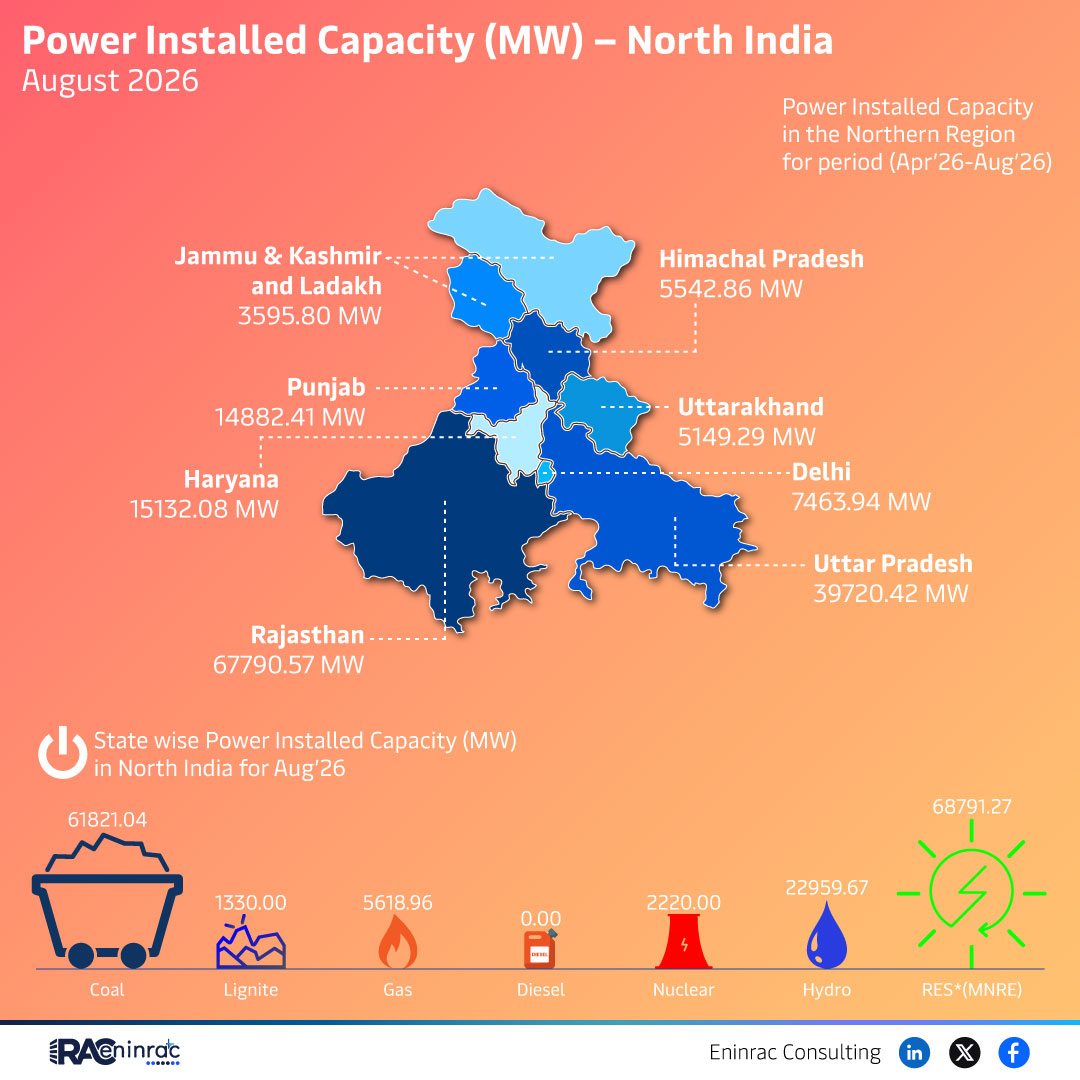
The North India power installed capacity August 2026 overview provides a clear snapshot of electricity generation across the region for the period April 2026 through August 2026. Understanding these figures matters because capacity trends influence investment decisions, policy formulation, and the reliability of supply for millions of consumers. Readers will learn the total megawatt (MW) values for each state, the mix of fuel sources, and the comparative performance of the leading regions during the reporting window.
What Does the Data Reveal About This Topic?
The data reveals that Rajasthan leads the northern region with a total installed capacity of 67,790.57 MW, while Jammu & Kashmir and Ladakh together contribute only 3,595.80 MW. This stark contrast raises questions about the distribution of generation assets, the role of renewable versus conventional sources, and the potential for future expansion in under‑served areas. By answering these questions, the analysis offers useful context for stakeholders seeking to balance growth with sustainability.
State‑wise Capacity Highlights for August 2026
Examining the state‑wise breakdown, Himachal Pradesh reports 5,542.86 MW, Uttarakhand 15,132.08 MW, and Uttar Pradesh 39,720.42 MW. Rajasthan’s 67,790.57 MW dominates the northern mix, reflecting significant coal, lignite, gas, and renewable installations. The fuel composition includes coal, lignite, gas, diesel, nuclear, hydro, and other renewable energy sources as categorized by MNRE. Smaller states such as Jammu & Kashmir and Ladakh show limited capacity, highlighting opportunities for targeted development of solar and hydro projects to improve regional equity.
Impact on Sectors and Industries
The capacity distribution directly impacts power‑intensive industries, including manufacturing, mining, and agribusiness, which rely on a stable supply. Investors monitor these figures to assess risk and identify growth corridors, especially in high‑capacity states like Rajasthan and Uttar Pradesh. Policymakers use the data to prioritize infrastructure upgrades, grid reinforcement, and incentive schemes for renewable integration. Consumers benefit from improved reliability and potential price stability as the generation mix evolves toward cleaner sources.
Key Takeaways
- Rajasthan holds the highest installed capacity in North India at 67,790.57 MW.
- Uttar Pradesh ranks second with 39,720.42 MW, showing strong growth.
- Jammu & Kashmir and Ladakh have the lowest capacity, indicating development potential.
- Coal, gas, and renewable sources together shape the regional generation portfolio.
- Capacity gaps suggest opportunities for solar and hydro expansion in smaller states.
- Stakeholders can leverage the data for investment, policy, and planning decisions.
FAQs
Which northern state has the greatest power installed capacity in August 2026?
Rajasthan leads with 67,790.57 MW of installed capacity.
How does Uttar Pradesh compare to Himachal Pradesh?
Uttar Pradesh’s capacity of 39,720.42 MW far exceeds Himachal Pradesh’s 5,542.86 MW.
What fuel sources dominate the north Indian power mix?
Coal, lignite, gas, diesel, nuclear, hydro, and other renewables all contribute, with coal and gas remaining prominent.
Are there opportunities for renewable growth in low‑capacity states?
Yes, states like Jammu & Kashmir and Ladakh can expand solar and hydro projects to raise their installed capacity.
Why is the August 2026 data important for investors?
It highlights capacity trends, regional disparities, and potential areas for infrastructure investment and renewable development.