
Introduction
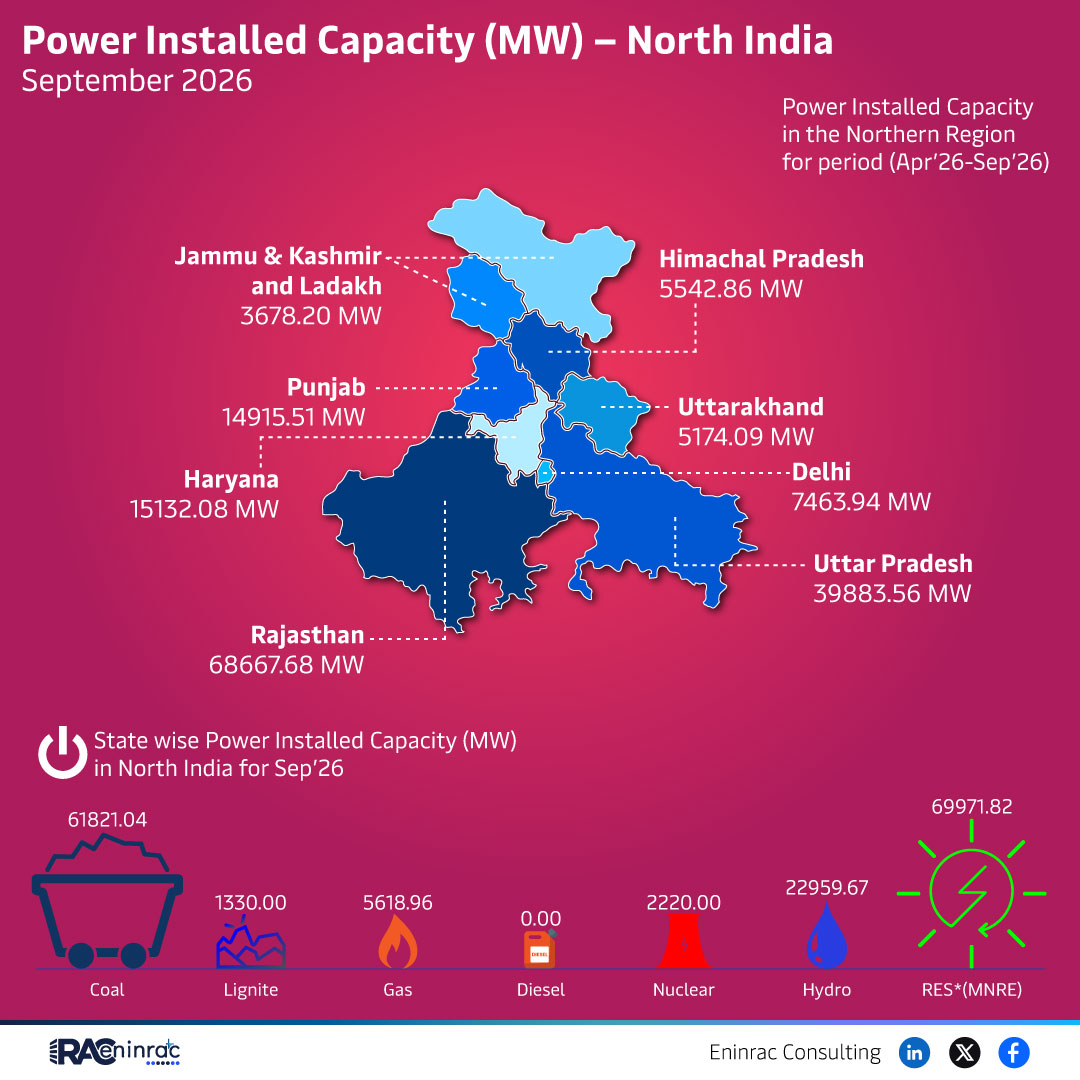
September 2026 data on North India power installed capacity provides a clear snapshot of how much electricity generation capability each state possessed during the first half of the fiscal year. Understanding these figures helps policymakers, investors, and industry analysts gauge regional energy strength, plan future infrastructure, and assess progress toward national renewable targets. This article breaks down the megawatt (MW) numbers for major northern states, highlights the dominant energy sources, and explains why these capacities matter for the broader power landscape.
What Does the Data Reveal About This Topic?
The data shows that Rajasthan leads the region with a massive 68,667.68 MW, followed closely by Uttar Pradesh at 39,883.56 MW, while smaller states such as Jammu & Kashmir and Ladakh contribute just 3,678.20 MW. The stark differences illustrate the uneven distribution of generation assets across North India. Answering the core question, the information tells us which states are power hubs, where growth opportunities exist, and how the mix of coal, gas, hydro, and renewable sources shapes regional reliability.
Statewise Power Capacity Comparison for September 2026
When we compare the numbers, Rajasthan’s capacity exceeds 68 GW, making it the single largest contributor in the north. Uttar Pradesh’s near‑40 GW capacity places it second, driven by a mix of coal and emerging renewable projects. Haryana’s 15,132.08 MW and Himachal Pradesh’s 5,542.86 MW illustrate mid‑range performance, while Uttarakhand’s 5,174.09 MW and Jammu & Kashmir & Ladakh’s 3,678.20 MW reflect more limited infrastructure, often constrained by terrain. These variations are linked to each state’s industrial demand, resource endowment, and policy environment, offering a roadmap for targeted capacity expansion.
Impact on Sectors and Industries
Higher installed capacity directly benefits manufacturing, agriculture, and services by ensuring stable power supply, which in turn attracts more investment. For renewable energy firms, states with large coal‑based capacity like Rajasthan are pivoting toward solar and wind, creating joint‑venture opportunities. Utilities and distribution companies must plan grid upgrades to accommodate the diverse mix of coal, gas, nuclear, hydro, and RES (MNRE) sources indicated in the data. Policymakers can use these insights to prioritize transmission corridors, incentivize clean‑energy projects, and balance regional energy security with national climate commitments.
Key Takeaways
- Rajasthan holds the largest power installed capacity in North India at 68,667.68 MW.
- Uttar Pradesh ranks second with 39,883.56 MW, emphasizing its strategic importance.
- Smaller states like Jammu & Kashmir & Ladakh contribute under 4,000 MW each, highlighting growth potential.
- The energy mix includes coal, lignite, gas, diesel, nuclear, hydro, and renewable sources.
- Capacity gaps suggest opportunities for renewable expansion in Uttarakhand and Himachal Pradesh.
- Stakeholders must align grid investments with state‑wise capacity trends to ensure reliability.
FAQs
Which north Indian state has the highest power installed capacity in September 2026?
Rajasthan leads with 68,667.68 MW of installed capacity.
How does Uttar Pradesh’s capacity compare to other northern states?
Uttar Pradesh’s 39,883.56 MW places it second after Rajasthan, far above Haryana and Himachal Pradesh.
What are the main energy sources contributing to the reported capacities?
The data reflects a mix of coal, lignite, gas, diesel, nuclear, hydro, and renewable energy sources.
Why is the installed capacity figure important for investors?
It indicates the region’s ability to supply electricity, affecting project viability and return expectations.
What opportunities exist for renewable energy in the northern region?
States with lower coal reliance, such as Uttarakhand and Himachal Pradesh, present significant renewable development potential.