
Introduction
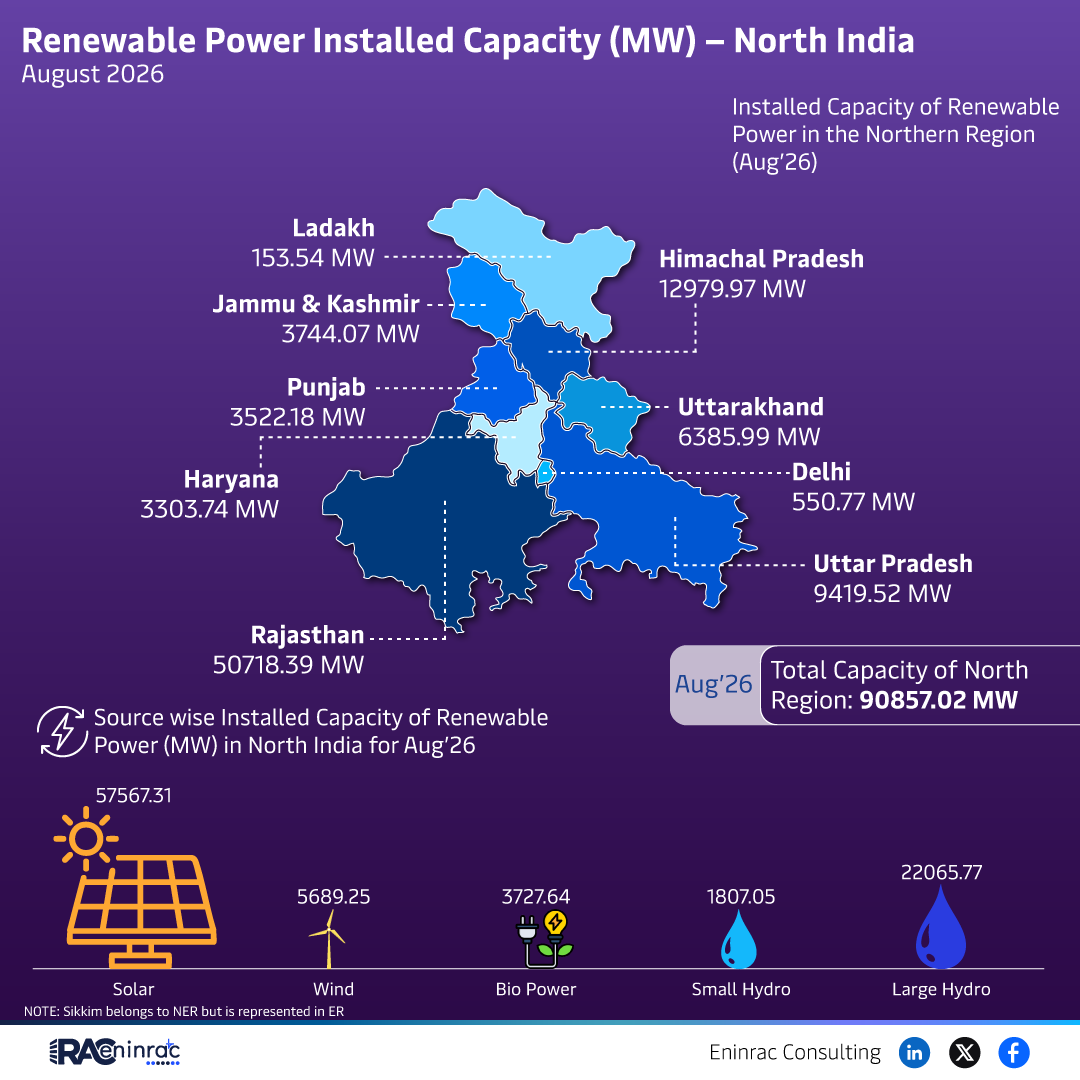
North India’s renewable power capacity has become a focal point for policymakers, investors and energy‑focused citizens. In August 2026 the region recorded a total installed renewable capacity of 90,857 MW, a figure that reflects rapid growth across solar, wind, bio‑power, small hydro and large hydro projects. This article unpacks the state‑wise data, examines the source mix, and explains why the numbers matter for the future of clean energy in the sub‑continent.
What Does the Data Reveal About This Topic?
What does the August 2026 snapshot tell us about renewable development in North India? The data shows that Rajasthan dominates the landscape with 50,718 MW, accounting for more than half of the region’s total. Following Rajasthan, Uttar Pradesh (9,419 MW), Uttarakhand (6,386 MW) and Haryana (3,304 MW) contribute substantially, while smaller states such as Ladakh (154 MW) and Himachal Pradesh (data not clearly listed) play a modest role. The overall trend points to a concentration of capacity in larger states that benefit from favorable policies and abundant natural resources.
State‑wise Renewable Power Capacity in North India
When we compare individual states, the disparity becomes evident. Rajasthan’s 50,718 MW dwarfs the combined capacity of the next three states, highlighting its strategic investments in solar farms and wind corridors. Uttar Pradesh follows with a diverse portfolio that includes both solar parks and bio‑energy units, pushing its total near 9,420 MW. Uttarakhand’s mountainous terrain supports small‑hydro installations that total over 6,300 MW, while Haryana’s flat plains have attracted large‑scale solar and wind projects amounting to roughly 3,300 MW. Ladakh, despite its high altitude and solar potential, records a modest 154 MW, reflecting early‑stage development. The total across the northern region reaches 90,857 MW, a milestone that underscores the accelerating transition to renewable sources.
Impact on Sectors and Industries
The surge in renewable capacity influences multiple sectors. Energy‑intensive industries such as cement, steel and chemicals can now source cleaner electricity, reducing carbon footprints and meeting ESG targets. The agricultural sector benefits from bio‑power projects that convert waste into useful energy, enhancing rural electrification. Financial markets see new opportunities as green bonds and climate‑aligned investment products gain traction. For policymakers, the data provides a baseline to shape subsidies, grid‑integration strategies and regional power‑exchange mechanisms, ensuring that the expanding renewable base is efficiently utilized.
Key Takeaways
- Rajasthan alone supplies over 55 % of North India’s renewable capacity.
- The total installed renewable capacity reached 90,857 MW in August 2026.
- Solar and wind dominate the source mix, with hydro and bio‑power contributing smaller but growing shares.
- State‑level disparities highlight policy and resource advantages in larger states.
- Industrial sectors can leverage the clean‑energy surge to meet sustainability goals.
- Policymakers must focus on grid upgrades and storage to accommodate the expanding renewable portfolio.
FAQs
Which state has the highest renewable power capacity in North India?
Rajasthan leads with 50,718 MW of installed renewable capacity.
What is the total renewable capacity for North India as of August 2026?
The region totals 90,857 MW across all renewable sources.
Which renewable sources contribute most to the capacity?
Solar and wind together account for the majority of the installed capacity, while small and large hydro and bio‑power add smaller portions.
How does this growth affect the industrial sector?
Industries gain access to cleaner electricity, helping lower emissions and align with ESG commitments.
What challenges remain for integrating this capacity into the grid?
Key challenges include ensuring grid stability, expanding transmission infrastructure and developing adequate energy storage solutions.