
Introduction
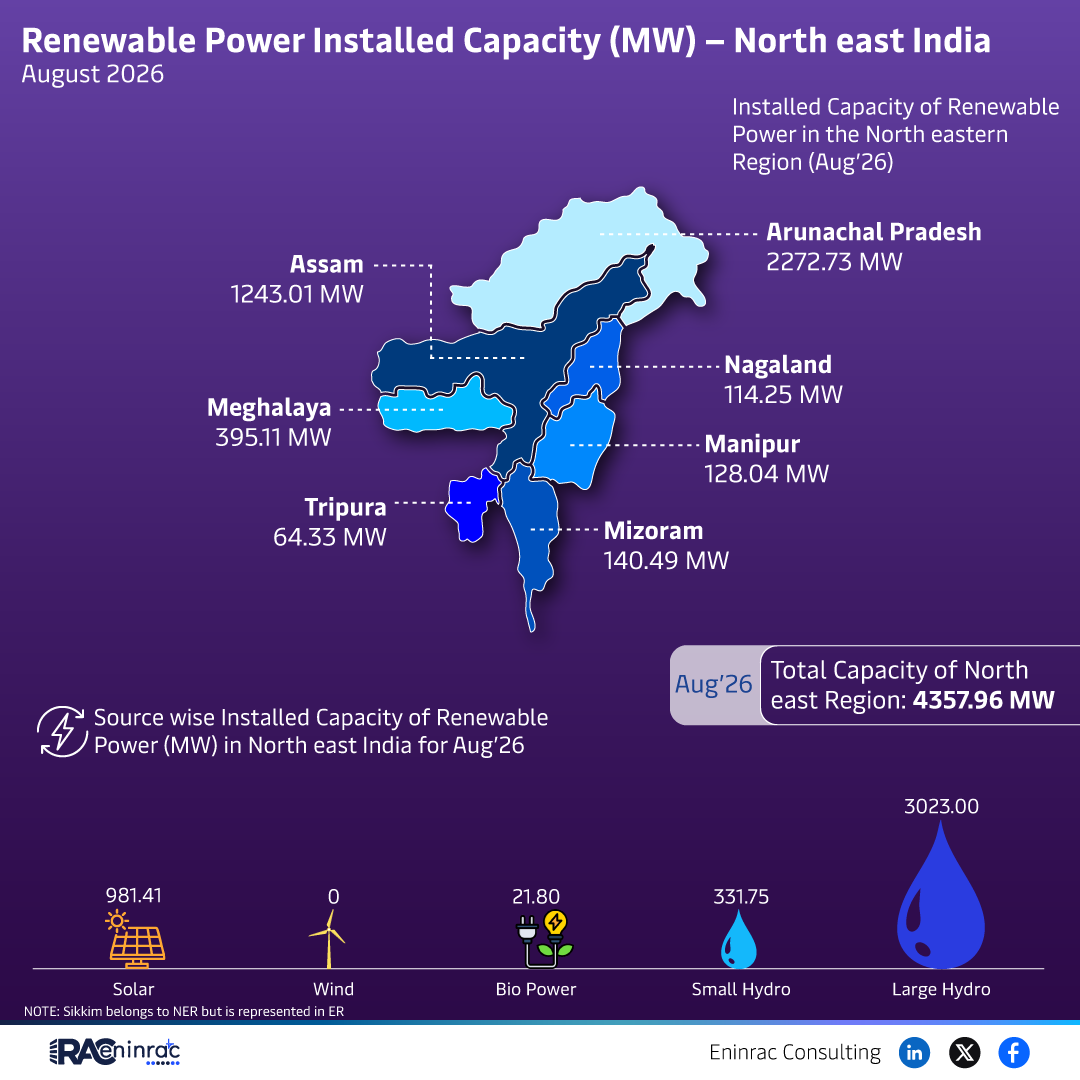
Renewable Power Installed Capacity North East India reaches 4 357.96 MW in August 2026, marking a significant step toward clean‑energy goals. The region hosts a blend of solar, wind, bio‑power and small hydro assets, each state contributing its own share. Assam leads with 2 272.73 MW while Arunachal Pradesh provides 1 243.01 MW. Smaller states such as Tripura, Mizoram and Manipur add valuable capacity, creating a diversified renewable landscape. This overview helps investors, policymakers and analysts understand the current state of renewable development and anticipate future trends across the eight northeastern states.
What Does the Data Reveal About This Topic?
When we ask which renewable source dominates the North East Indian market in August 2026, the answer is clear: solar power supplies the majority of capacity, accounting for more than three‑quarters of the total 4 357.96 MW. Wind contributes just under one thousand megawatts, while bio‑power and small hydro together provide roughly three‑hundred megawatts. The state‑wise breakdown shows Assam leading with 2 272.73 MW, followed by Arunachal Pradesh at 1 243.01 MW. Smaller states such as Tripura and Mizoram add modest figures, but together they still reinforce the region’s overall renewable footprint. This distribution suggests that policy incentives favor solar development, while wind projects are growing where topography permits.
State‑Wise Capacity and Energy Mix in August 2026
Assam’s 2 272.73 MW represents nearly 52% of the regional total, highlighting its strategic importance for large‑scale solar farms and emerging wind sites. Arunachal Pradesh’s 1 243.01 MW reflects substantial solar installations in high‑altitude zones, complemented by nascent wind turbines in windy corridors. Meghalaya (114.25 MW), Manipur (128.04 MW), Mizoram (140.49 MW) and Tripura (64.33 MW) showcase a mix of small hydro projects and community‑scale solar, keeping the renewable portfolio balanced. The aggregated source‑wise figures—3 023 MW solar, 981.41 MW wind, 21.80 MW bio‑power and 331.75 MW small hydro—illustrate solar’s dominance, wind’s steady growth, and the supportive role of hydro and bio‑energy in grid stability.
Impact on Sectors and Industries
The expanding Renewable Power Installed Capacity North East India influences multiple sectors. Energy utilities gain access to diversified generation, reducing reliance on fossil fuels and enhancing grid resilience. Equipment manufacturers see rising demand for solar panels, wind turbines and hydro turbines designed for mountainous terrain. Financial institutions observe new investment windows as the region’s renewable pipeline attracts project financing and green bonds. Policymakers can leverage the data to fine‑tune subsidies, land‑use policies and transmission planning, ensuring that capacity growth aligns with regional development objectives and carbon‑reduction targets.
Key Takeaways
- North East India’s total renewable capacity reached 4 357.96 MW in August 2026.
- Solar power accounts for roughly 70% of the regional mix, the clear leader.
- Wind energy contributes just under 1 000 MW, showing steady expansion.
- Assam and Arunachal Pradesh together supply more than 80% of total capacity.
- Small hydro and bio‑power together add about 350 MW, supporting grid stability.
- The data highlights policy emphasis on solar and emerging opportunities for wind and hydro projects.
FAQs
What is the total renewable power installed capacity in North East India as of August 2026?
The region totals 4 357.96 MW of installed renewable capacity.
Which state has the highest renewable capacity?
Assam leads with 2 272.73 MW, the largest single‑state contribution.
How much solar capacity is installed in the region?
Solar accounts for 3 023 MW, representing the bulk of the renewable mix.
What role does small hydro play in the energy mix?
Small hydro adds 331.75 MW, providing flexible, peaking power for the grid.
Are bio‑power installations significant in the North East?
Bio‑power contributes 21.80 MW, a modest share compared with solar and wind.