
Introduction
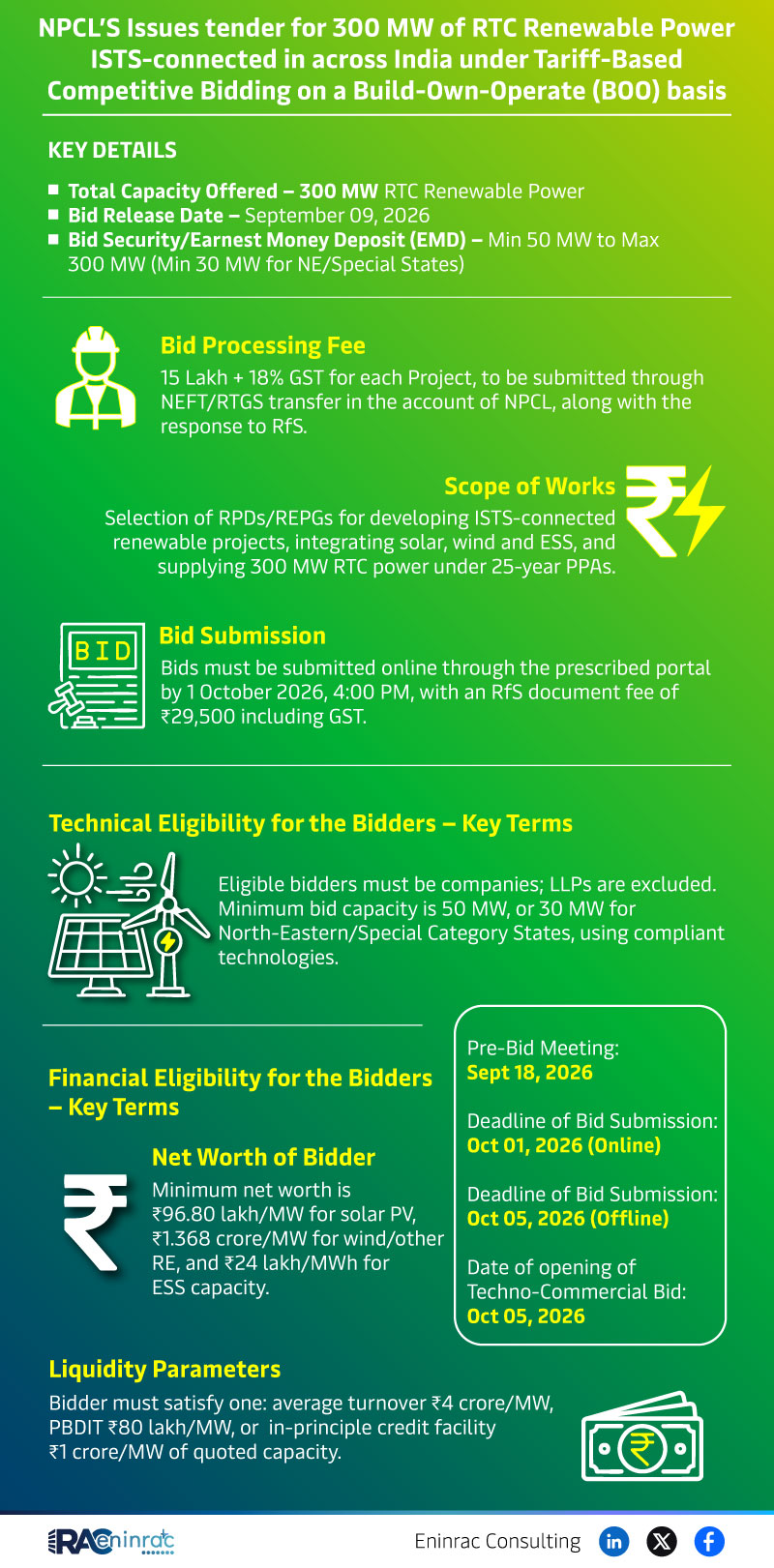
The NPCL ISTS‑connected renewable bidding round invites qualified developers to offer up to 300 MW of real‑time capacity (RTC) under 25‑year power purchase agreements. The deadline for online submission is 1 October 2026, with an offline deadline on 5 October 2026. This opportunity targets solar, wind and energy‑storage projects in North‑Eastern and Special Category States, and sets clear technical and financial thresholds for participants. Successful bidders will secure long‑term contracts that support India’s clean‑energy transition and provide stable revenue streams.
What Does the Data Reveal About This Topic?
What are the key eligibility and financial criteria for bidders? The data shows that only companies (not LLPs) can apply, with a minimum net‑worth of 96.80 lakh per MW for solar PV and 21.368 crore per MW for wind or other capacities. Bidders must also meet one liquidity benchmark: average turnover of 4 crore per MW, PBDIT of 80 lakh per MW, or an in‑principle credit facility of 1 crore per MW. Additional fees include a 15 lakh processing charge plus GST and a 29,500 rupee RFS document fee. The bid security and earnest money deposit are linked to the declared capacity, reinforcing bidder commitment and project seriousness.
Bid Requirements and Financial Eligibility
The bid package mandates a minimum 30 MW offering per project for the targeted states, with an overall capacity ceiling of 300 MW RTC. Technical eligibility requires compliance with renewable technologies approved for the North‑Eastern/Special Category regions. Financial eligibility is anchored to the bidder’s net‑worth, turnover or profit before interest, depreciation and tax (PBDIT) figures, ensuring sufficient liquidity to undertake large‑scale renewable construction. The scope also includes selection of Renewable Project Developers (RPDs) and Renewable Energy Project Groups (REPGs) to coordinate solar, wind and ESS integration. The bid security and earnest money deposit are tied to the 300 MW capacity, reinforcing commitment from participants.
Impact on Sectors and Industries
The ISTS‑connected bidding framework is poised to accelerate renewable generation in under‑served regions, creating investment pipelines for solar, wind and battery storage firms. Power producers gain long‑term revenue certainty through 25‑year PPAs, while utilities benefit from diversified real‑time supply that enhances grid stability. Financial institutions see new credit opportunities tied to verified liquidity parameters, and state governments can advance clean‑energy targets without direct fiscal outlays. Policymakers view this mechanism as a lever to meet renewable obligations while attracting private capital without increasing fiscal pressure. Overall, the market dynamics encourage technology integration and lower project‑level cost curves.
Key Takeaways
- 300 MW RTC capacity offered with a 30 MW minimum per project.
- Only corporate entities qualify; LLPs are excluded from participation.
- Financial eligibility hinges on net‑worth, turnover or PBDIT benchmarks.
- Bid security and processing fees are required for each project proposal.
- Deadline for online bids is 1 Oct 2026; offline by 5 Oct 2026.
- Long‑term 25‑year PPAs provide revenue certainty for renewable developers.
FAQs
What is the total capacity available in this bidding round?
The round offers up to 300 MW of real‑time capacity (RTC).
Who is eligible to submit a bid?
Only companies can bid; limited liability partnerships (LLPs) are not eligible.
What are the key financial thresholds for solar projects?
Solar bidders must have a minimum net‑worth of 96.80 lakh per MW and meet one liquidity test such as 4 crore turnover per MW.
When must bids be submitted and what fees apply?
Online bids are due by 1 Oct 2026 at 4 PM with a 29,500 rupee RFS fee; offline bids close on 5 Oct 2026 with a 15 lakh processing fee plus GST.
How long are the power purchase agreements?
All awarded projects will operate under 25‑year PPAs guaranteeing stable revenues.