
Introduction
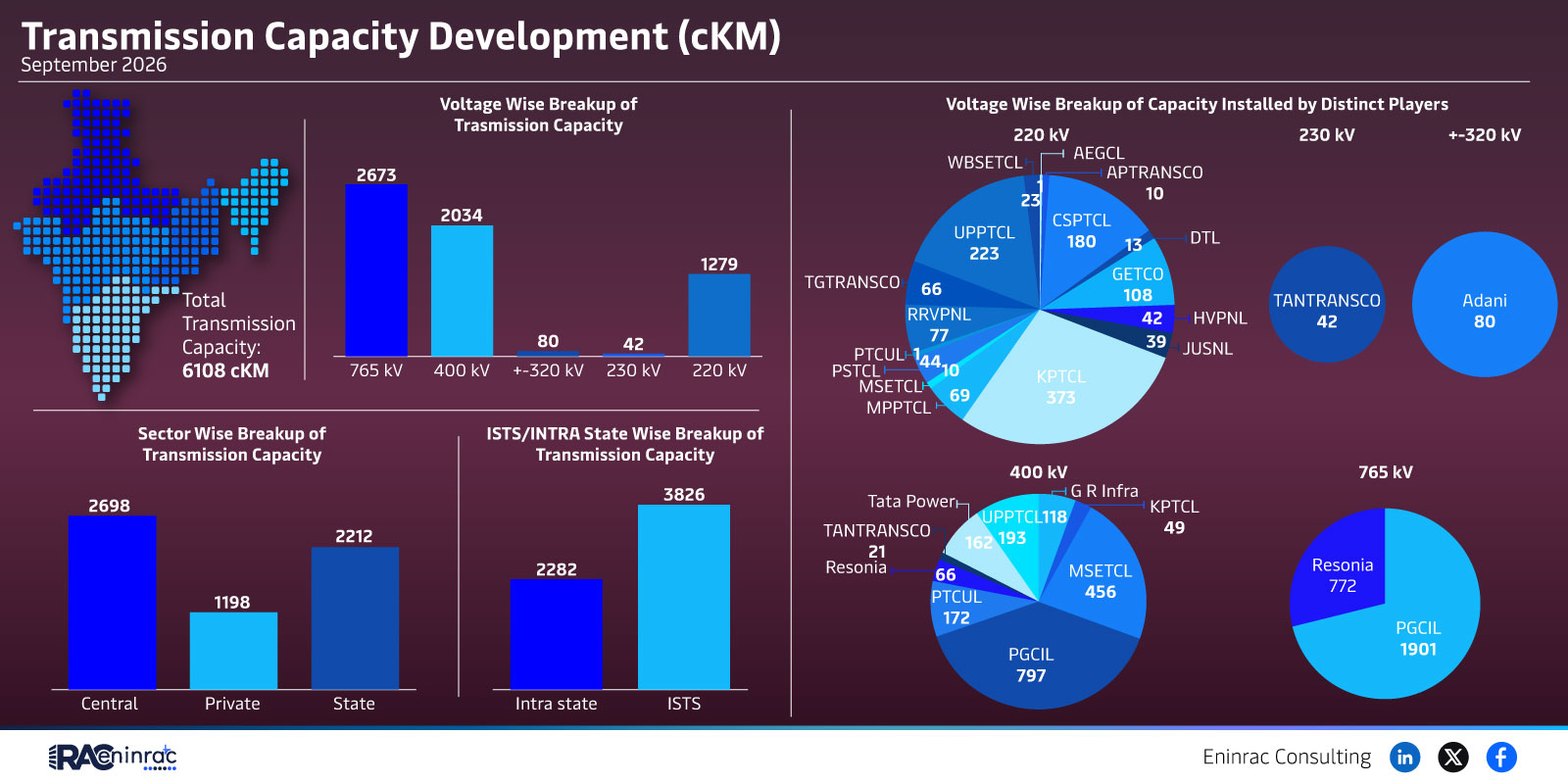
The September 2026 transmission capacity report provides a comprehensive snapshot of India’s power grid expansion across multiple voltage levels. It captures total installed capacity measured in circuit kilometres (cKM), breaks down contributions by central, state and private entities, and highlights the role of major transmission utilities. Understanding this data helps policymakers, investors and industry analysts gauge the pace of infrastructure growth, identify regional strengths, and anticipate future investment needs. The report also reveals how voltage‑wise distribution aligns with demand corridors, offering valuable insight for strategic planning and grid reliability enhancement.
What Does the Data Reveal About This Topic?
The data shows a cumulative transmission capacity of 6,108 cKM across five voltage classes ranging from 220 kV to 765 kV. Central and state players together account for the majority of the network, with the private sector contributing a smaller yet growing share. Voltage‑wise, the highest capacity lies in the 765 kV corridor, followed by 400 kV, 320 kV, 230 kV and 220 kV lines. This hierarchy reflects the prioritisation of long‑distance, high‑power corridors that link major generation hubs to load centres, while lower‑voltage lines serve regional distribution.
Voltage and Regional Distribution of Transmission Capacity
When examined by voltage, the 765 kV segment holds roughly 2,673 cKM, indicating a strong focus on bulk power transfer. The 400 kV network adds another 2,034 cKM, supporting inter‑regional connectivity. The 320 kV tier contributes 1,279 cKM, bridging the gap between high‑voltage corridors and sub‑transmission layers. State‑wise breakdown reveals that central utilities manage approximately 2,698 cKM, while state utilities collectively handle about 3,826 cKM, showcasing a balanced partnership. Intra‑state transmission adds another 2,212 cKM, emphasising the importance of internal grid reinforcement. Leading players such as WBSETCL, APTRANSCO, and TGTRANSCO together account for a significant portion of the installed capacity, with individual contributions ranging from single‑digit to several hundred cKM.
Impact on Sectors and Industries
The expansion of transmission capacity directly influences generation planning, renewable integration, and industrial power security. A robust high‑voltage backbone enables smoother dispatch of large‑scale solar and wind farms, reducing curtailment and improving market efficiency. Industries reliant on stable supply—such as steel, cement and chemicals—benefit from lower outage risk and more predictable tariffs. Moreover, enhanced transmission links attract foreign direct investment, as investors gain confidence in the grid’s ability to handle increased load. Policymakers can leverage this data to prioritise funding for underserved regions, align with climate goals, and streamline regulatory approvals.
Key Takeaways
- Total transmission capacity reached 6,108 cKM in September 2026.
- 765 kV lines hold the largest share at 2,673 cKM.
- Central and state utilities together dominate network ownership.
- Private sector participation is growing but remains modest.
- Major players like WBSETCL and APTRANSCO lead capacity additions.
- Enhanced capacity supports renewable integration and industrial stability.
FAQs
What is the total transmission capacity reported for September 2026?
The report records 6,108 circuit kilometres of transmission capacity across all voltage levels.
Which voltage level has the highest installed capacity?
The 765 kV corridor leads with approximately 2,673 cKM, reflecting its role in long‑distance power transfer.
How do central and state utilities compare in capacity ownership?
Central utilities manage about 2,698 cKM, while state utilities collectively own roughly 3,826 cKM, indicating a balanced distribution.
Which private companies are contributing to transmission development?
Companies such as WBSETCL, APTRANSCO, TGTRANSCO and TANTRANSCO are among the private entities adding capacity, though their shares are smaller than public utilities.
Why is increased transmission capacity important for renewable energy?
Higher capacity, especially at 765 kV and 400 kV, enables efficient integration of large solar and wind farms, reducing curtailment and supporting grid stability.