
Introduction
The West India region recorded detailed electricity consumption for electric vehicle public charging stations (EVPCS) during the financial year April 2025 to March 2026. This dataset captures how much power was drawn by EV chargers, excluding heavy‑duty vehicle loads, and breaks the figures down by state and by individual distribution companies (discoms). Understanding this consumption pattern is essential for planners, investors, and policymakers who aim to scale clean mobility, match supply with demand, and integrate renewable generation.
What Does the Data Reveal About This Topic?
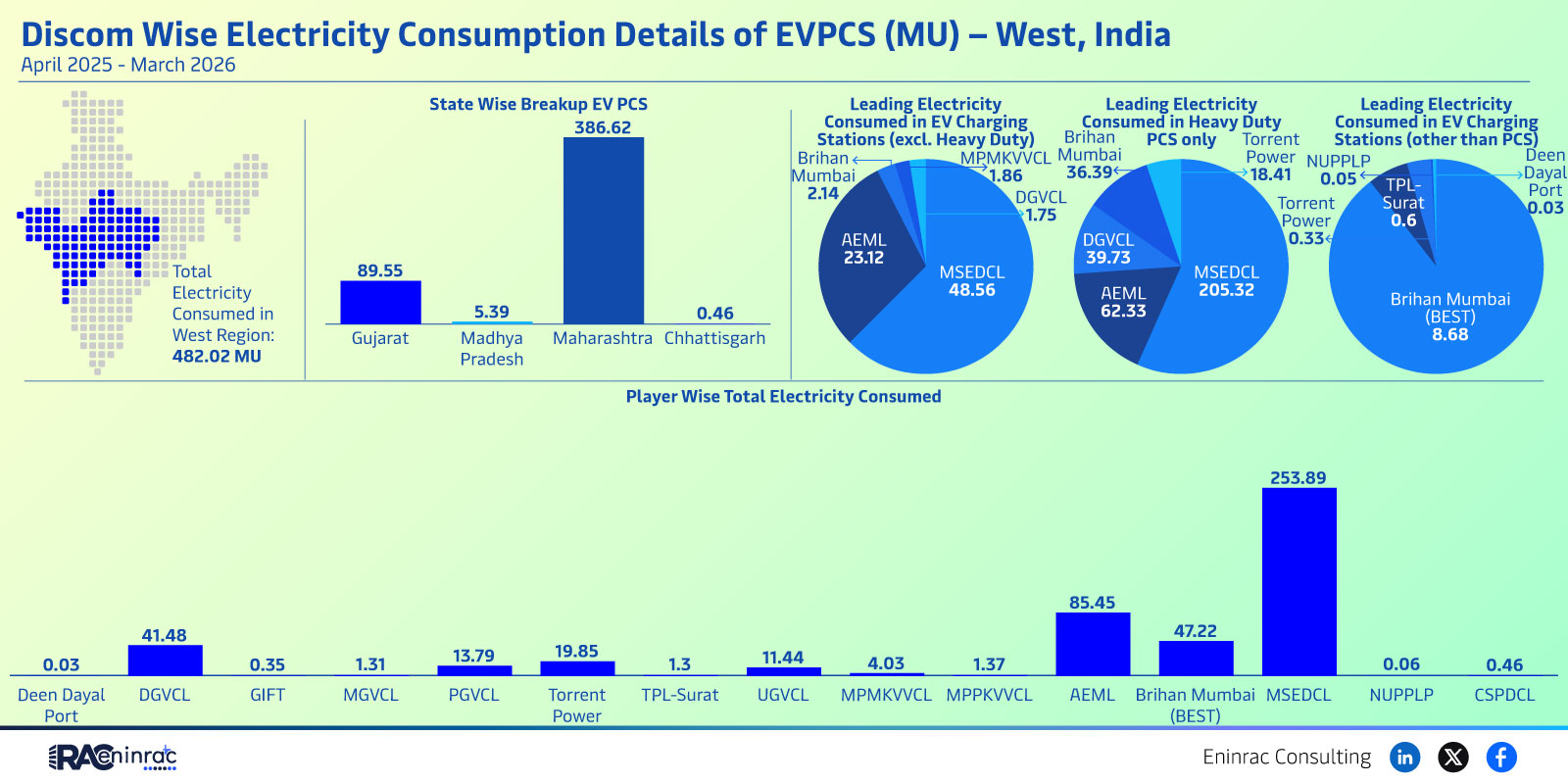
Does the raw data show which states or discoms dominate EV charging electricity use in West India? The answer is clear: Gujarat leads with the highest cumulative consumption, followed closely by Maharashtra, Madhya Pradesh, and Chhattisgarh. Among discoms, MPPKVVCL, MSEDCL, and Mumbai Power emerge as top consumers, reflecting dense charger networks in their service areas. The figures also highlight that overall EV charging demand accounts for roughly 386.62 MU, while heavy‑duty charging remains a small share of the total load.
Statewise Consumption Highlights
When we compare statewise electricity usage, Gujarat records the largest share, indicating robust EV adoption and an extensive public‑charging infrastructure. Maharashtra trails with significant uptake, driven by metropolitan hubs such as Mumbai and Pune. Madhya Pradesh shows growing demand, suggesting emerging charger deployments in Tier‑2 cities. Chhattisgarh, while smaller in absolute terms, demonstrates a steady increase that may signal future market expansion. At the discom level, MPPKVVCL (Madhya Pradesh Power) reports 86 MU, while Mumbai Power contributes 36.39 MU, together representing a substantial portion of the regional total.
Impact on Sectors and Industries
The recorded electricity consumption for EV charging influences multiple sectors. For utilities, the data underlines the need to strengthen grid capacity, especially in high‑load states, and to incorporate time‑of‑use tariffs that align with renewable generation peaks. Renewable energy developers can target these high‑consumption zones to install solar or wind projects that directly feed EV chargers, reducing reliance on fossil‑based power. Automobile manufacturers and fleet operators gain insights into charging availability, helping them plan vehicle rollouts and charging‑as‑a‑service models. Regulators can use these numbers to set realistic EV adoption targets and incentivize infrastructure investments.
Key Takeaways
- Gujarat records the highest EV charging electricity consumption in West India.
- Maharashtra and Madhya Pradesh follow closely, indicating strong market growth.
- MPPKVVCL and Mumbai Power are the top discoms by electricity use.
- Heavy‑duty vehicle charging remains a minor component of total load.
- Data supports strategic grid upgrades and renewable integration plans.
- Policymakers can base EV incentives on statewise consumption trends.
FAQs
Which state consumes the most electricity for EV charging in West India?
Gujarat leads with the highest recorded consumption, reflecting its extensive public‑charging network and early EV adoption.
What proportion of total electricity use is attributed to heavy‑duty vehicles?
Heavy‑duty charging accounts for a small fraction of the overall load, with the majority dedicated to passenger EV charging.
How can utilities prepare for rising EV charging demand?
Utilities should invest in grid reinforcement, adopt smart metering, and coordinate renewable generation to meet peak charging periods.
Why are MPPKVVCL and Mumbai Power top consumers?
Both discoms serve densely populated areas with a high concentration of public chargers, driving their electricity consumption figures.
What role does renewable energy play in EV charging?
Renewables can supply clean power to chargers, reducing carbon intensity and aligning EV growth with climate goals.