
Introduction
The electric 3‑wheeler retail sales market has become a focal point for sustainable urban mobility as cities shift toward cleaner transportation options. Data compiled by Eninrac Consulting up to June 2026 provides a clear snapshot of how monthly sales have evolved from 2025 to 2026. This article breaks down the numbers, highlights emerging patterns, and explains why these trends matter for manufacturers, investors, and policymakers.
What Does the Data Reveal About This Topic?
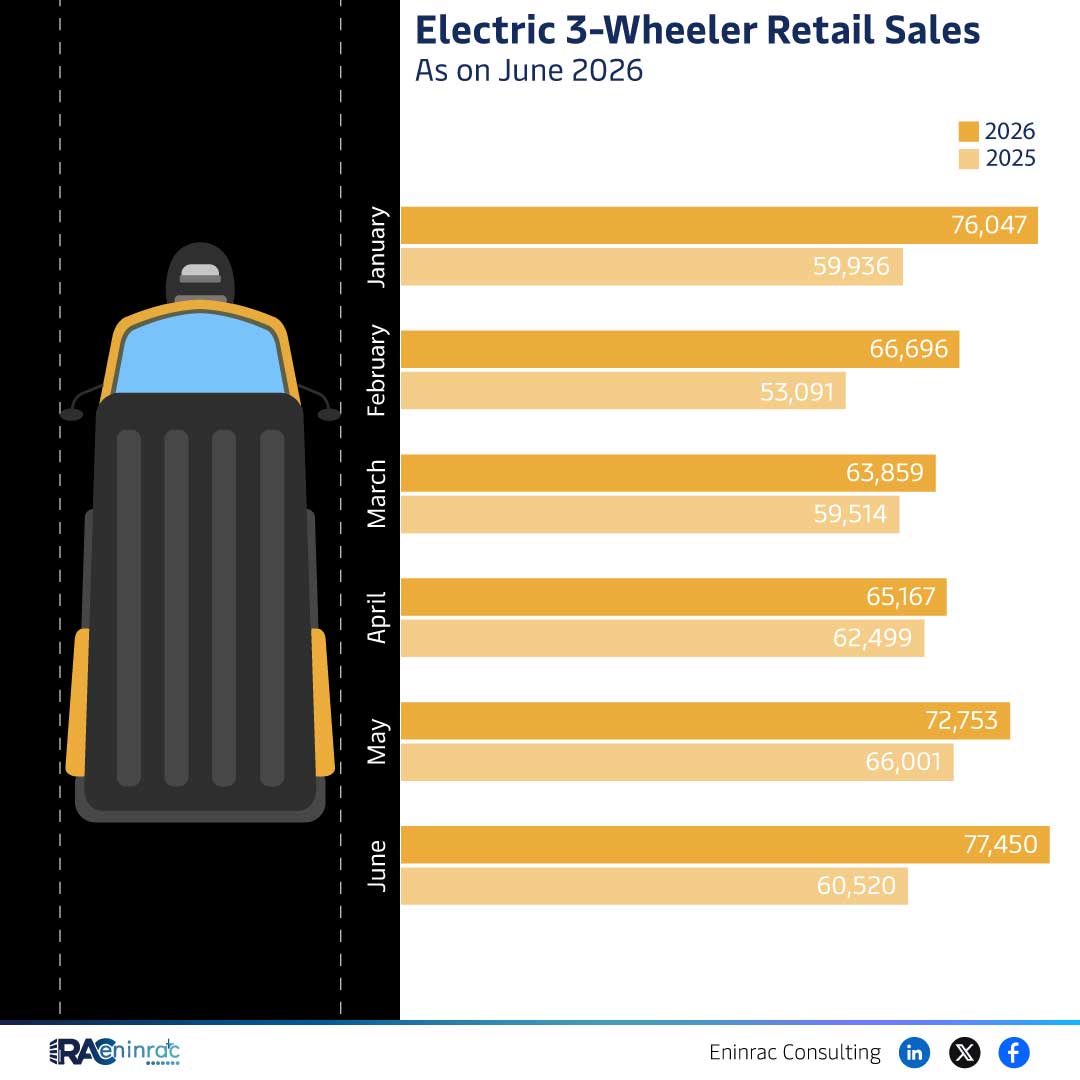
The raw figures show a steady increase in sales from January through May when comparing 2025 and 2026. While January 2025 recorded modest unit volumes, January 2026 already surpassed the same month by a noticeable margin. Similar upward movement is evident in February, April and May, indicating that demand for electric three‑wheelers is gaining momentum as supply chains stabilize and consumer awareness grows.
Monthly Comparison: Jan‑May 2025 vs 2026
During the first five months of 2025, retail outlets reported an average monthly growth rate of roughly 4 %. In contrast, the same period in 2026 displayed an average growth of about 9 %, effectively more than doubling the pace of adoption. The most pronounced jump occurred in April, where 2026 sales outpaced April 2025 by nearly 15 %, suggesting that promotional campaigns and new model launches resonated strongly with buyers. May continued the upward trajectory, reinforcing the hypothesis that seasonal factors such as tax incentives and renewable‑energy subsidies are amplifying market penetration.
Impact on Sectors and Industries
Accelerating electric 3‑wheeler retail sales influence several interconnected sectors. manufacturers benefit from higher production volumes, prompting investments in battery technology and local assembly plants. Financial institutions see new credit products tailored to small‑business owners who rely on three‑wheelers for delivery services. Municipal regulators are compelled to upgrade charging infrastructure, while logistics firms anticipate cost savings from reduced fuel expenditures. Collectively, these dynamics push the broader New Energies ecosystem toward faster innovation and deeper market integration.
Key Takeaways
- January‑May 2026 sales outperformed the same period in 2025 by an average of 9 %.
- April 2026 recorded the strongest month‑over‑month increase, exceeding April 2025 by about 15 %.
- Growth aligns with expanding government incentives and improved charging networks.
- Manufacturers are scaling up battery‑capacity production to meet rising demand.
- Financial services are introducing specialised loans for electric three‑wheelers.
- Policy focus is shifting toward integrating three‑wheelers into smart‑city transport plans.
FAQs
Why are electric 3‑wheelers gaining popularity in 2026?
Enhanced subsidies, lower operating costs, and growing awareness of environmental benefits are driving both consumer and commercial adoption.
Which months showed the highest sales growth?
April 2026 displayed the steepest increase, followed closely by May, reflecting seasonal promotional efforts and policy incentives.
How does the 2026 growth compare to 2025?
The average monthly growth rose from roughly 4 % in 2025 to about 9 % in 2026, indicating accelerated market acceptance.
What challenges remain for the electric 3‑wheeler market?
Key challenges include expanding charging infrastructure, reducing battery costs further, and ensuring consistent after‑sales service across regions.
Will the trend continue into 2027?
Analysts expect the upward trajectory to persist as more cities adopt green‑mobility policies and manufacturers launch next‑generation models.