
Introduction
The April 2026 power generation report for India provides a detailed snapshot of how thermal and nuclear plants performed against their programmed targets. Understanding these figures is essential for stakeholders ranging from policymakers to investors because they reflect the reliability of the energy mix and indicate future capacity planning needs. This article walks through the program versus actual generation, highlights sector‑wise contributions, and discusses implications for the broader electricity market.
What Does the Data Reveal About This Topic?
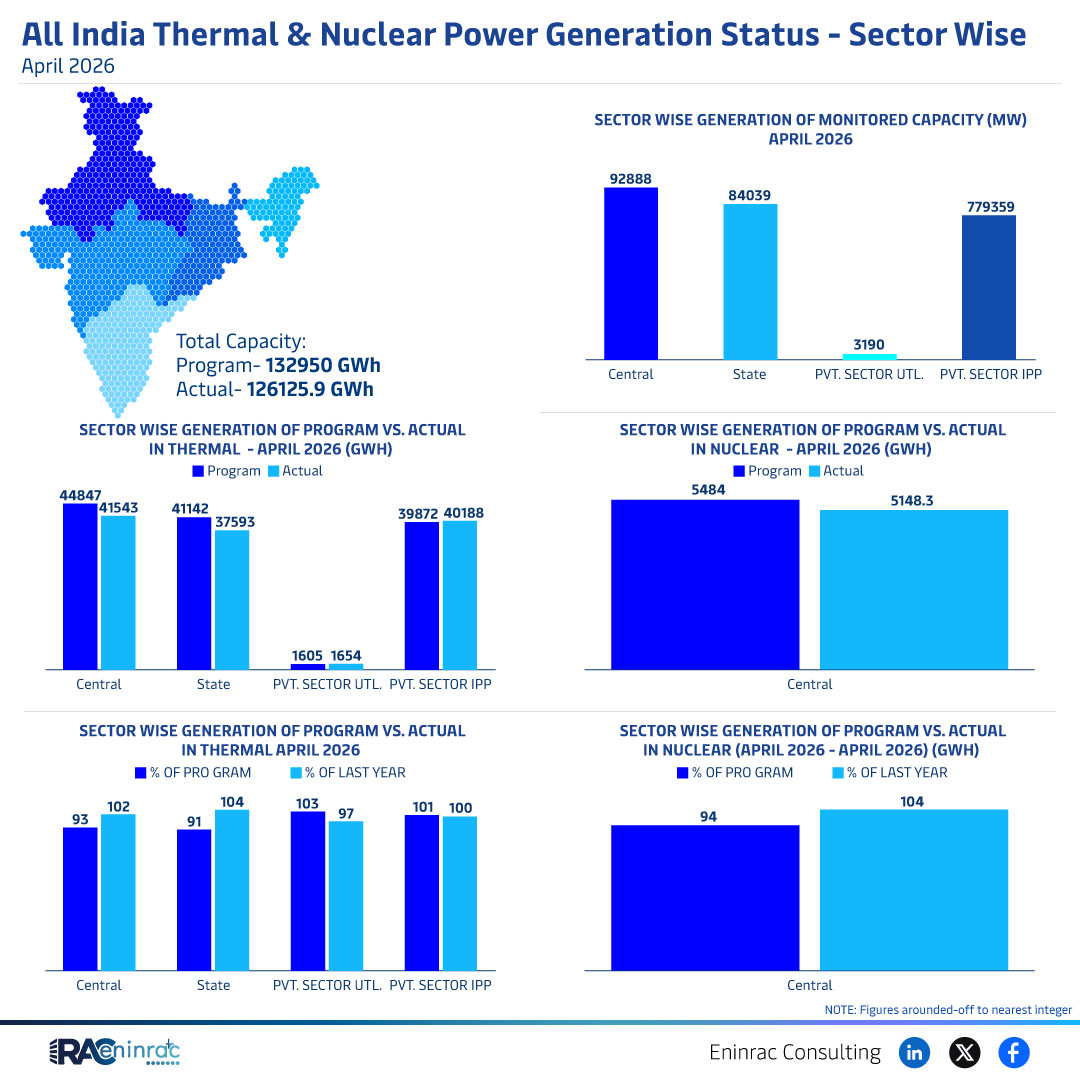
At a high level the data shows that total programmed generation for the month was 132,950 gigawatt hours while actual generation reached 126,125.9 gigawatt hours, meaning the grid operated slightly below its forecast. The shortfall was observed mainly in the thermal segment where the gap between programmed and actual output was larger than in the nuclear segment. This answer clarifies why the overall performance lagged and where the biggest variances occurred.
Thermal vs Nuclear Generation Comparison
Thermal power accounted for the bulk of the generation mix in April 2026 with a programmed output of roughly 128,000 gigawatt hours and an actual output slightly lower. Nuclear plants contributed a smaller but steady share, with programmed generation around 5,150 gigawatt hours and actual generation close to 5,200 gigawatt hours, indicating that nuclear performance marginally exceeded its target. Monitored capacity in megawatts shows that central thermal facilities held the largest capacity at 92,888 MW, followed by state‑run plants at 84,039 MW. Private sector and independent power producer (IPP) capacities together added about 7,793 MW, while utility private sector capacity contributed just 3,190 MW. These figures illustrate that thermal plants dominate both capacity and generation, while nuclear plants deliver consistent output with minimal variance.
Impact on Sectors and Industries
The slight under‑performance of thermal generation can influence electricity pricing, especially for industrial consumers who rely on stable supply for manufacturing processes. Investors in private thermal projects may reassess risk models based on the observed gap between program and actual output. Policymakers can use the data to justify accelerating diversification into renewable and nuclear sources to mitigate reliance on coal‑based thermal plants. The steady nuclear output reinforces its role as a low‑carbon baseload resource, supporting India’s climate commitments and encouraging further investment in the nuclear sector.
Key Takeaways
- Total programmed generation for April 2026 was 132,950 GWh while actual generation was 126,125.9 GWh.
- Thermal power generated the majority of electricity, but fell short of its programmed target.
- Nuclear generation marginally exceeded its programmed target, showing a reliable performance.
- Central thermal capacity of 92,888 MW dominates the monitored capacity landscape.
- State‑run thermal capacity contributed 84,039 MW, highlighting significant public sector involvement.
- Private sector and IPP capacities together added roughly 7,793 MW, indicating growing private participation.
FAQs
Why did actual thermal generation fall below the programmed target?
Factors such as plant maintenance, fuel supply constraints, and unexpected outages can reduce thermal output below forecasts.
Did nuclear power meet its generation goals in April 2026?
Yes nuclear plants slightly outperformed their programmed target, delivering around 5,200 GWh against a 5,150 GWh plan.
Which sector holds the largest monitored capacity in India?
The central thermal sector holds the largest capacity at 92,888 megawatts.
How might the generation shortfall affect electricity prices?
A shortfall can tighten supply, leading to higher spot market prices especially for high‑consumption industrial users.
What does this data suggest for future energy planning?
The data encourages a balanced approach that strengthens nuclear and renewable capacity while improving the efficiency of thermal operations.