
Introduction
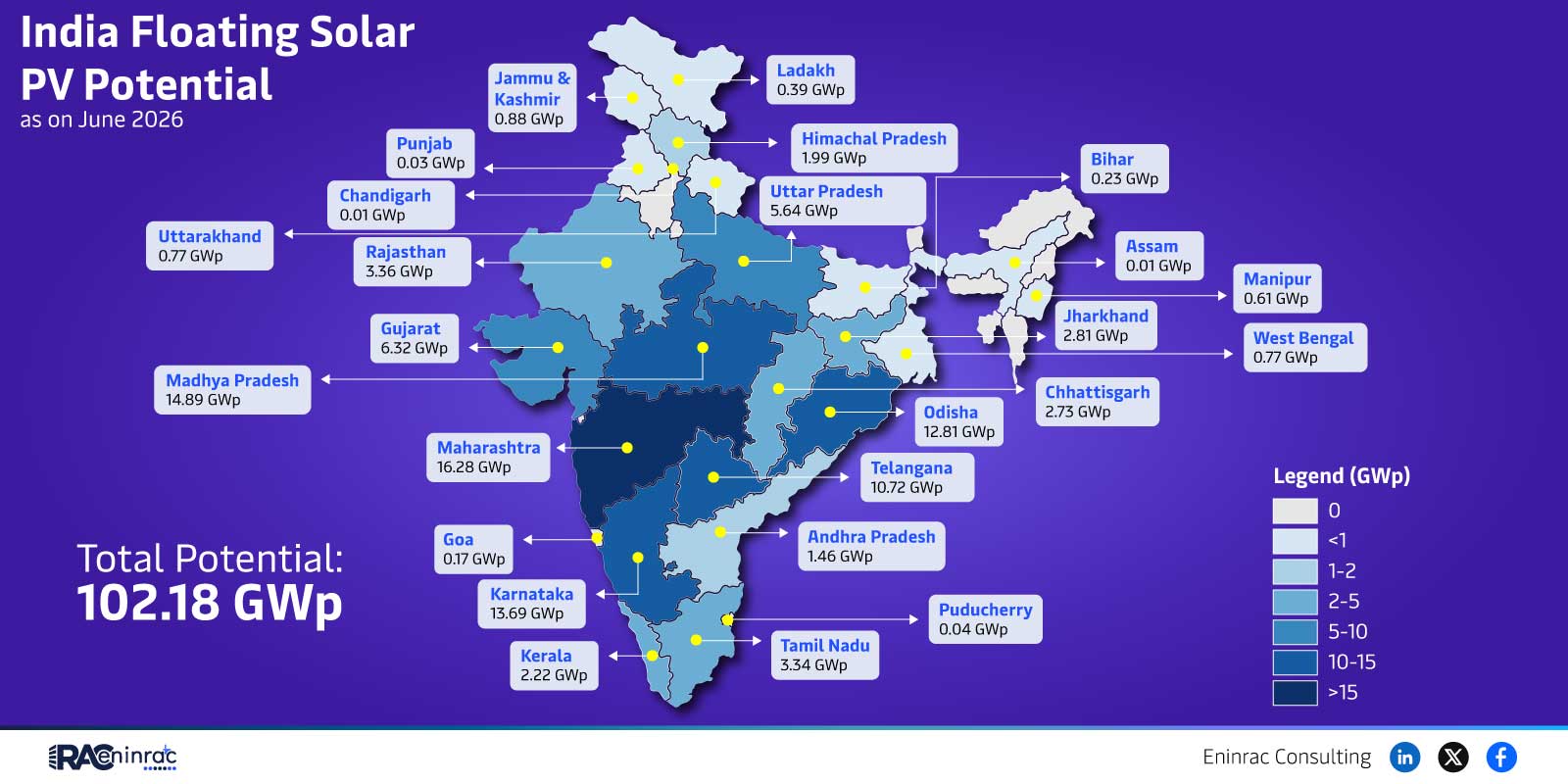
India’s floating solar market is rapidly emerging as a critical component of the nation’s renewable energy strategy. The latest figures compiled for June 2026 show a cumulative potential of roughly 17 GWp across several states. This page examines the state‑wise floating solar PV potential, explains why these values matter for energy planners, and highlights the opportunities for investors, utilities, and policymakers. Understanding the distribution of floating solar capacity helps stakeholders prioritize projects, manage water‑body resources, and meet ambitious climate targets.
What Does the Data Reveal About This Topic?
What does the data reveal about India’s floating solar PV potential? The snapshot shows that Karnataka leads with approximately 16.28 GWp, followed closely by Telangana at 10.72 GWp and Madhya Pradesh at 14.89 GWp. Smaller contributors such as Jammu & Kashmir (0.88 GWp) and Uttarakhand (0.70 GWp) demonstrate early‑stage development, while states like West Bengal and Kerala contribute modestly. The total reported potential of about 17 GWp suggests a fragmented but growing market where each state’s water resources and policy frameworks drive distinct capacity estimates.
State‑wise Floating Solar Capacity Highlights
State‑wise floating solar capacity highlights reveal clear regional trends. Karnataka’s 16.28 GWp reflects strong state incentives, abundant reservoirs, and private‑sector participation, positioning it as the flagship market. Telangana’s 10.72 GWp benefits from large irrigation canals and a proactive renewable‑energy policy. Madhya Pradesh’s 14.89 GWp underscores its focus on inland water bodies and balanced geographic spread. In contrast, northern states such as Jammu & Kashmir and Uttarakhand record sub‑gigawatt potentials, indicating nascent adoption hindered by terrain and limited infrastructure. West Bengal’s 6.32 GWp and Kerala’s emerging projects illustrate opportunities on both coastal and inland reservoirs.
Impact on Sectors and Industries
Impact on sectors and industries is multi‑dimensional. Renewable‑energy developers can tap floating solar to overcome land constraints, while water‑resource managers gain ancillary benefits such as reduced evaporation and improved water quality. The power sector anticipates higher capacity factors because of cooler lake surfaces, potentially lowering levelized costs. Financial institutions see new green‑bond opportunities, and state governments can meet national targets more efficiently. Moreover, the agricultural sector may benefit from shade‑induced microclimates that protect crops, while tourism operators near lakes can promote eco‑friendly attractions.
Key Takeaways
- Karnataka dominates with over 16 GWp, driven by strong incentives.
- Telangana and Madhya Pradesh each exceed 10 GWp, showing rapid project pipelines.
- Northern states lag behind, indicating untapped potential in high‑altitude reservoirs.
- Floating solar improves water‑body efficiency by reducing evaporation and enhancing algae control.
- Investors gain diversified assets with higher capacity factors and lower land costs.
- Policy alignment across central and state levels is crucial for scaling the market.
FAQs
What is floating solar PV and how does it differ from ground‑mounted solar?
Floating solar PV consists of photovoltaic panels mounted on water bodies such as reservoirs, dams or lakes. The water cools the modules, boosting efficiency compared with land‑based installations.
Which Indian state has the highest floating solar potential?
Karnataka leads with roughly 16.28 GWp of reported floating solar potential, reflecting strong policy support, abundant reservoir capacity, and active private‑sector participation.
How does floating solar affect water evaporation?
Modules shade the water surface, reducing direct sunlight and wind exposure, which can cut evaporation rates by 20‑30 % depending on climate and lake size.
What are the investment opportunities in India's floating solar market?
Investors can target project development, EPC contracts, O&M services, and green‑bond financing, especially in high‑potential states like Karnataka, Telangana and Madhya Pradesh.
What policy measures support floating solar in India?
Central and state governments provide capital subsidies, concessional tariffs, streamlined approvals and water‑use permissions, encouraging utilities and private firms to develop floating solar projects.