
Introduction
The Western Region of India is facing a critical assessment of its energy power requirement for August 2026. Understanding the magnitude of demand across states such as Gujarat, Madhya Pradesh, Chhattisgarh and Goa helps policymakers, utilities and investors gauge supply‑side adequacy. This page analyses the latest state‑wise energy power requirement (measured in million units, MU) released for the period April‑June 2026 through August 2026. Readers will learn which state has the highest demand, how the aggregated requirement compares with the supplied volume, and what implications this data holds for the broader power sector.
What Does the Data Reveal About This Topic?
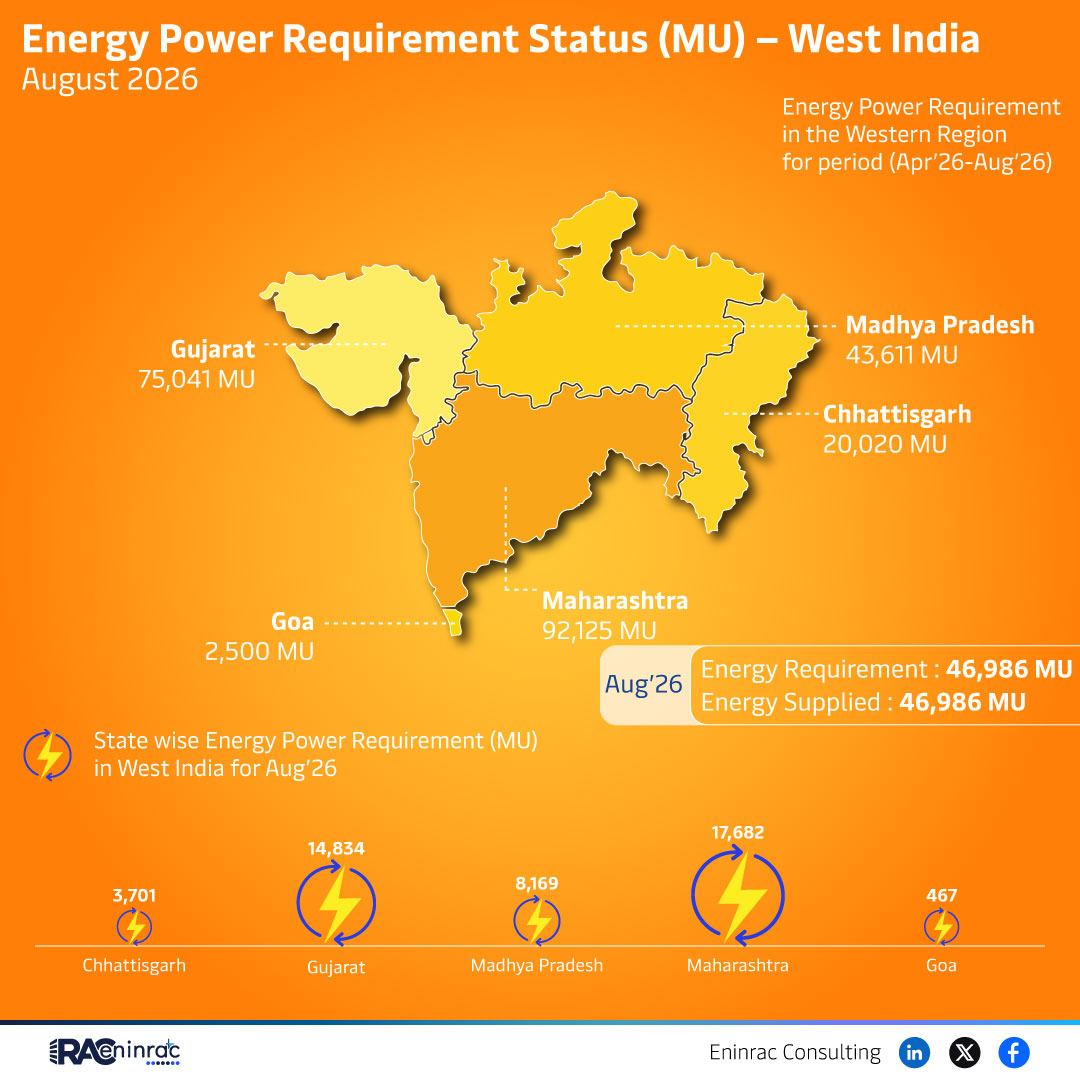
The figures indicate that Gujarat accounts for the largest share of demand with 75,041 MU, followed by Madhya Pradesh at 43,611 MU, Chhattisgarh at 20,020 MU, and Goa contributing 2,500 MU. Despite the high regional demand, the reported total energy requirement for August 2026 stands at 46,986 MU, matching the amount supplied. This suggests that while individual states show substantial needs, the overall grid balance for the month remained tight, with supply meeting the aggregated requirement exactly.
State‑wise Energy Requirements in West India for August 2026
State‑wise Energy Requirements in West India for August 2026 illustrate a pronounced disparity among the four jurisdictions. Gujarat’s demand of 75,041 MU represents more than half of the combined requirement of the listed states, highlighting its industrial base and rapid urbanisation. Madhya Pradesh, though traditionally classified as Central India, appears in the western dataset with a significant 43,611 MU demand, driven by expanding manufacturing and agricultural processing. Chhattisgarh’s 20,020 MU reflects its growing power‑intensive mining activities, while Goa’s modest 2,500 MU aligns with its smaller population and tourism‑focused economy. The gap between individual state demand and the total reported requirement suggests that the data may represent a subset of allocations or a phased reporting approach.
Impact on Sectors and Industries
The observed energy power requirement patterns affect multiple sectors. Utilities must prioritize capacity upgrades in Gujarat and Madhya Pradesh to avoid bottlenecks, prompting investments in new generation assets and transmission reinforcement. Industrial consumers, especially in textiles, chemicals and automotive clusters, rely on reliable supply to maintain production schedules. Policymakers can use the demand snapshot to fine‑tune load‑dispatch directives and incentivise renewable integration, aligning with national clean‑energy goals. Financial markets monitor such regional demand signals to assess the profitability of power projects and to allocate capital toward emerging opportunities in the western corridor.
Key Takeaways
- Gujarat leads West India with 75,041 MU demand in August 2026.
- Madhya Pradesh shows a strong secondary demand of 43,611 MU.
- Chhattisgarh contributes 20,020 MU, driven by mining activities.
- Goa’s demand remains modest at 2,500 MU.
- Total reported requirement and supply both equal 46,986 MU, indicating a balanced month.
- Utilities need targeted capacity expansion to sustain high‑demand states.
FAQs
Which state has the highest energy demand in West India for August 2026?
Gujarat, with a reported demand of 75,041 MU, has the highest energy requirement.
What is the total energy requirement reported for August 2026?
The total energy requirement for the month is 46,986 MU.
How does the supplied energy compare to the requirement?
The supplied energy matches the requirement exactly at 46,986 MU.
Why does Gujarat show a larger demand than other states?
Gujarat’s large industrial base, extensive urbanisation and higher population drive its greater electricity consumption.
What actions can utilities take to meet the projected demand?
Utilities should invest in new generation capacity, strengthen transmission networks and promote renewable integration in high‑demand areas.