
Introduction
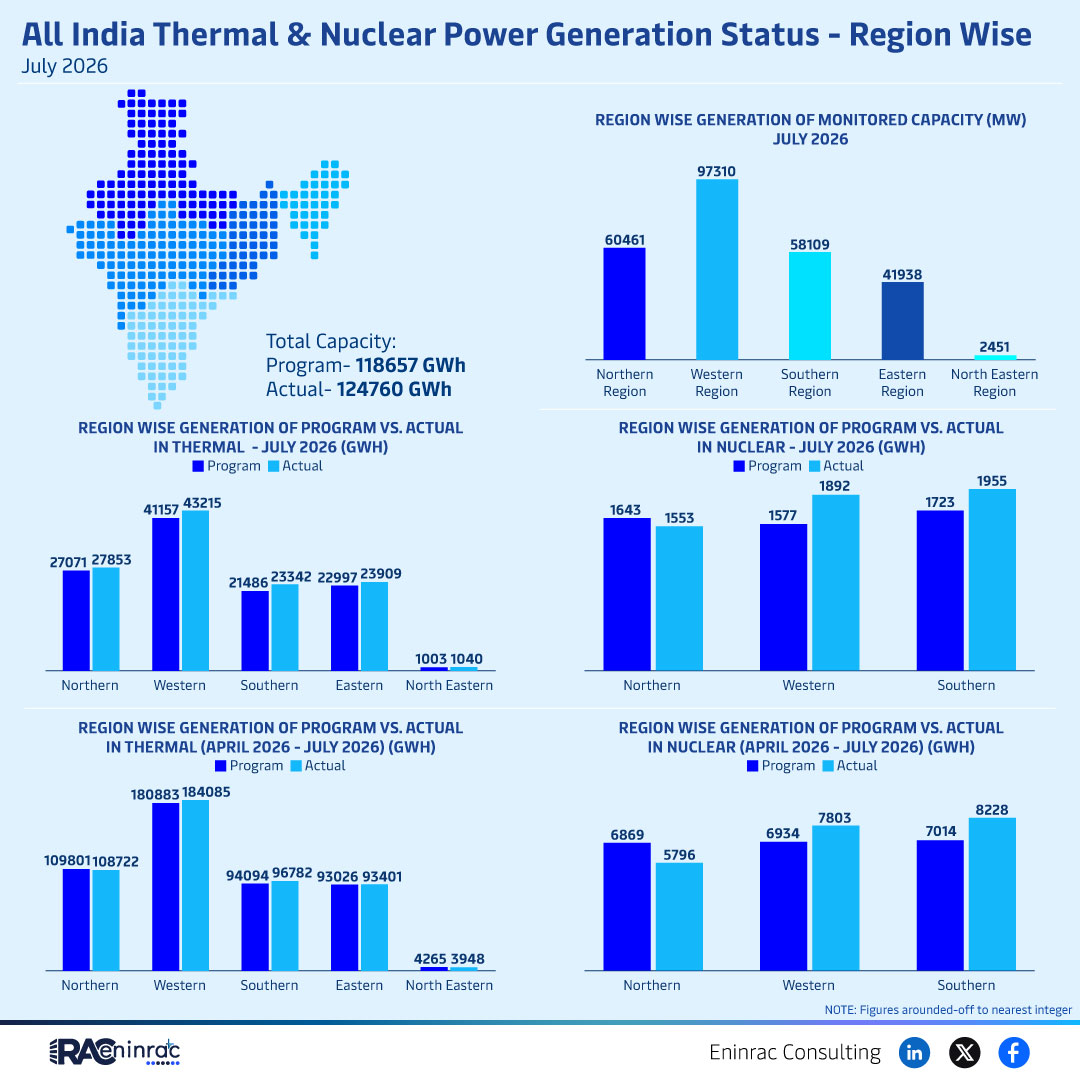
India’s July 2026 power report provides a detailed snapshot of the country’s electricity landscape, focusing on thermal and nuclear generation across all regions. The July 2026 report is a key source for analyzing India thermal and nuclear power generation trends. The data captures both planned (program) figures and actual performance, highlighting where the sector exceeds expectations and where shortfalls occur. Readers will learn how total capacity reached 124,760 GWh for thermal sources, surpassing the 118,657 GWh target, and how nuclear output rose modestly to 1,955 GWh. The regional breakdown also includes a combined monitored capacity of 97,310 MW, helping assess grid reliability and future planning.
What Does the Data Reveal About This Topic?
The figures ask a simple question: did India’s power generation plan for July 2026 align with reality? The answer is mixed. Thermal plants delivered 124,760 GWh, clearly beating the program’s 118,657 GWh goal, indicating strong operational efficiency and possibly higher fuel availability. In contrast, nuclear generation reached 1,955 GWh against a modest 1,892 GWh program, showing only a slight improvement. Regional gaps appear, with the Northern zone leading thermal output, while the Western region supplies the bulk of nuclear electricity. These patterns reveal where investments are paying off and where bottlenecks remain.
Regional Comparison of Thermal and Nuclear Output
The regional tables expose clear divergences. In the thermal segment, the North contributed over 58,000 MW of monitored capacity, far ahead of the South’s 41,938 MW and the East’s 41,909 MW. The West held a middle position with 42,115 MW. For nuclear, the West posted the highest generation at 2,173 GWh, while the North delivered 1,892 GWh and the East lagged with 1,577 GWh. These contrasts suggest that infrastructure density, fuel logistics, and policy incentives vary significantly across zones, influencing both capacity utilisation and actual electricity produced.
Impact on Sectors and Industries
The performance gap between program targets and actual generation influences several stakeholders. Grid operators benefit from higher thermal output, easing load‑balancing challenges and reducing reliance on imports. Investors see the North’s consistent over‑performance as a sign of stable returns, while the West’s nuclear growth attracts interest in low‑carbon assets. Policymakers can use the shortfall in Eastern nuclear output to prioritize new reactor projects or upgrades. Meanwhile, equipment manufacturers and fuel suppliers adjust production schedules to match the regional demand patterns revealed in the July 2026 data.
Key Takeaways
- Thermal generation exceeded its program target by about 6,000 GWh.
- Nuclear output modestly outperformed the program, reaching 1,955 GWh.
- The Northern region is the dominant thermal power contributor.
- The Western region leads nuclear electricity production.
- Eastern nuclear generation lagged behind program expectations.
- Overall capacity growth signals strong sector momentum for the second quarter of 2026.
FAQs
What was the total thermal generation in July 2026?
India’s thermal plants generated 124,760 GWh, surpassing the planned 118,657 GWh.
How did nuclear generation compare to its target?
Nuclear output reached 1,955 GWh, slightly above the 1,892 GWh program.
Which region produced the most thermal power?
The Northern region supplied the highest thermal generation, over 58,000 MW of monitored capacity.
Where is nuclear power strongest in India?
The Western region delivered the largest nuclear generation at 2,173 GWh.
What implications do these figures have for investors?
Strong thermal over‑performance and growing nuclear output suggest stable returns and opportunities in low‑carbon projects.