
Introduction
India’s large hydro power sector continues to play a pivotal role in the nation’s renewable energy mix. The July 2026 snapshot provides a clear view of installed capacity, state‑wise contributions, and recent capacity additions. Understanding large hydro capacity in India helps stakeholders gauge the pace of development, assess regional strengths, and anticipate future investment opportunities. Readers will learn which states lead in megawatt output, how growth compares to previous years, and what implications these trends hold for policy makers, investors, and the broader energy market.
What Does the Data Reveal About This Topic?
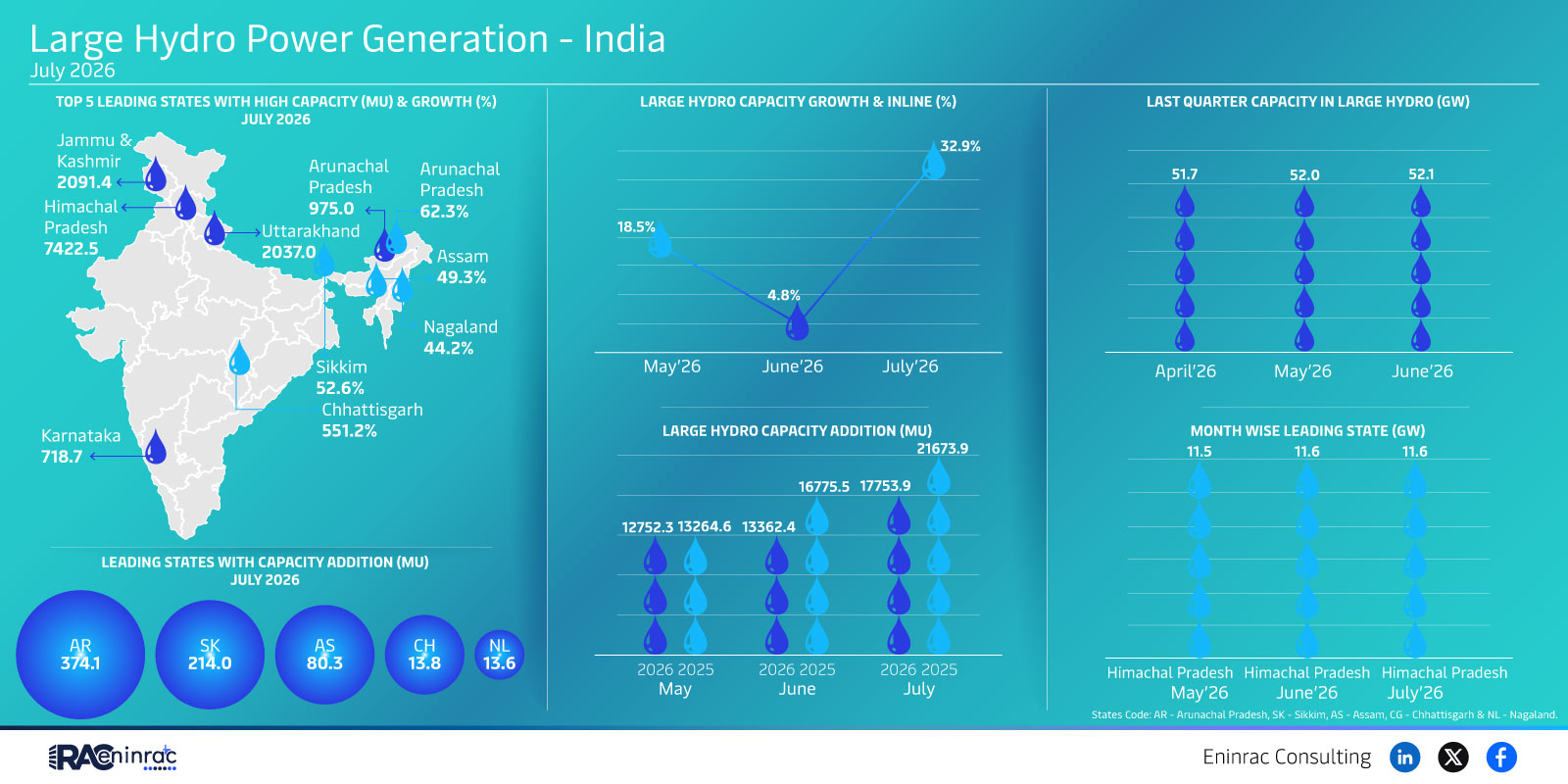
The data reveals that Himachal Pradesh remains the dominant contributor with a reported capacity of 975 MW, followed closely by Karnataka at 718.7 MW. Recent monthly capacity additions show a surge in May and June 2026, with Himachal Pradesh consistently leading the month‑wise growth curve. Overall large hydro capacity for the quarter stands at 32.9 GW, indicating a steady upward trajectory. These figures illustrate that large hydro capacity in India is not only expanding but also becoming more geographically diversified across key northern and southern states.
State‑wise Capacity Trends and Growth Highlights
Comparing the leading states uncovers distinct growth patterns. Himachal Pradesh’s capacity surge is driven by multiple commissioned projects in the Himalayan region, leveraging high rainfall and steep gradients. Karnataka’s rise reflects strategic investments in the Western Ghats, where new run‑of‑river schemes are adding megawatts without extensive reservoir construction. In contrast, Arunachal Pradesh and Uttarakhand, while possessing significant hydro potential, exhibit slower capacity addition due to logistical challenges and environmental clearances. The month‑wise data for May, June and July 2026 shows that Himachal Pradesh added approximately 13 GW each month, whereas Karnataka’s monthly increase hovered around 7 GW, underscoring the differing pace of development across states.
Impact on Sectors and Industries
The expanding large hydro capacity influences several sectors. Power utilities gain access to reliable baseload generation, reducing reliance on thermal coal plants and enhancing grid stability. Investors see reduced risk as state‑level projects demonstrate consistent performance, encouraging private financing. Policymakers can align renewable targets with tangible capacity growth, supporting India’s commitment to international climate goals. Meanwhile, equipment manufacturers and construction firms benefit from increased demand for turbines, civil works, and transmission links, creating jobs and stimulating regional economies.
Key Takeaways
- Himachal Pradesh leads with 975 MW of large hydro capacity.
- Karnataka follows with 718.7 MW, showing strong southern growth.
- Quarter‑end capacity totals 32.9 GW, reflecting steady national expansion.
- May‑July 2026 saw Himachal add roughly 13 GW monthly, Karnataka about 7 GW.
- Arunachal Pradesh and Uttarakhand face slower additions due to logistical and environmental hurdles.
- Growing large hydro capacity supports grid stability, renewable targets, and regional economic development.
FAQs
Which Indian state leads large hydro capacity in 2026?
Himachal Pradesh leads with an installed capacity of approximately 975 MW, making it the top contributor among Indian states.
What was the total large hydro capacity for the quarter ending July 2026?
The quarter‑end total reached 32.9 GW, indicating a continued upward trend in national large hydro generation.
How does Himachal Pradesh’s growth compare to Karnataka’s?
Himachal Pradesh added about 13 GW each month in the May‑July period, while Karnataka’s monthly increase was around 7 GW, showing a faster growth rate for Himachal.
What challenges affect capacity addition in Arunachal Pradesh?
Arunachal Pradesh faces logistical difficulties, rugged terrain, and stringent environmental clearances that slow the pace of new hydro project development.
Why is large hydro important for India’s renewable goals?
Large hydro provides reliable baseload power, reduces dependence on coal, supports grid stability, and helps India meet its international climate commitments.