
Introduction
Large hydro power remains a cornerstone of India’s renewable energy strategy, delivering baseload electricity while supporting water management and flood control. The August 2026 snapshot focuses on the most recent capacity figures, growth trends, and quarterly additions across key states. Understanding where capacity is concentrated and how quickly it is expanding helps investors, policymakers, and industry analysts gauge the sector’s momentum and identify opportunities for future development. This article unpacks the raw data, highlights leading regions, and explains the broader implications for the Indian power landscape.
What Does the Data Reveal About Large Hydro Power Capacity in India?
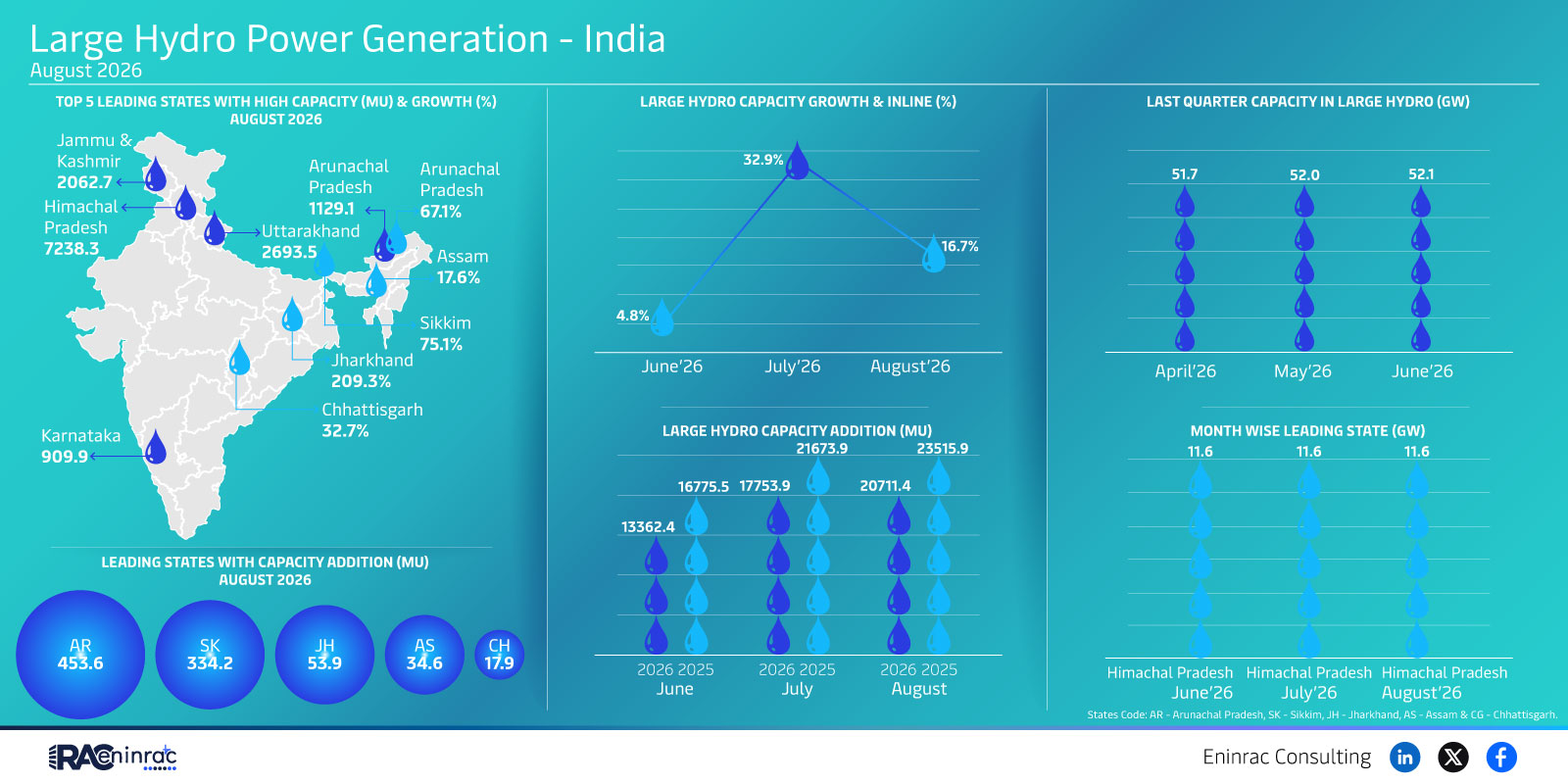
The data shows that a handful of states dominate the large hydro portfolio, with Arunachal Pradesh, Himachal Pradesh, and Uttarakhand contributing the highest installed capacity measured in megawatts (MU). Growth rates are strongest in the northeastern and Himalayan zones, reflecting both new projects and the commissioning of previously stalled schemes. Quarterly figures indicate a steady rise in capacity addition from June through August 2026, reinforcing the sector’s resilience despite seasonal constraints.
State‑wise Capacity and Growth Highlights
Arunachal Pradesh leads with approximately 2,062.7 MU, followed closely by Himachal Pradesh at 1,129.1 MU and Uttarakhand at 723.8 MU. Karnataka, though traditionally stronger in solar and thermal, registers a modest 909.9 MU addition, underscoring a diversification trend. The month‑wise breakdown reveals that Himachal Pradesh contributed the most to large hydro capacity in June, July, and August, each month adding roughly 11.6 GW of new generation. Overall, the total large hydro capacity addition for the quarter reached about 21,673.9 MU, signalling a healthy upward trajectory for the sector.
Impact on Sectors and Industries
The expansion of large hydro power influences multiple facets of the Indian economy. For utilities, increased hydro capacity improves grid stability and reduces reliance on fossil‑fuel peaking plants. Investors benefit from predictable cash flows associated with long‑term power purchase agreements tied to hydro projects. Policymakers gain a flexible tool for meeting renewable targets while addressing water resource management. Moreover, downstream industries such as tourism and agriculture experience ancillary benefits from regulated river flows and improved irrigation infrastructure.
Key Takeaways
- Arunachal Pradesh, Himachal Pradesh, and Uttarakhand dominate large hydro capacity in India.
- The quarter‑end addition of 21,673.9 MU marks strong growth amid seasonal challenges.
- Himachal Pradesh consistently leads month‑wise capacity additions for June‑August 2026.
- Karnataka’s modest hydro growth signals diversification beyond its solar dominance.
- Hydro expansion supports grid reliability, renewable targets, and water management.
- Investors and policymakers can leverage steady hydro growth for long‑term planning.
FAQs
Which Indian state has the highest large hydro capacity?
Arunachal Pradesh leads with roughly 2,062.7 MU of large hydro capacity as of August 2026.
What was the total capacity addition in the quarter ending August 2026?
The quarter saw an addition of about 21,673.9 MU of large hydro capacity across the country.
How does large hydro power affect grid stability?
Hydro provides baseload and flexible generation, helping balance intermittency from solar and wind and reducing reliance on fossil‑fuel peakers.
Why is Himachal Pradesh a key contributor each month?
Its mountainous terrain and existing infrastructure enable rapid commissioning of new projects, leading to consistent monthly additions.
Are there policy incentives supporting large hydro growth?
Yes, the government offers preferential tariffs, streamlined clearances, and financing incentives to accelerate hydro development.