
Introduction
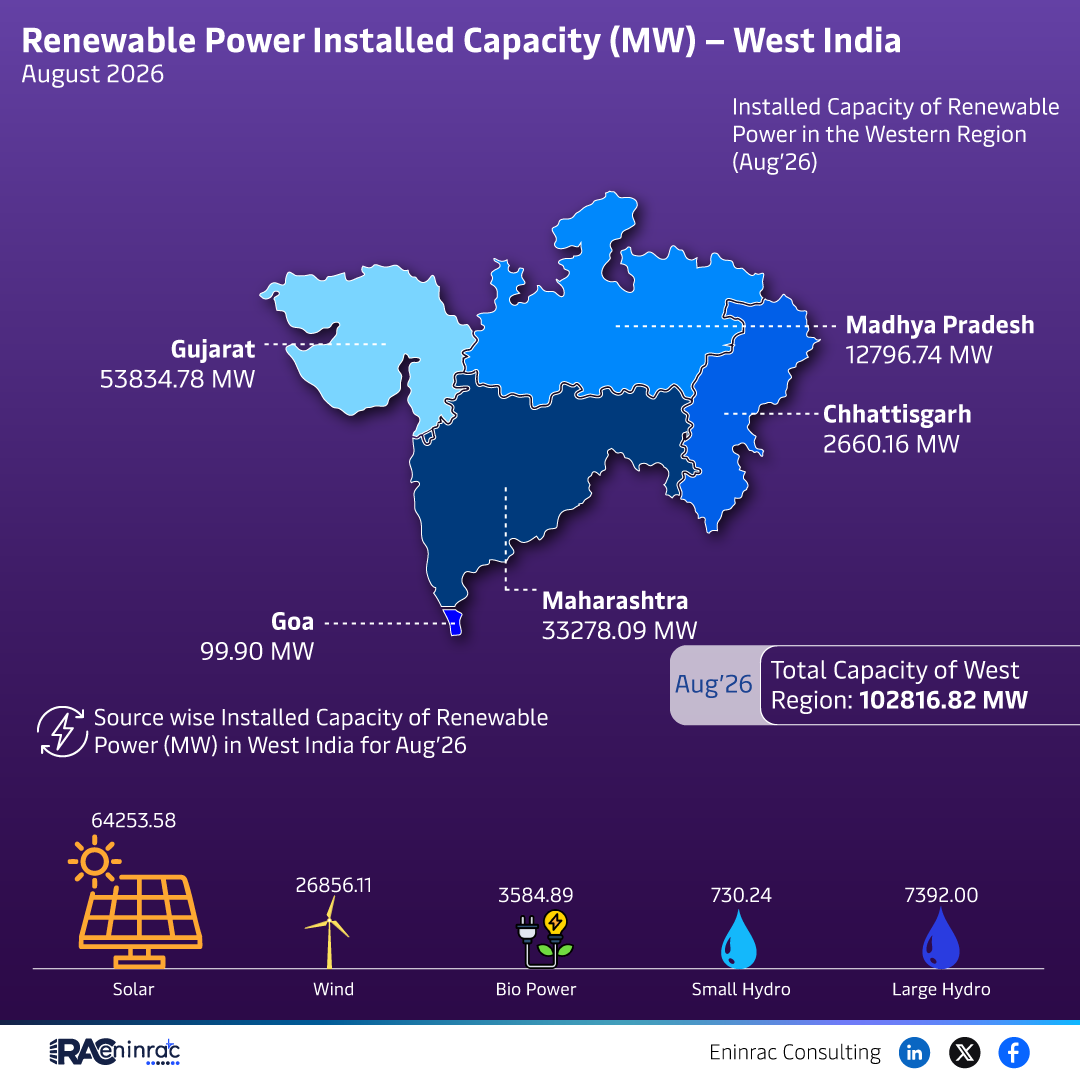
Renewable Power Installed Capacity West India reached a remarkable 102,816.82 MW in August 2026. This surge reflects the region’s accelerating shift toward clean energy sources and underscores the importance of tracking state‑wise contributions. In this article we explore the latest figures, examine the technology mix, and discuss why these numbers matter for investors, policymakers, and the public.
What Does the Data Reveal About This Topic?
The data shows that West India’s total renewable capacity has crossed the 100 GW threshold, with solar accounting for the largest share, followed by wind, bio‑power and hydro. The rapid growth raises questions about regional planning, grid integration, and future expansion potential.
State‑Wise Capacity Highlights
Among the western states, Gujarat leads with 53,834.78 MW, driven largely by solar farms in the arid zones. Maharashtra follows with 33,278.09 MW, a blend of solar and wind projects along its coastline. Smaller contributions come from Goa (99.90 MW), Madhya Pradesh (12,796.74 MW), and Chhattisgarh (2,660.16 MW). These figures illustrate a clear concentration of capacity in states with favourable policy frameworks and abundant renewable resources.
Impact on Sectors and Industries
The expanding capacity influences multiple sectors. Power generators are diversifying portfolios, while equipment manufacturers see rising demand for PV modules, wind turbines and bio‑energy plants. Financial institutions are creating green financing products, and state governments are revising procurement policies to accommodate higher renewable shares. Consumers benefit from cleaner air and potentially lower electricity costs as renewable penetration rises.
Key Takeaways
- West India’s renewable capacity exceeded 102 GW in August 2026.
- Solar dominates the mix, representing roughly 62 % of the total.
- Gujarat is the top contributor, followed by Maharashtra.
- Wind, bio‑power and hydro together add more than 35 % of capacity.
- Growth is supported by state policies, falling technology costs and investor interest.
- Continued expansion will require grid upgrades and storage solutions.
FAQs
What is the total renewable capacity in West India as of August 2026?
It stands at 102,816.82 MW, covering solar, wind, bio‑power and hydro.
Which state has the highest renewable capacity?
Gujarat, with 53,834.78 MW, leads the region.
What renewable technology contributes the most?
Solar power, accounting for roughly 62 % of the total capacity.
How does this growth affect electricity prices?
Increasing renewable share can lower long‑term costs by reducing dependence on fossil fuels.
What challenges remain for further expansion?
Key challenges include grid integration, storage deployment and ensuring consistent policy support.