
Introduction
The large hydro power generation sector in India continues to shape the country’s renewable energy landscape. In June 2026, newly released capacity data highlights which states are leading the charge, how quarterly additions are trending, and what these figures mean for the broader market. This article breaks down the top‑performing states, examines recent capacity growth, and explores the implications for investors, policymakers, and industry stakeholders. Understanding these dynamics helps readers assess future opportunities and challenges within India’s hydropower arena.
What Does the Data Reveal About This Topic?
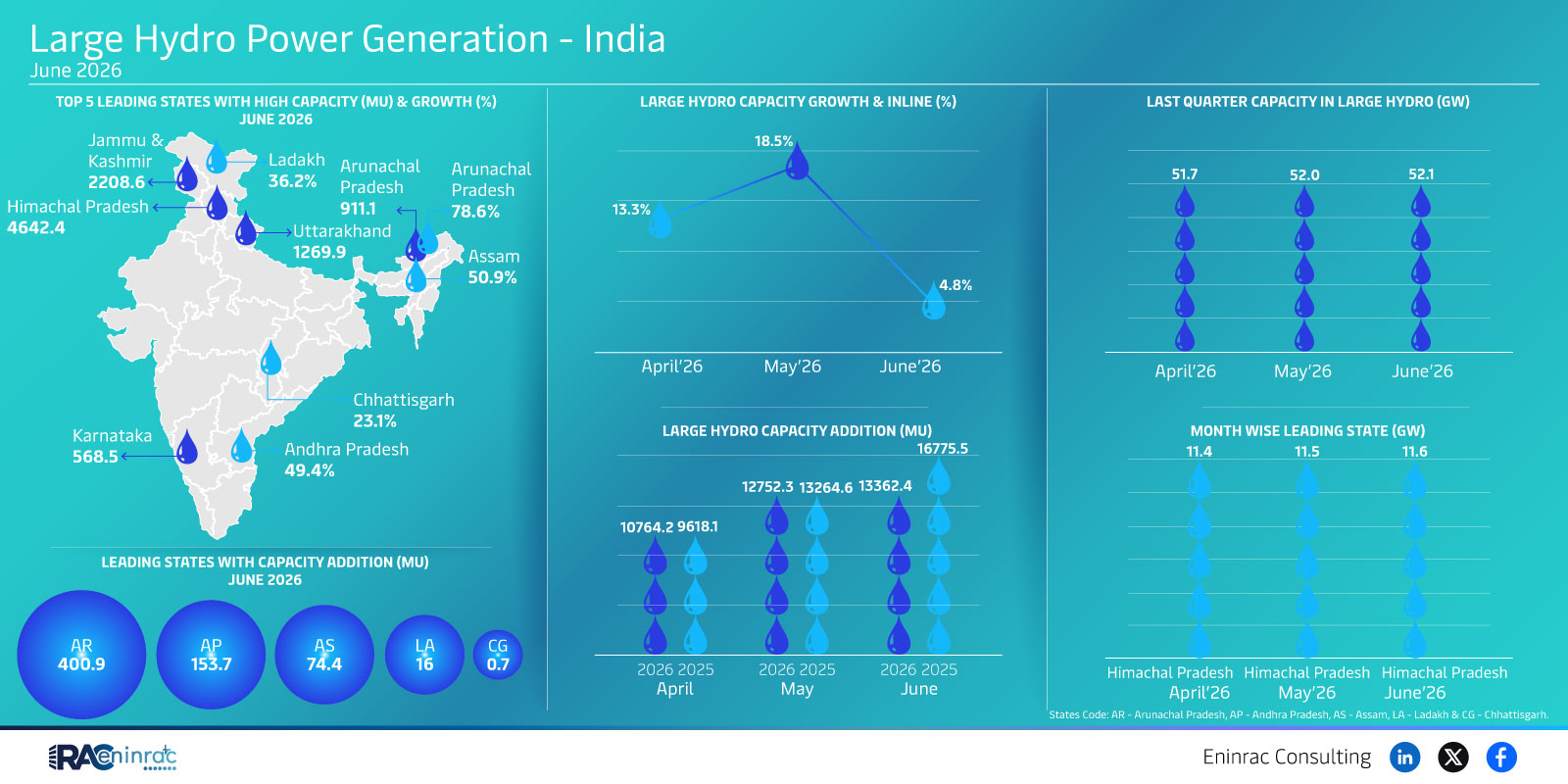
The raw figures show that Himachal Pradesh, Kashmir & Ladakh, and Uttarakhand dominate large hydro capacity, while states such as Arunachal Pradesh and Andhra Pradesh contribute modestly. Quarterly capacity addition peaked in May 2026 with 13,264.6 MW, indicating a strong upward trend compared with the same period in 2025. The data also confirms that the last quarter’s total large hydro capacity reached 16,775.5 MW, underscoring a steady expansion across the country.
Top States Leading Large Hydro Capacity and Growth
When comparing the leading states, Himachal Pradesh stands out with a capacity of 4,642.4 MW, far ahead of Kashmir & Ladakh at 2,208.6 MW and Uttarakhand at 1,269.9 MW. Arunachal Pradesh lags with only 78.6 MW, while Chhattisgarh and Karnataka register 49.4 MW and 568.5 MW respectively. The month‑wise data for April, May, and June 2026 shows Himachal Pradesh consistently supplying the highest capacity each month, reinforcing its position as the key hydro hub. Growth percentages indicate that smaller states are adding capacity at a higher rate proportionally, suggesting emerging development opportunities.
Impact on Sectors and Industries
Large hydro power generation influences several sectors. For the electricity generation industry, increased capacity improves grid stability and reduces reliance on fossil fuels. Investors view the rising hydro capacity as a low‑risk renewable asset, attracting capital to states with supportive policies. Policymakers can leverage the growth trends to prioritize infrastructure upgrades, water resource management, and environmental safeguards. Additionally, the construction and engineering sectors benefit from rising demand for dams, tunnels, and transmission lines, while rural communities gain access to reliable power, fostering economic development.
Key Takeaways
- Himachal Pradesh leads large hydro capacity with over 4,600 MW.
- Kashmir & Ladakh rank second, confirming northern dominance.
- May 2026 saw the highest quarterly capacity addition.
- Smaller states show higher proportional growth rates.
- Capacity expansion supports grid stability and renewable targets.
- Investors see hydro as a stable, low‑risk renewable asset.
FAQs
Which Indian states have the highest large hydro capacity in 2026?
Himachal Pradesh, Kashmir & Ladakh, and Uttarakhand hold the three largest capacities, with Himachal Pradesh leading at 4,642.4 MW.
How did large hydro capacity change in the last quarter of 2026?
The sector added 16,775.5 MW in the last quarter, with May 2026 recording the peak monthly addition of 13,264.6 MW.
Why is Himachal Pradesh consistently the top performer?
Abundant mountainous terrain, favorable water flow, and strong state policies enable Himachal Pradesh to develop extensive hydro projects.
What does the growth trend mean for investors?
Steady capacity additions signal a reliable returns environment, encouraging investment in hydro infrastructure and related services.
How can policymakers support emerging hydro states?
By offering incentives, streamlining clearances, and investing in grid connectivity, policymakers can accelerate growth in states like Arunachal Pradesh and Karnataka.