
Introduction
The off‑river pumped storage capacity landscape in India is rapidly evolving as new projects move forward under construction. As of June 2026, several large‑scale facilities are being built across the country, ranging from modest 500 MW sites to massive 3 000 MW plants. This article explains the significance of these developments, outlines the key locations and their installed capacities, and examines how this expanding storage network supports India’s renewable energy ambitions and grid reliability.
What Does the Data Reveal About This Topic?
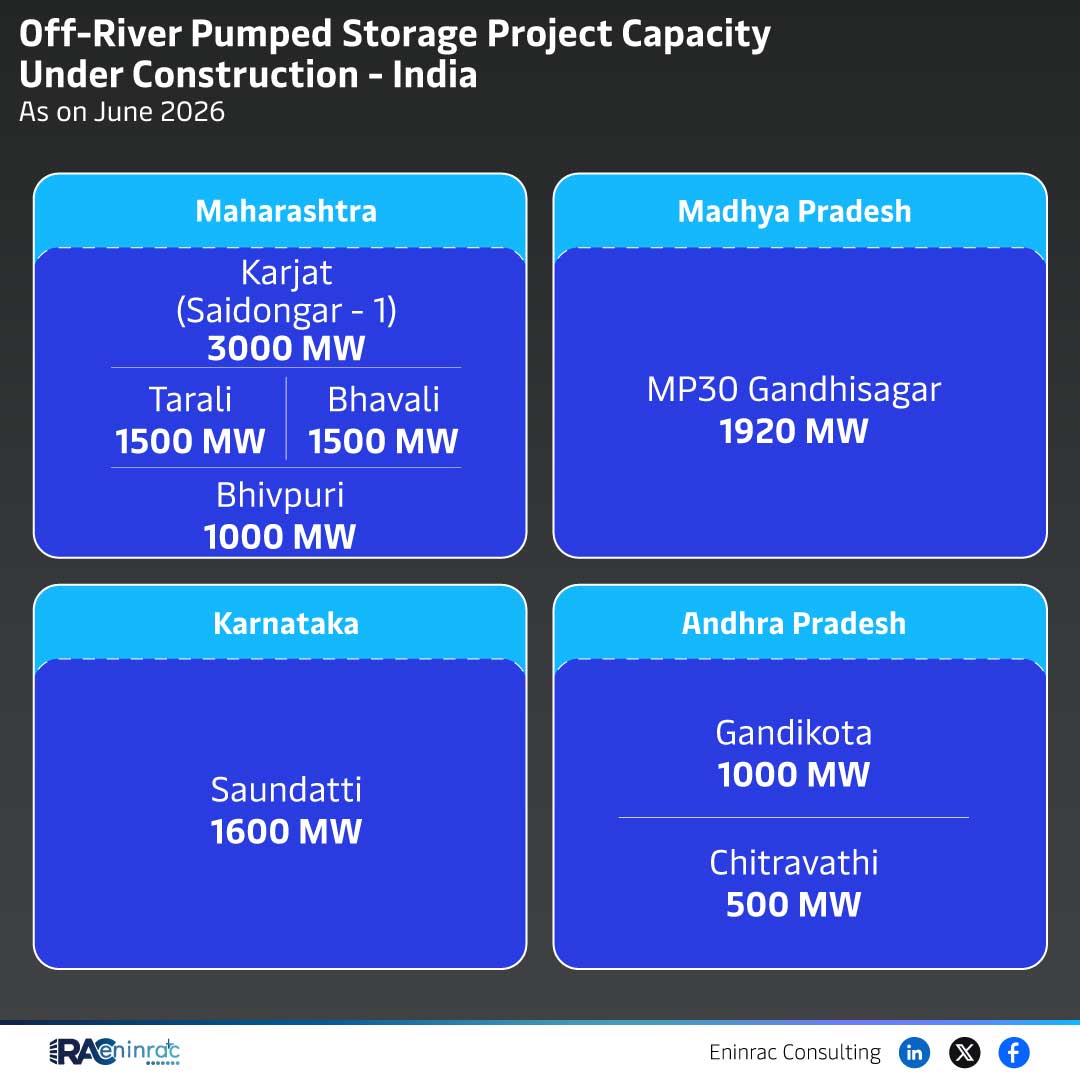
The raw data shows a clear concentration of high‑capacity pumped storage projects in strategic regions such as Karjat, Tarali Bhavali, and Bhivpuri, with individual plant sizes of 1 000 MW to 3 000 MW. It answers the question of where India is focusing its investment: on off‑river sites that can quickly balance variable solar and wind output, thereby enhancing overall system flexibility. The data also highlights a diversity of project scales, indicating a balanced approach that includes both flagship megaprojects and smaller regional installations.
Regional Capacity Distribution of Off‑River Pumped Storage Projects
Comparing the listed sites reveals notable geographical trends. Maharashtra hosts the largest single capacity at Karjat (Saidongar‑1) with 3 000 MW, while Karnataka features multiple projects such as Saundatti (1 000 MW) and a 1 600 MW plant, reflecting the state’s strong renewable integration goals. Smaller but significant capacities appear in Telangana and Andhra Pradesh, exemplified by the 500 MW Chitravathi project. The variance in plant size suggests that developers are tailoring projects to local water resource availability, grid congestion points, and regional demand for storage services.
Impact on Sectors and Industries
The surge in off‑river pumped storage capacity influences several key sectors. Power generators gain a reliable tool to store excess renewable generation, reducing curtailment and enabling higher solar and wind penetration. Transmission operators benefit from smoother load curves, easing the need for expensive upgrades. Investors see new opportunities in long‑term infrastructure assets with stable revenue streams tied to capacity payments. Policymakers can leverage these projects to meet national targets for clean energy, grid resilience, and carbon reduction, while consumers ultimately enjoy a more stable and potentially lower‑cost electricity supply.
Key Takeaways
- India’s off‑river pumped storage capacity under construction totals over 12 000 MW, illustrating a major commitment to energy storage.
- Karjat’s 3 000 MW facility is the largest single project, setting a benchmark for future megaprojects.
- Project sizes vary from 500 MW to 3 000 MW, reflecting tailored solutions for regional grid needs.
- Maharashtra and Karnataka dominate the development pipeline, aligning with their aggressive renewable integration plans.
- These storage assets will help integrate higher shares of solar and wind, reducing curtailment and improving reliability.
- Stakeholders across generation, transmission, finance, and policy will benefit from the enhanced flexibility these projects provide.
FAQs
What is off‑river pumped storage and how does it differ from traditional pumped storage?
Off‑river pumped storage does not rely on a natural river for water conveyance; instead, it uses closed‑loop reservoirs, minimizing environmental impact and allowing placement in diverse locations.
Why is the capacity range from 500 MW to 3 000 MW significant?
This range shows that projects are designed for both large‑scale grid support and regional balancing, offering flexibility to match different demand and resource profiles.
How will these projects affect India’s renewable energy targets?
By providing large, fast‑response storage, they enable higher penetration of solar and wind, helping India meet its 2030 renewable generation goals.
What are the main challenges in constructing off‑river pumped storage plants?
Key challenges include securing suitable land, managing high upfront capital costs, and ensuring efficient water management within closed‑loop systems.
When are the listed projects expected to become operational?
Most sites are slated for commissioning between 2027 and 2030, subject to regulatory approvals and financing timelines.