
Introduction
The on‑river pumped storage project capacity landscape in India is rapidly evolving as several states push forward with large‑scale hydro‑electric schemes. As of September 2026, three key regions—Andhra Pradesh, Karnataka, and Tamil Nadu—host active constructions that together contribute thousands of megawatts of flexible generation. Understanding these numbers helps investors, policymakers, and energy analysts gauge how much storage will be available to balance renewable intermittency, support grid stability, and meet ambitious carbon targets. This article breaks down the latest capacity figures, compares regional performance, and highlights the strategic importance of projects such as Sharavathy Upper Sileru and Kundah Stage I.
What Does the Data Reveal About This Topic?
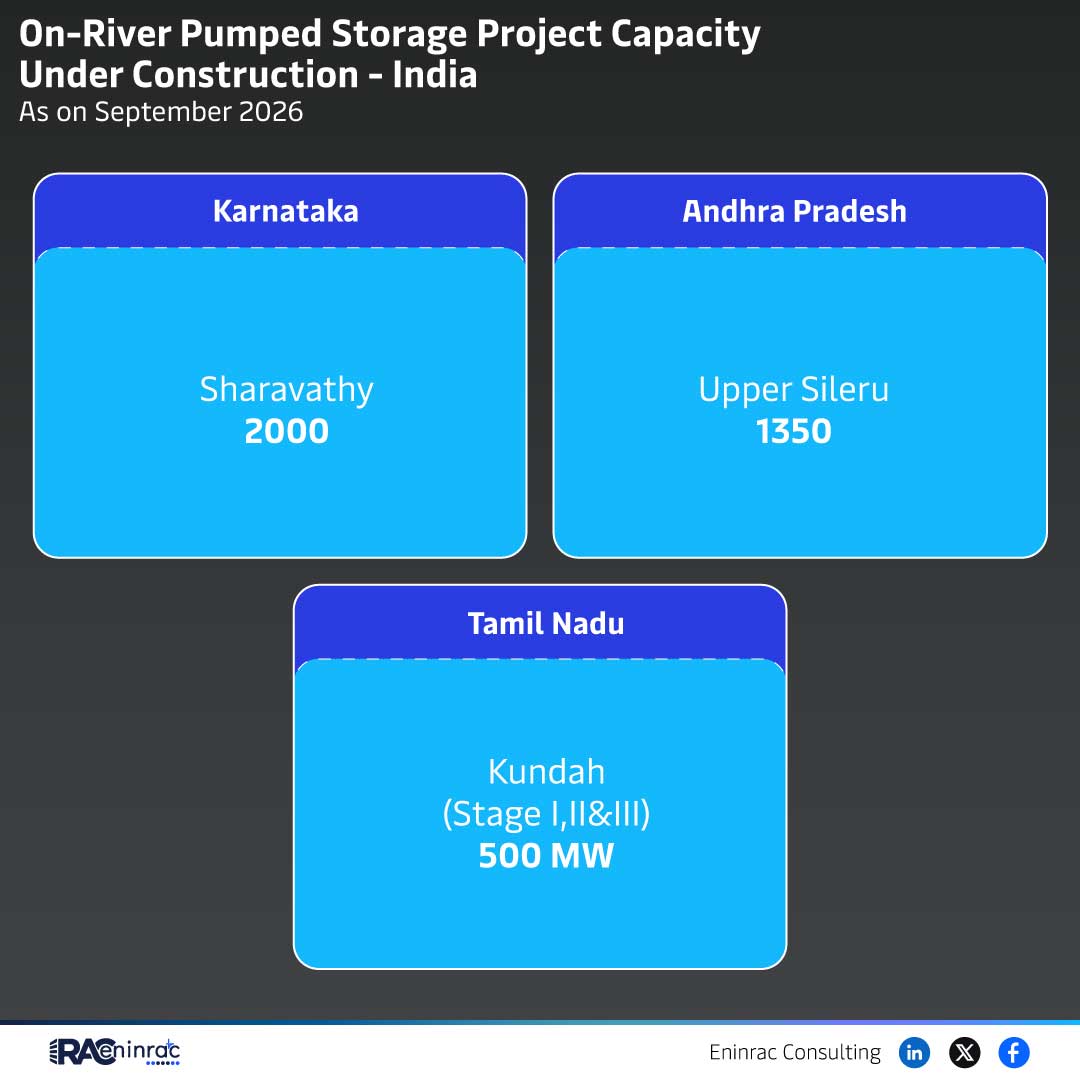
The data shows that Andhra Pradesh and Karnataka each report a combined on‑river pumped storage capacity of roughly 2,000 MW and 1,350 MW respectively, while Tamil Nadu contributes an additional 500 MW through the Kundah Stage I development. The figures indicate a clear concentration of large‑scale storage in the southern corridor, reflecting favorable topography and water resources. In simple terms, the southern states together account for over 3,800 MW of capacity, dwarfing other regions that have yet to launch comparable projects. This concentration suggests that future grid balancing solutions in India will likely depend heavily on these southern hubs.
Regional Capacity Comparison
When the three states are placed side by side, the disparity becomes evident. Andhra Pradesh’s 2,000 MW figure derives from the Sharavathy Upper Sileru scheme, which taps a steep river gradient to achieve high head and efficiency. Karnataka follows with 1,350 MW spread across multiple sites, including the Sharavathy Upper Sileru extension, indicating coordinated state‑level planning. Tamil Nadu’s 500 MW contribution comes from the single‑phase Kundah Stage I, a project that illustrates the state’s cautious but steady approach to expanding storage. The overall trend points to larger, multi‑site developments in Andhra Pradesh and Karnataka, while Tamil Nadu opts for incremental capacity additions.
Impact on Sectors and Industries
Increased on‑river pumped storage capacity directly influences several sectors. The power generation industry gains a reliable buffer to store excess solar and wind output, reducing curtailment and enhancing market efficiency. Transmission operators benefit from smoother load curves, lowering the need for costly peaking plants. Renewable energy developers see improved project economics, as storage can now be bundled with generation to meet firm‑capacity obligations. Financial markets respond with heightened investor interest in infrastructure bonds tied to these projects, while policymakers receive concrete data to shape incentives for further storage deployment across the nation.
Key Takeaways
- Andhra Pradesh leads with a 2,000 MW on‑river pumped storage capacity.
- Karnataka follows with 1,350 MW, highlighting multi‑site development.
- Tamil Nadu contributes 500 MW through Kundah Stage I.
- The southern states together provide over 3,800 MW of storage.
- High head sites like Sharavathy Upper Sileru boost efficiency.
- Expanded capacity supports grid stability, renewable integration, and investment flows.
FAQs
What is on‑river pumped storage?
It is a hydroelectric system that stores energy by moving water between an upper and lower reservoir along a river, generating power during release.
Why are Andhra Pradesh and Karnataka dominant?
The terrain offers steep gradients and ample water flow, enabling high‑head projects with large storage potential.
How does pumped storage aid renewable integration?
It absorbs excess solar or wind generation and releases it when demand spikes, reducing intermittency.
What is the timeline for these projects?
All listed projects are under construction and expected to reach commercial operation between 2027 and 2029.
Can other Indian states replicate this model?
Yes, states with suitable river valleys and elevation differences can develop similar on‑river pumped storage schemes.