
Introduction
September 2026 marks a pivotal reporting period for India’s electrical infrastructure, with a detailed snapshot of sub‑stations capacity development measured in megawatts (MW) and megavolt‑amperes (MVA). The data aggregates voltage‑wise and sector‑wise breakups, highlighting contributions from central, state and private transmission players such as WBSETCL, APTRANSCO, and PGCIL. Understanding this information helps regulators, investors and planners gauge how new sub‑stations are expanding the grid, where capacity gaps remain, and which voltage levels are receiving the most attention.
What Does the Data Reveal About This Topic?
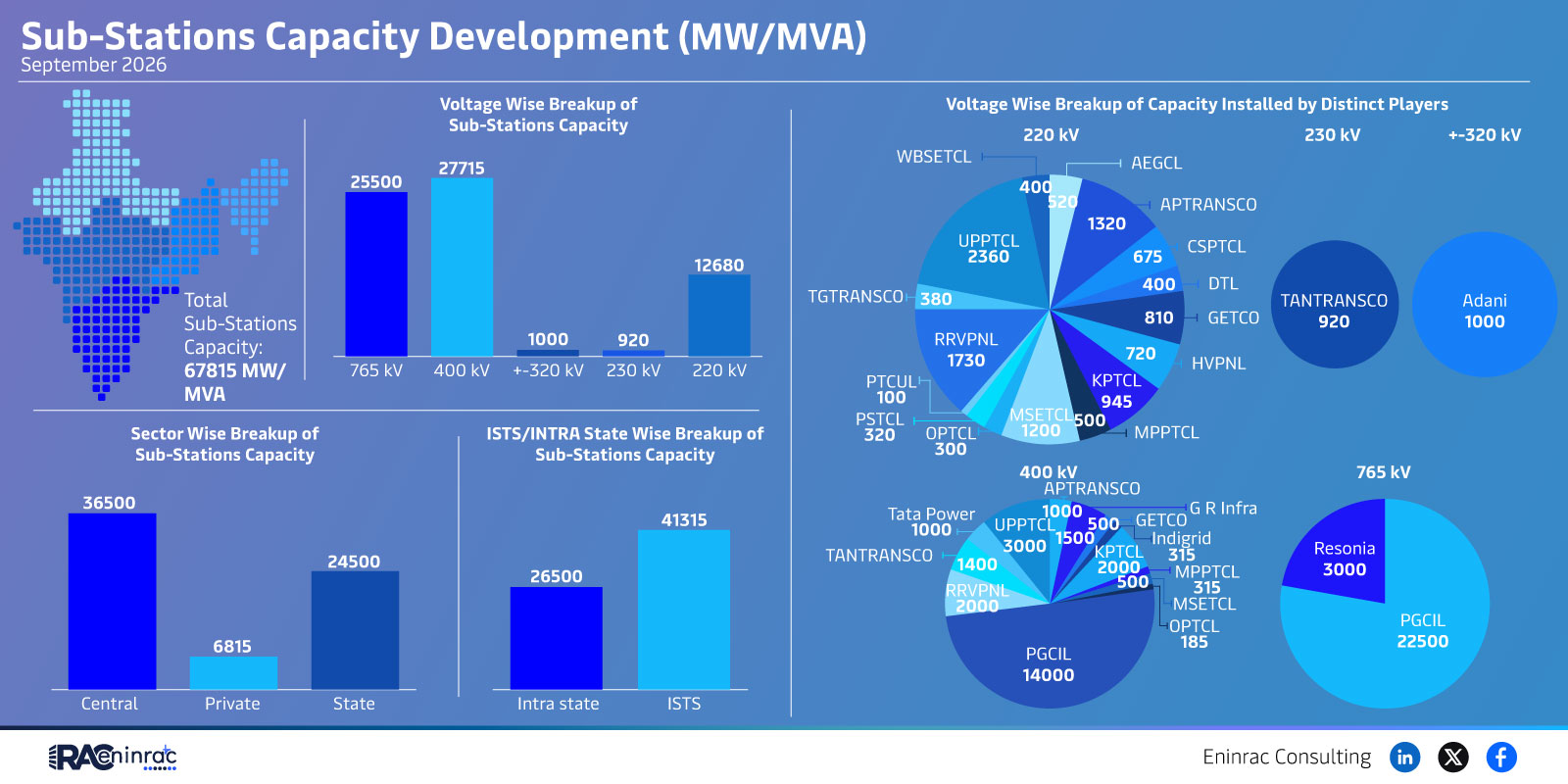
The most striking insight is the sheer volume of capacity added at the 400 kV and 220 kV levels, where the combined total reaches roughly 67 GW and 68 GVA respectively. Private entities account for about 7 GW of the 400 kV capacity, while state utilities dominate the 230 kV segment with more than 35 GW. The data also shows a modest but growing presence of ultra‑high voltage (UHV) 765 kV projects, reflecting the national push toward long‑distance power transmission. In summary, voltage tier and ownership type together shape the development trajectory of the Indian grid.
Voltage‑Specific Capacity Distribution Across India
Examining the voltage‑wise breakup reveals that the 400 kV class holds the largest share of installed capacity, totaling 27 715 MW, followed closely by the 230 kV tier at 25 500 MW. The 220 kV level contributes 12 680 MW, while the 765 kV segment adds a modest 6 815 MW. When expressed in MVA, the 400 kV infrastructure reaches 36 500 MVA, whereas the 230 kV and 220 kV voltages deliver 41 315 MVA and 24 500 MVA respectively. This distribution underscores a strategic focus on high‑voltage corridors that can transport large power blocks efficiently, while still maintaining significant capacity at the intermediate 220 kV level to support regional distribution networks. Sector‑wise, private players such as TANTRANSCO and MPPTCL together account for roughly 1 GW at 400 kV, whereas state‑run utilities like PGCIL and WBSETCL dominate the higher voltage slots, collectively delivering over 30 GW. This split demonstrates how both central and state agencies collaborate to meet the country’s growing demand for reliable transmission.
Impact on Sectors and Industries
The ongoing sub‑stations capacity development directly influences several key sectors. For power generation, higher‑capacity transmission nodes enable larger plants to inject electricity without bottlenecks, encouraging investment in renewable and thermal projects. Distribution companies benefit from improved voltage stepping, which reduces losses and enhances reliability for end‑users. Financial markets see new opportunities as infrastructure bonds and equity stakes in transmission assets become more attractive. Policy makers can align this growth with national clean‑energy targets, using the expanded grid to integrate solar and wind farms spread across distant regions. Overall, the expanded sub‑station network strengthens grid resilience and supports economic growth.
Key Takeaways
- 400 kV sub‑stations hold the largest installed capacity at over 27 GW.
- State utilities dominate the 230 kV and 400 kV segments, contributing more than 30 GW.
- Private transmission players are adding around 1 GW at the highest voltage level.
- The emerging 765 kV UHV projects indicate a shift toward long‑distance power transfer.
- Capacity growth at 220 kV supports regional distribution and reduces transmission losses.
- Overall sub‑station expansion aligns with India’s renewable integration and grid‑resilience goals.
FAQs
What is sub‑stations capacity development?
It refers to the addition and upgrade of sub‑station facilities measured in MW and MVA to improve grid performance.
Why is voltage level important in transmission planning?
Higher voltage levels allow larger power transfers over longer distances with lower losses, shaping network efficiency.
Which entities contribute most to 400 kV capacity?
State utilities such as PGCIL and WBSETCL provide the bulk of 400 kV capacity, complemented by private firms.
How does increased sub‑station capacity affect renewable energy integration?
More capacity creates reliable corridors for solar and wind farms, enabling smoother and larger renewable injections.
What future trends are expected for India’s sub‑station network?
Continued growth at ultra‑high voltage, greater private participation, and alignment with clean‑energy targets are anticipated.