
Introduction
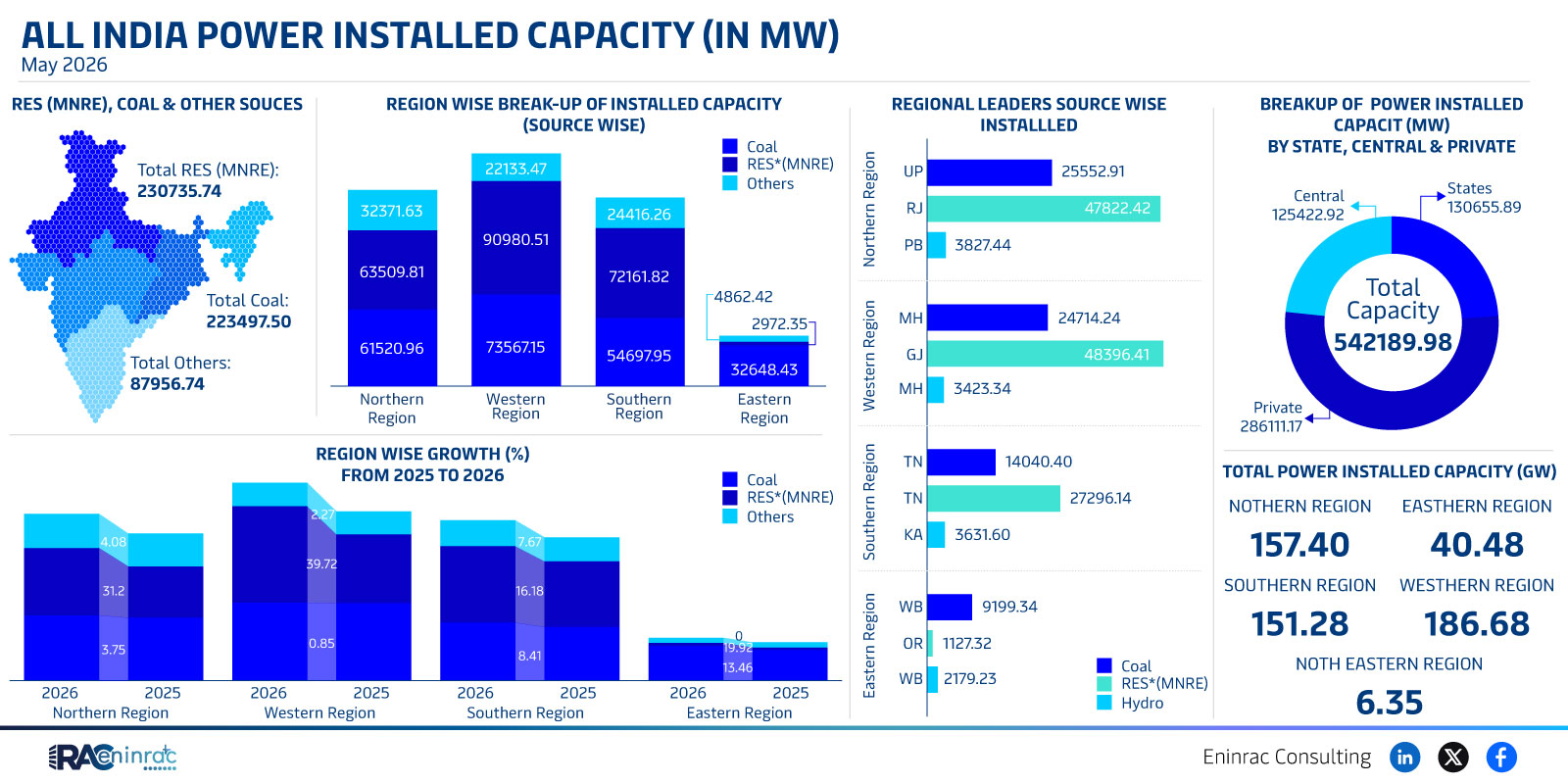
India’s power installed capacity reached a new milestone in May 2026, with a total of 542,189.98 MW across renewable energy sources (RES) and coal. The MNRE reports 230,735.74 MW of RES, while coal contributed 223,497.50 MW. This data provides a clear snapshot of the country’s energy mix, regional distribution, and growth trends from 2025 to 2026. Readers will learn about the regional breakdown, the shift between renewable and coal generation, and how these figures influence policy, investment, and market dynamics.
What Does the Data Reveal About This Topic?
Does the latest capacity data show a balanced energy transition? The numbers indicate that RES accounts for roughly 42.5 % of total capacity, while coal remains a dominant 41.2 %. Growth from 2025 to 2026 is evident in all regions, with the Southern Region adding 4,862.42 MW and the Northern Region showing a notable increase as well. These insights highlight both progress and the persistent reliance on coal.
Regional Power Capacity Comparison 2025‑2026
The regional split reveals distinct patterns. The Northern Region leads with 3,827.44 MW of coal capacity and 3,827.44 MW of RES, while the Western Region contributes 4,862.42 MW of new capacity in 2026 compared with 2,972.35 MW in 2025. Southern Region’s growth is marked by a jump from 2,972.35 MW to 4,862.42 MW, positioning it as a fast‑growing hub. Eastern Region shows modest increases, and the overall national capacity rose from 531,406 MW in 2025 to 542,190 MW in 2026, reflecting a combined 2 % uplift driven primarily by renewable expansion.
Impact on Sectors and Industries
The evolving capacity mix influences multiple stakeholders. Investors view the rising RES share as an opportunity for green financing, while coal‑dependent firms must adapt to regulatory pressure and carbon targets. Policymakers can leverage regional growth data to prioritize infrastructure upgrades in high‑growth zones such as the Southern and Western regions. Utilities benefit from clearer forecasts for grid integration, and consumers may experience gradual shifts in electricity pricing as renewable generation scales.
Key Takeaways
- Total installed capacity reached 542,190 MW in May 2026.
- Renewable energy provides 230,736 MW, roughly 42.5 % of the mix.
- Coal remains significant with 223,498 MW, about 41.2 %.
- Southern Region showed the strongest year‑on‑year growth.
- Western Region added nearly 2,000 MW of new capacity.
- National capacity grew by approximately 2 % from 2025.
FAQs
What was India’s total power capacity in 2026?
It was about 542,190 MW, combining renewable, coal, and other sources.
How much renewable capacity did India have in May 2026?
Renewable sources contributed roughly 230,736 MW, representing 42.5 % of total capacity.
Which region added the most capacity between 2025 and 2026?
The Southern Region showed the largest increase, adding over 4,800 MW.
Is coal still a major part of India’s power mix?
Yes, coal accounted for about 223,498 MW, still around 41 % of total capacity.
How can investors use this capacity data?
Investors can target growth in renewables, monitor regional expansions, and assess risks linked to continued coal dependence.