
Introduction
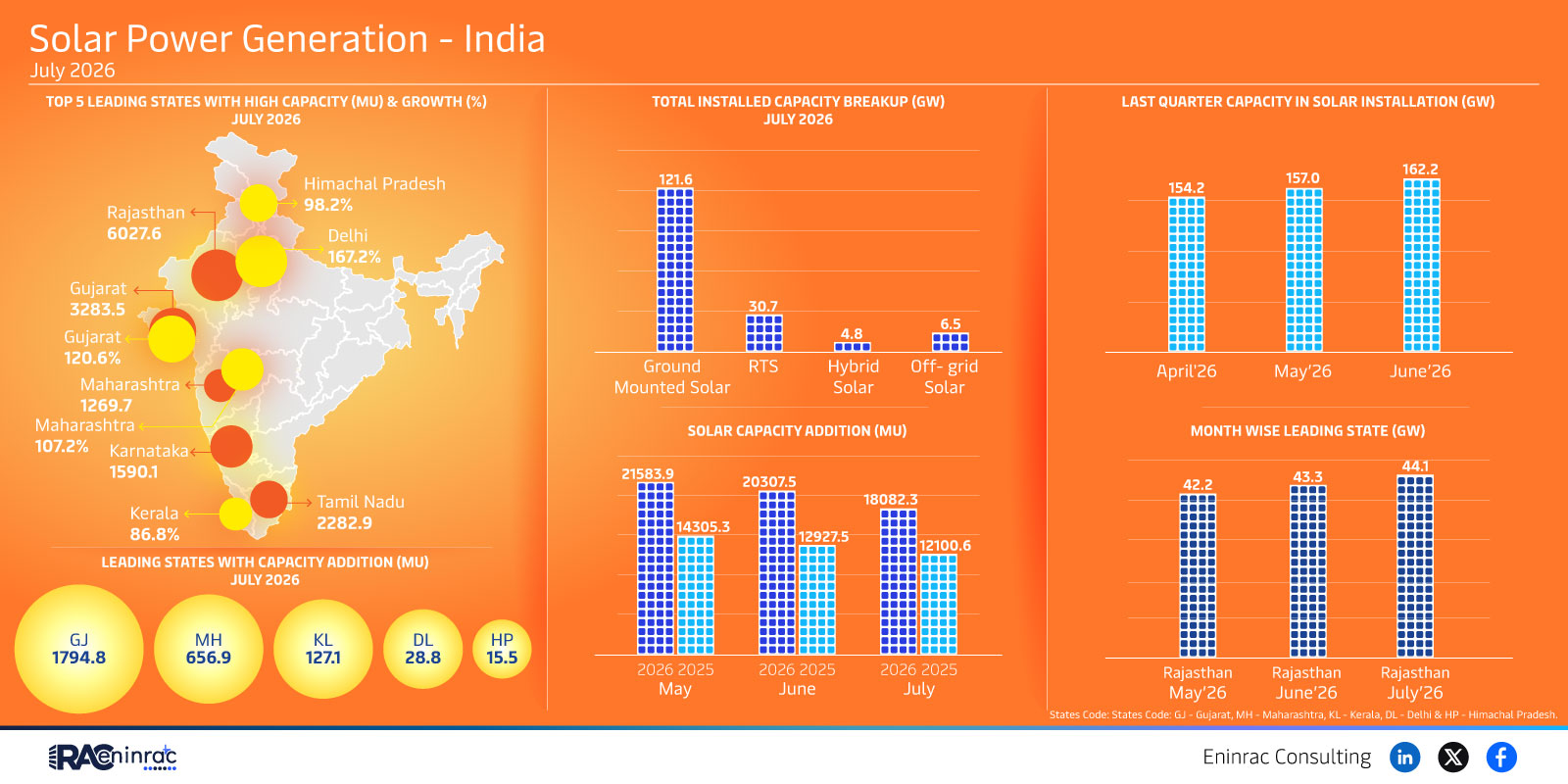
India’s solar power generation market accelerated markedly in July 2026, with new capacity installations pushing the national total to new heights. The latest statistics reveal that Tamil Nadu contributed 2,282.9 MW of installed capacity, cementing its position as the top state by cumulative megawatts. Monthly addition figures show a surge of 162.2 GW across the country, while Rajasthan emerged as the leading state for month‑on‑month growth in May, June and July. This data set offers investors, policymakers, and industry analysts a clear snapshot of where solar development is concentrated and how momentum is shifting among Indian states.
What Does the Data Reveal About This Topic?
The core question the July 2026 report answers is which Indian states are driving the country’s solar capacity expansion and at what speed. Tamil Nadu’s 2,282.9 MW underscores its long‑term dominance, while Rajasthan’s repeated monthly leadership indicates a rapid regional catch‑up. The aggregate addition of 162.2 GW in the last quarter confirms that the solar sector is outpacing many traditional power sources, and the spread of capacity growth across states such as Gujarat, Maharashtra and Kerala suggests a broadening geographic base for renewable investment. These trends also reflect supportive policies at both central and state levels, encouraging large‑scale projects and rooftop installations alike.
State‑wise Solar Capacity Trends and Monthly Leaders
State‑wise analysis for July 2026 highlights a clear divergence between cumulative capacity leaders and monthly growth drivers. Tamil Nadu remains the heavyweight with a total installed capacity exceeding 2.2 GW, followed by Gujarat and Maharashtra in the broader top‑five list. In contrast, Rajasthan topped the month‑wise rankings for May, June and July, contributing the largest share of the 162.2 GW added during the quarter. This dual pattern illustrates that while some states maintain a large base, others are accelerating quickly through new projects, grid‑connected farms, and hybrid installations that boost short‑term capacity figures.
Impact on Sectors and Industries
The surge in solar capacity directly influences several key sectors. Power utilities benefit from a diversified generation mix, reducing reliance on coal and enhancing grid stability. Manufacturing sees increased demand for photovoltaic modules, inverters and balance‑of‑system components, spurring job creation in domestic supply chains. Financial institutions observe new lending opportunities tied to solar project financing, while investors track higher returns in renewable portfolios. Moreover, policy makers can leverage the data to refine subsidy schemes, land allocation and transmission planning, ensuring that the rapid expansion aligns with national energy security and climate targets.
Key Takeaways
- Tamil Nadu leads with 2,282.9 MW, the highest cumulative solar capacity in India.
- Rajasthan topped monthly additions for May, June and July, driving quarterly growth.
- Overall solar capacity addition reached 162.2 GW in the last quarter of 2026.
- States such as Gujarat, Maharashtra and Kerala continue to expand the renewable base.
- Rapid capacity growth supports grid stability, reduces coal dependence, and boosts clean‑energy jobs.
- Policymakers can use these trends to fine‑tune incentives and transmission planning.
FAQs
Which state had the highest installed solar capacity in July 2026?
Tamil Nadu recorded 2,282.9 MW of installed capacity, making it the leading state in July 2026.
How much solar capacity was added in India during the last quarter of 2026?
India added approximately 162.2 GW of solar capacity in the fourth quarter of 2026, reflecting strong growth.
Why is Rajasthan significant in the monthly solar capacity rankings?
Rajasthan led monthly additions for three consecutive months, showing rapid project deployment and effective state policies.
What impact does the increase in solar capacity have on India's energy mix?
The rise in solar generation diversifies the energy mix, lowers coal use, and enhances grid reliability.
How can investors benefit from the current solar growth trends in India?
Investors gain opportunities in project financing, equipment manufacturing, and renewable‑focused funds as capacity expands rapidly.