
Introduction
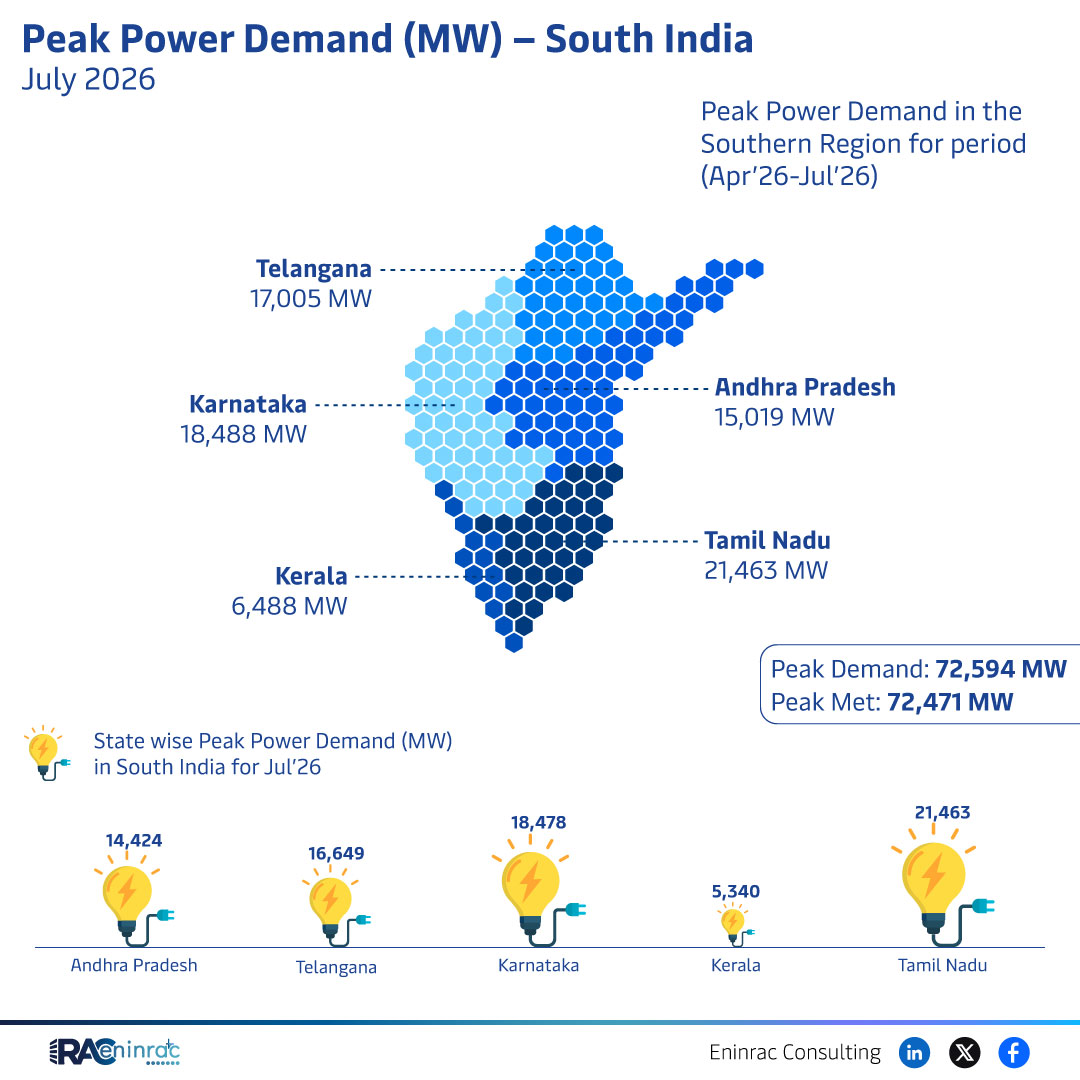
South India experienced a significant surge in electricity consumption during July 2026, with the region’s peak power demand reaching 72,594 MW. This figure represents the highest instantaneous load recorded across the five southern states—Andhra Pradesh, Karnataka, Kerala, Tamil Nadu, and Telangana—during the period from April to July 2026. Understanding these numbers is crucial for grid operators, policymakers, and investors because they reflect the stress on generation assets, transmission capacity, and distribution networks. In this article we unpack the statewise figures, compare the leading load centers, and discuss the broader implications for the Indian power sector.
What Does the Data Reveal About This Topic?
The primary question is: which state contributed the most to the July 2026 peak load? The data shows Tamil Nadu recorded the highest individual demand at 21,463 MW, followed by Andhra Pradesh with 18,478 MW and Karnataka at 16,649 MW. Telangana and Kerala placed lower with 17,005 MW and 6,488 MW respectively. Combined, these five states supplied the total regional peak of 72,594 MW, confirming that the southern grid operated near its maximum capacity during the summer month.
Statewise Comparison of July 2026 Peak Load
A closer look at the numbers highlights distinct patterns. Tamil Nadu’s demand of 21,463 MW surpasses the next largest state by more than three hundred megawatts, underscoring its role as the dominant load center in the south. Andhra Pradesh and Karnataka each hover around the 18 MW mark, indicating strong industrial and residential consumption. Telangana’s 17,005 MW reflects robust growth in commercial activity, while Kerala’s 6,488 MW is notably lower, driven by a smaller population and higher energy efficiency initiatives. These disparities help planners allocate resources and prioritize infrastructure upgrades where they are most needed.
Impact on Sectors and Industries
The July 2026 peak demand data influences several sectors. Generation companies must ensure sufficient capacity, often turning to gas‑fired or renewable plants to meet short‑term spikes. Transmission operators face the challenge of maintaining line stability and avoiding overloads, prompting investments in high‑voltage corridors. Distribution utilities need to manage feeder loads, especially in high‑demand zones like Tamil Nadu and Andhra Pradesh. Investors watch these trends to gauge market opportunities in power equipment, storage solutions, and demand‑response services. Policymakers also use the insights to shape tariffs, incentive schemes, and long‑term grid resilience strategies.
Key Takeaways
- Tamil Nadu led the southern region with a peak of 21,463 MW.
- Andhra Pradesh and Karnataka each contributed roughly 18 MW of peak load.
- Telangana posted 17,005 MW, showing rapid commercial growth.
- Kerala’s demand remained the lowest at 6,488 MW.
- The combined regional peak reached 72,594 MW in July 2026.
- High peak values stress generation, transmission, and distribution assets, guiding future investments.
FAQs
Which southern state had the highest peak power demand in July 2026?
Tamil Nadu recorded the highest peak demand at 21,463 MW.
What was the total peak demand for South India in July 2026?
The region’s total peak demand reached 72,594 MW.
How does Kerala’s peak demand compare to other states?
Kerala’s peak demand of 6,488 MW is significantly lower than the other four states, reflecting its smaller load base.
Why is statewise peak demand data important for the power sector?
It helps planners allocate generation, strengthen transmission, and target distribution upgrades to meet regional load peaks.
What implications does the July 2026 data have for future investments?
High demand in Tamil Nadu, Andhra Pradesh, and Karnataka signals opportunities in generation capacity, grid reinforcement, and smart‑grid technologies.