
Introduction
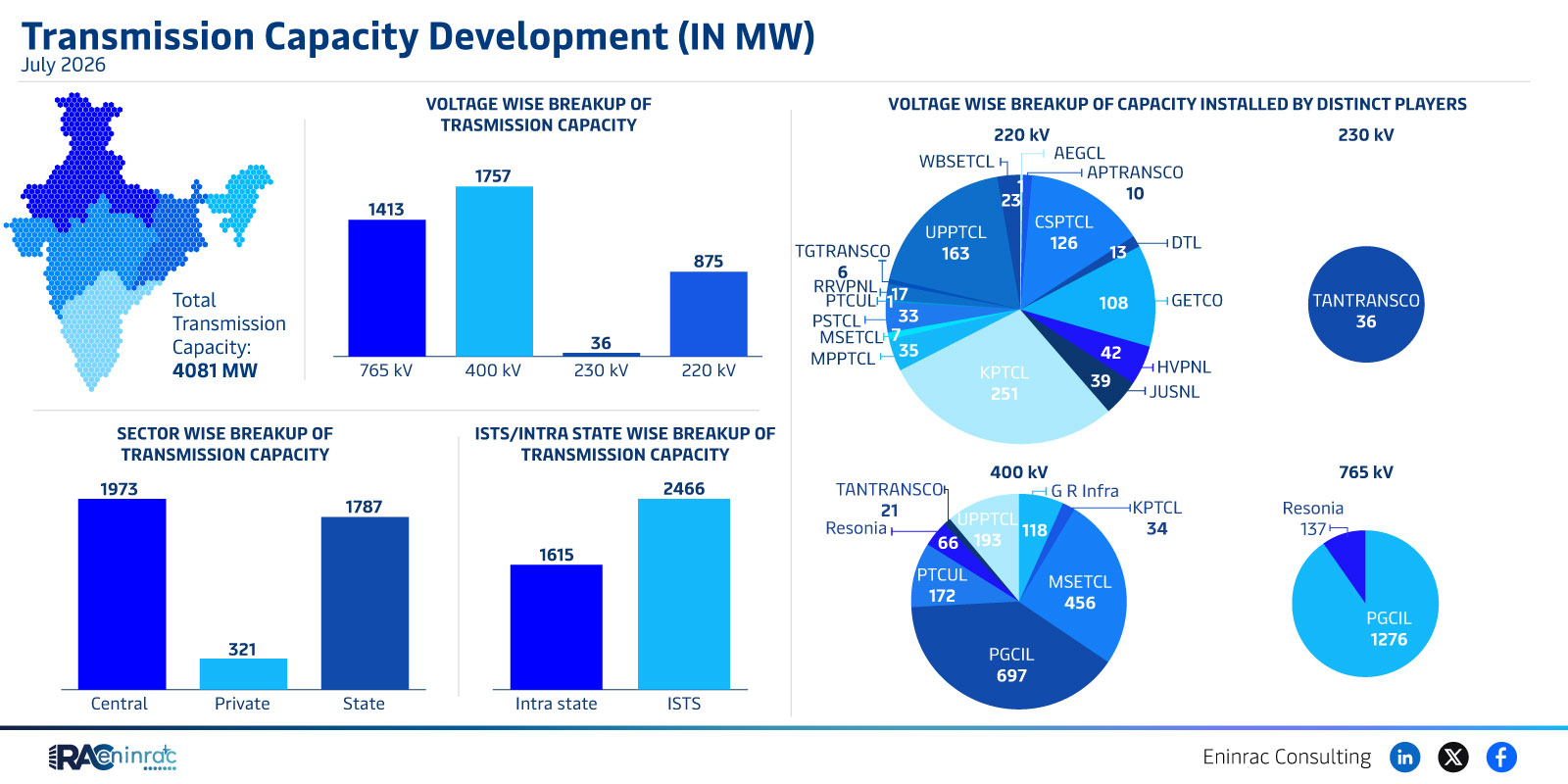
The July 2026 transmission capacity development report presents a snapshot of new megawatt (MW) capacity added across India’s power grid. The data breaks down capacity by individual transmission utilities, voltage levels, and intra‑state versus inter‑state segments. Understanding these figures helps stakeholders gauge the speed of grid expansion, identify leading players, and assess regional transmission strength. This article explains the key numbers, trends, and implications for the broader electricity ecosystem.
What Does the Data Reveal About This Topic?
What insight does the July 2026 data provide? It shows that total newly installed transmission capacity reached approximately 1,757 MW, with a notable share of 36 MW attributed to state‑wide projects. Major players such as AEGCL, APTRANSCO, CSPTCL, and TGTRANSCO each contributed distinct portions of the capacity, while the overall voltage distribution highlights a focus on the 765 kV tier. The figures indicate a steady increase in high‑voltage corridors that support long‑distance power flow.
Voltage Wise Capacity Distribution Among Transmission Players
Analyzing the voltage wise breakup reveals that the 765 kV line segment dominates the capacity additions, reflecting strategic investments in high‑capacity corridors. Utilities like AEGCL and APTRANSCO lead the deployment at this voltage, while others allocate resources across lower voltage levels to strengthen regional grids. The data also distinguishes between central and state‑wise allocations, showing that central corridors receive a larger share of high‑voltage capacity, whereas intra‑state links focus on reinforcing local reliability.
Impact on Sectors and Industries
Enhanced transmission capacity directly influences multiple sectors. Power generators gain reliable pathways to deliver electricity to distant load centers, reducing curtailment risks. Industrial consumers benefit from more stable supply and lower transmission losses, supporting manufacturing competitiveness. Investors see clearer signals for infrastructure financing, while policymakers can align grid upgrades with renewable integration goals. Overall, the capacity growth bolsters grid resilience and helps meet rising demand across urban and rural areas.
Key Takeaways
- July 2026 saw approximately 1,757 MW of new transmission capacity installed.
- High‑voltage 765 kV lines received the largest share of upgrades.
- AEGCL, APTRANSCO, CSPTCL, and TGTRANSCO are the top contributing utilities.
- State‑wide projects added 36 MW, highlighting focused regional development.
- The capacity boost supports renewable energy integration and grid reliability.
- Stakeholders across generation, industry, and finance benefit from the expanded grid.
FAQs
Which utilities contributed the most to July 2026 transmission capacity?
AEGCL, APTRANSCO, CSPTCL, and TGTRANSCO led the additions, each delivering significant megawatt figures.
Why is the 765 kV voltage level emphasized?
765 kV lines enable long‑distance power transfer with lower losses, making them essential for national grid strength.
How does the new capacity affect renewable energy projects?
Greater transmission capacity provides clearer pathways for renewable generation to reach markets, reducing curtailment.
What is the difference between central and intra‑state transmission capacity?
Central capacity refers to inter‑state corridors, while intra‑state capacity focuses on links within a single state.
Will investors see new opportunities from this capacity growth?
Yes, the expanding grid creates demand for financing, construction, and technology services related to transmission projects.