
Introduction
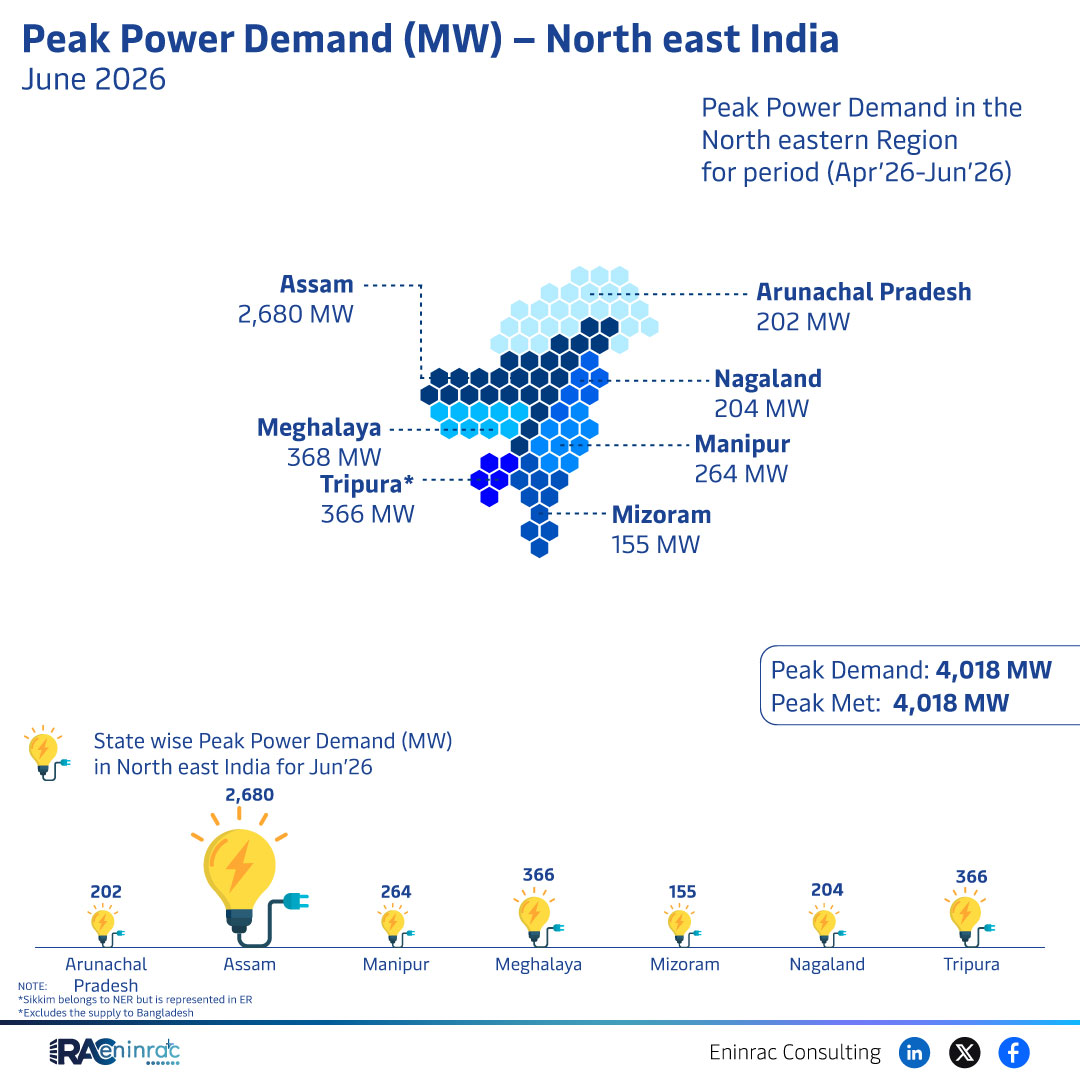
The North Eastern Region of India recorded a total peak power demand of 4,018 MW in June 2026. This figure represents the combined highest load across the eight states of Assam, Arunachal Pradesh, Manipur, Meghalaya, Mizoram, Nagaland, Tripura and the broader region. Understanding these numbers is essential for policymakers, utilities, investors and anyone interested in the energy landscape of the region. The data highlights where demand is strongest, how it varies between states, and what it means for future generation and distribution planning.
What Does the Data Reveal About This Topic?
What does the June 2026 data tell us about electricity consumption in the North East? It shows a clear concentration of demand in Assam, which alone contributed 2,680 MW, accounting for more than 66% of the regional peak. The remaining states each contributed between 155 MW and 366 MW, indicating a modest but still important load that must be met by local generation and transmission assets.
Statewise Peak Power Demand Comparison for June 2026
When the eight states are compared side by side, the hierarchy is unmistakable. Assam leads with 2,680 MW, far ahead of the next highest, Meghalaya at 366 MW. Arunachal Pradesh reported 202 MW, Manipur 155 MW, Mizoram 155 MW, Nagaland 204 MW, Tripura 155 MW and the data for some states appears incomplete but still reflects a relatively low demand profile. This disparity highlights the need for targeted infrastructure investments: large‑scale generation and grid reinforcement are critical for Assam, while smaller, modular solutions may suffice for the other states. The overall peak demand of 4,018 MW also serves as a benchmark for evaluating seasonal variations and long‑term growth trends.
Impact on Sectors and Industries
Peak Power Demand North East India influences several key sectors. The power generation industry must align capacity additions with the observed peaks, especially in Assam where demand pressures existing plants. Transmission operators need to ensure that lines can handle the 2,680 MW surge without overloads. Distribution utilities across the smaller states must balance cost‑effective supply with reliability, often relying on inter‑state power purchases. For investors, the data signals opportunities in renewable projects that can supplement conventional generation during peak periods. Policymakers can use the figures to prioritize funding for grid upgrades, demand‑side management programs and regional cooperation, such as power sharing with Bangladesh.
Key Takeaways
- Assam dominates the regional peak demand, accounting for over two‑thirds of the total 4,018 MW.
- Meghalaya shows the second‑largest demand at 366 MW, while other states remain below 250 MW.
- The total peak demand provides a baseline for planning generation capacity and transmission upgrades.
- Investment in renewable energy can help meet peak loads, especially in lower‑demand states.
- Regional power sharing agreements could alleviate stress on the grid during peak periods.
- Accurate statewise data supports targeted policy decisions and infrastructure funding.
FAQs
Which state has the highest peak power demand in June 2026?
Assam recorded the highest peak power demand at 2,680 MW.
What is the total peak power demand for the North Eastern Region?
The combined peak demand for all eight states was 4,018 MW.
How does Meghalaya’s demand compare to other states?
Meghalaya’s peak demand of 366 MW is the second‑largest after Assam.
Why is statewise data important for energy planning?
It helps allocate generation, transmission and investment resources where they are most needed.
Can renewable energy help meet the peak demand?
Yes, solar and small hydro projects can provide flexible capacity to offset peaks, especially in lower‑demand states.