
Introduction
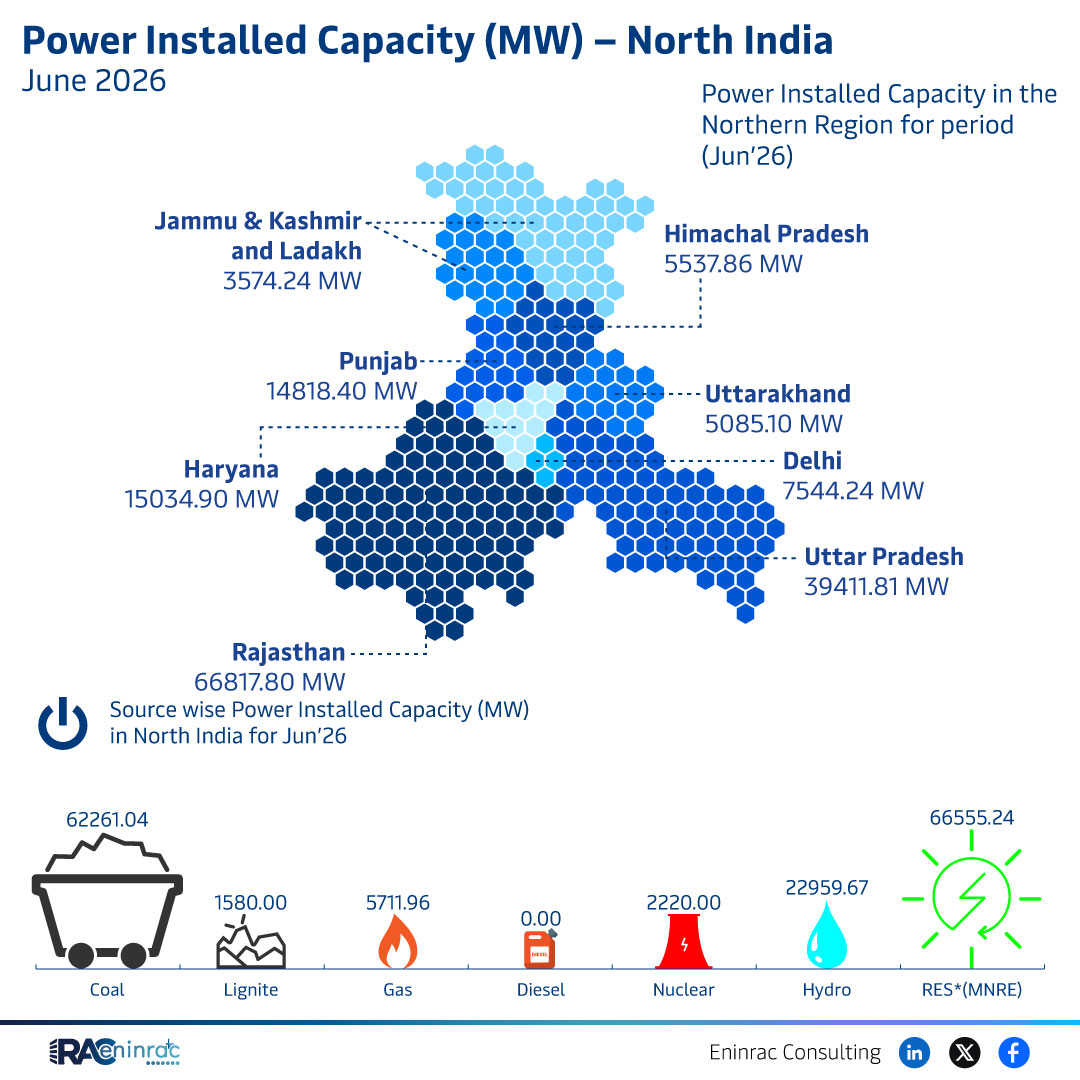
The June 2026 North India power installed capacity data provides a pivotal snapshot of electricity generation across the region, covering the states of Jammu & Kashmir, Himachal Pradesh, Ladakh, Punjab, Uttarakhand, Delhi, Haryana, Uttar Pradesh and Rajasthan. The figures compiled by Enirac Consulting show total megawatt (MW) values for each state and a source‑wise breakdown that includes coal, lignite, gas, diesel, nuclear, hydro and renewable energy sources. Understanding this distribution helps policymakers, investors and analysts gauge regional growth trends, assess resource adequacy and plan future generation‑mix adjustments.
What Does the Data Reveal About This Topic?
The June 2026 figures reveal that Rajasthan leads the northern region with a staggering 66,818 MW of installed capacity, followed by Uttar Pradesh at 39,412 MW and Haryana at 15,035 MW. Together these three states account for more than half of the total 158,300 MW reported for North India. Coal remains the dominant source, contributing roughly 62,261 MW, while renewables (including hydro, solar and wind) supply just over 6,600 MW, highlighting the ongoing reliance on fossil fuels despite growing renewable installations.
State‑wise Capacity Highlights for June 2026
Punjab’s capacity stands at 14,818 MW, driven largely by coal‑based plants, whereas Delhi’s comparatively modest 7,544 MW reflects a mix of gas, nuclear and renewable projects. Jammu & Kashmir, Himachal Pradesh and Ladakh together contribute 3,574 MW, underscoring the challenges of developing infrastructure in mountainous terrain. Uttarakhand’s 5,085 MW is predominantly hydro, while the northern belt sees a gradual increase in renewable share, especially in Rajasthan where solar farms have added over 1,200 MW to the grid.
Impact on Sectors and Industries
The capacity distribution influences multiple sectors. Utilities must balance base‑load coal generation with intermittent renewable output, prompting investments in grid flexibility and storage. Heavy industries in Haryana and Punjab benefit from reliable coal power, whereas the burgeoning renewable segment creates opportunities for solar EPC firms and wind turbine manufacturers. Policymakers can leverage the data to design targeted incentives, strengthen transmission corridors and address emissions goals aligned with India’s climate commitments.
Key Takeaways
- Rajasthan holds the highest installed capacity in North India.
- Coal accounts for the majority of generation, exceeding 60 GW.
- Renewables contribute just under 7 GW, indicating growth potential.
- Three states (Rajasthan, Uttar Pradesh, Haryana) make up over 50 % of total capacity.
- Hydro remains significant in Uttarakhand and Himachal Pradesh.
- Capacity gaps in Jammu & Kashmir and Ladakh highlight infrastructure challenges.
FAQs
What is the total power installed capacity for North India in June 2026?
The combined installed capacity across the eight northern states is approximately 158,300 MW.
Which energy source provides the largest share of capacity?
Coal leads with about 62,260 MW, far surpassing other sources.
How does Rajasthan’s capacity compare to other states?
Rajasthan’s 66,818 MW is the highest, more than double the capacity of the next largest state, Uttar Pradesh.
What is the renewable energy contribution in the region?
Renewables (hydro, solar, wind) total around 6,600 MW, representing roughly 4 % of the northern region’s capacity.
Why are Jammu & Kashmir and Ladakh’s capacities relatively low?
Difficult terrain, limited transmission infrastructure and lower investment levels keep their installed capacity modest.