
Introduction
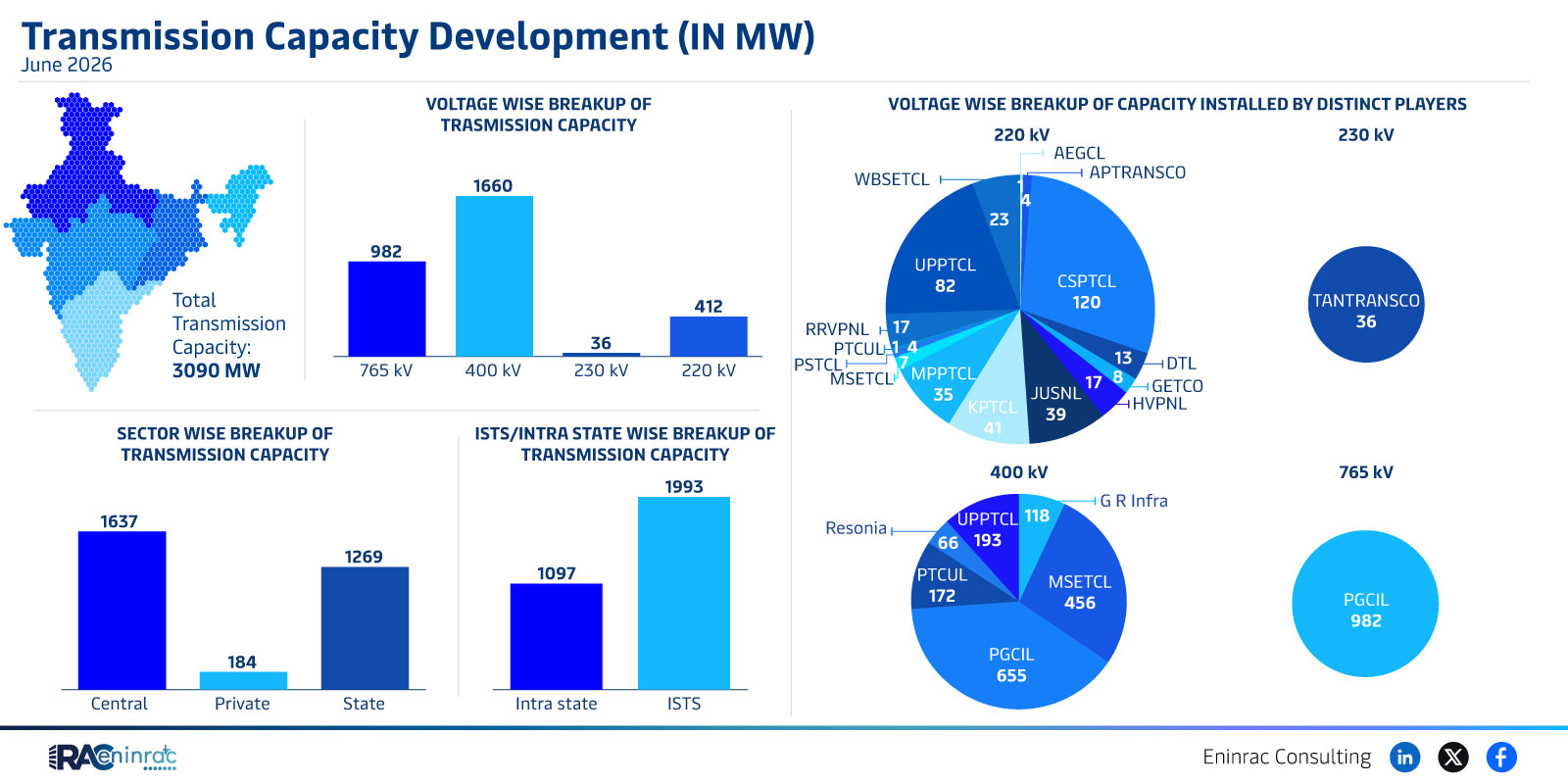
The June 2026 transmission capacity development report offers a detailed snapshot of India’s high‑voltage network expansion. It outlines how major utilities such as AEGCL, WBSETCL, APTRANSCO, and TANTRANSCO have added megawatts across 765 kV, 400 kV, 230 kV and 220 kV lines. Understanding this data helps policymakers, investors, and industry analysts assess grid reliability, future power trade, and regional growth prospects.
What Does the Data Reveal About This Topic?
What key trends emerge from the June 2026 figures? The report shows a total installed transmission capacity of roughly 3,090 MW, with the 765 kV tier contributing the largest share at 1,993 MW. Mid‑range 400 kV lines add about 1,097 MW, while lower voltage corridors (230 kV and 220 kV) together provide the remaining 456 MW and 184 MW respectively. This distribution indicates a strong focus on ultra‑high voltage corridors to support long‑distance power transfer.
Voltage‑wise Capacity Distribution by Player
Comparing the contributions of each utility reveals distinct strategies. AEGCL leads in the 765 kV segment with approximately 982 MW, underscoring its role in inter‑regional bulk power exchange. WBSETCL and APTRANSCO split the remaining high‑voltage allotment, each adding roughly 500 MW. In the 400 kV band, WBSETCL dominates with over 600 MW, while TANTRANSCO’s focus remains on expanding 230 kV and 220 kV networks to improve state‑level reliability. These differences highlight how central and state players prioritize voltage levels based on geographic demand and existing infrastructure.
Impact on Sectors and Industries
The expanded transmission capacity directly influences several key sectors. Power generators gain access to broader markets, enabling higher utilization of renewable assets. Industrial consumers benefit from reduced transmission losses and more stable supply, encouraging capital investment in energy‑intensive regions. For financial markets, the clear growth in high‑voltage corridors signals lower risk for infrastructure bonds, while regulators can better plan ancillary services and grid stability measures.
Key Takeaways
- India’s total transmission capacity reached approximately 3,090 MW in June 2026.
- The 765 kV tier accounts for the majority share, reflecting a focus on long‑distance bulk transfer.
- AEGCL is the leading contributor to ultra‑high voltage capacity.
- State utilities prioritize lower voltage expansions to enhance local reliability.
- Greater high‑voltage capacity supports renewable integration and grid resilience.
- Investors view expanded transmission networks as lower‑risk infrastructure assets.
FAQs
What is the total transmission capacity added in June 2026?
About 3,090 MW of new capacity was reported across all voltage levels.
Which voltage level carries the most new capacity?
The 765 kV tier, with roughly 1,993 MW, holds the largest share.
Which utility contributed the most to the 765 kV network?
AEGCL added approximately 982 MW, making it the top contributor.
How does this development affect renewable energy projects?
Higher ultra‑high voltage capacity improves the ability to transport renewable power from remote sites to demand centres, facilitating greater renewable penetration.
Why are state utilities focusing on 230 kV and 220 kV lines?
These lower voltage upgrades strengthen regional distribution, reduce congestion, and enhance reliability for local consumers.