
Introduction
The May 2026 peak power demand data for East India provides a snapshot of electricity consumption across the region’s major states. Understanding which states draw the most power helps grid operators, policymakers, and investors plan for capacity, reliability, and future growth. This article breaks down the numbers, highlights key trends, and explains the implications for the power sector.
What Does the Data Reveal About This Topic?
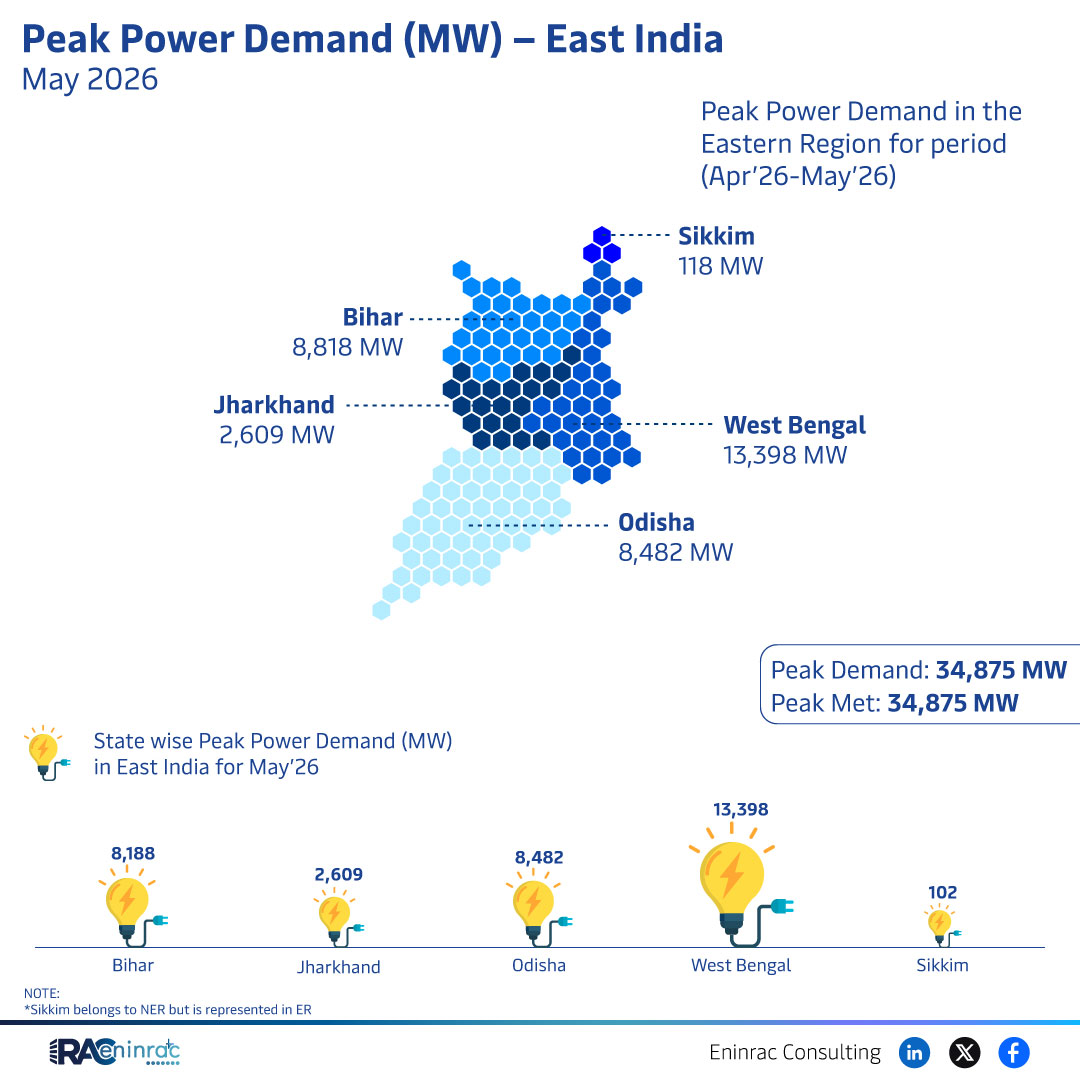
The data shows that West Bengal recorded the highest peak demand at 13,398 MW, followed by Bihar with 8,818 MW and Odisha with 8,482 MW. Jharkhand contributed 2,609 MW and Sikkim, although part of the North‑East region, reported 118 MW. The combined peak demand for the Eastern Region reached 34,875 MW, indicating a substantial load that must be met by generation and transmission assets.
State‑wise Comparison of Peak Demand
When comparing the states, West Bengal leads by a clear margin, reflecting its larger industrial base and higher population density. Bihar and Odisha are close competitors, each exceeding 8,000 MW, driven by growing manufacturing and agricultural processing loads. Jharkhand’s demand is modest at just over 2,600 MW, while Sikkim’s demand remains minimal, consistent with its smaller economy and lower electrification intensity.
Impact on Sectors and Industries
High peak demand in West Bengal, Bihar, and Odisha influences several sectors. Industrial manufacturers must ensure reliable supply to avoid production losses. Commercial users experience higher tariffs during peak periods, prompting demand‑side management initiatives. Utilities face pressure to dispatch additional generation, often from thermal plants, which raises emissions concerns and highlights the need for renewable integration. Policymakers can use this data to prioritize transmission upgrades and incentivize energy efficiency programs.
Key Takeaways
- West Bengal recorded the highest May 2026 peak demand at 13,398 MW.
- Bihar and Odisha each exceeded 8,000 MW, showing strong regional growth.
- Jharkhand contributed 2,609 MW, reflecting moderate industrial activity.
- Sikkim’s demand of 118 MW remains low despite inclusion in the Eastern Region data.
- The total Eastern Region peak demand reached 34,875 MW.
- These figures underline the need for capacity expansion, grid reinforcement, and renewable integration.
FAQs
Which state had the highest peak power demand in May 2026?
West Bengal, with a peak demand of 13,398 MW.
How does Bihar’s demand compare to Odisha’s?
Bihar reported 8,818 MW while Odisha reported 8,482 MW, making Bihar slightly higher.
Why is Sikkim’s demand so low?
Sikkim has a smaller population and less industrial activity, resulting in a modest 118 MW peak demand.
What is the total peak demand for the Eastern Region?
The combined peak demand for the region was 34,875 MW.
What actions can utilities take to manage high peak demand?
Utilities can deploy demand‑response programs, increase renewable generation, and upgrade transmission infrastructure to handle peak loads.