
Introduction
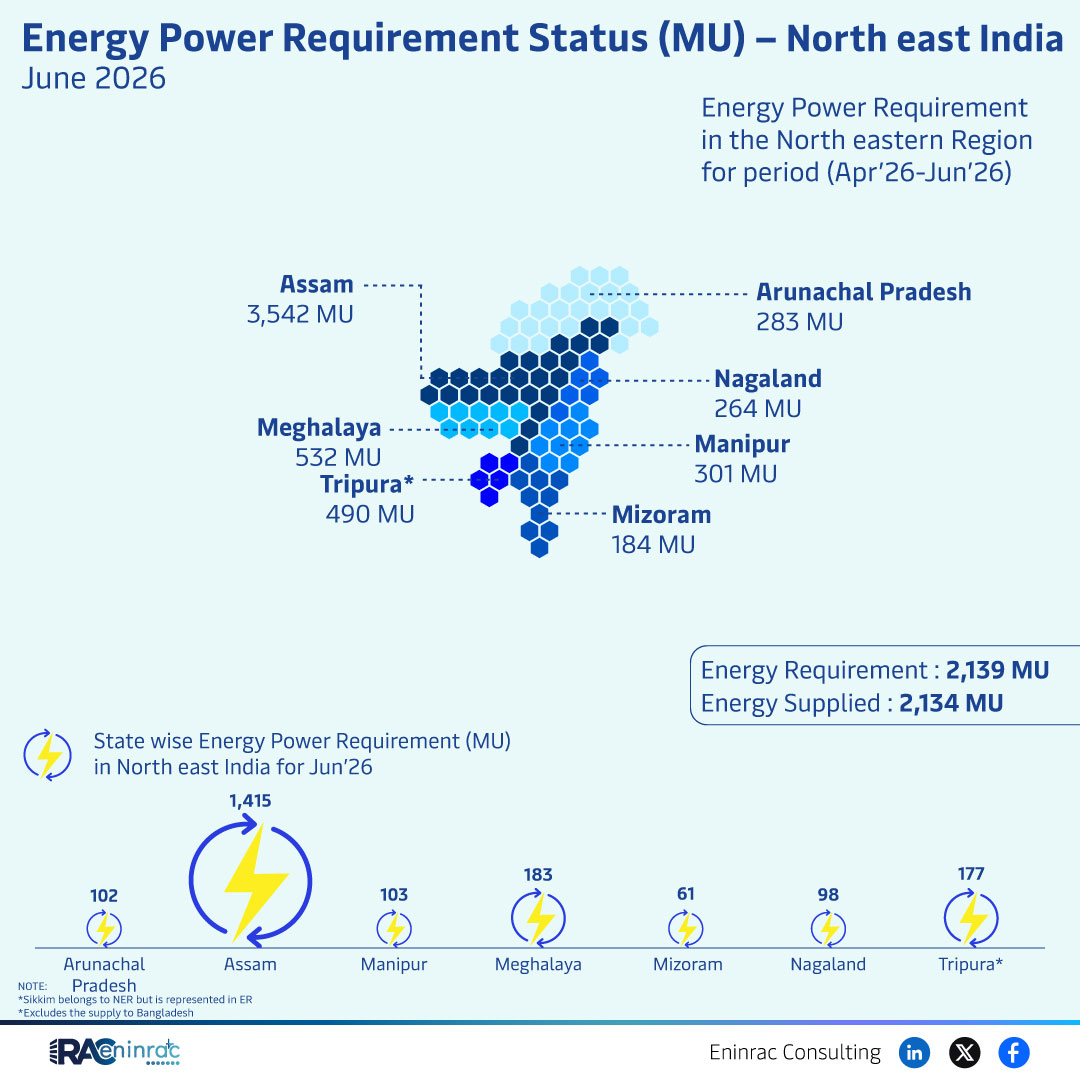
North East India’s power sector is under close observation as the region approaches a critical juncture in its energy planning for June 2026. The latest figures reveal a total energy requirement of 2,139 million units (MU) across the eight states, while the supply recorded stands at 2,134 MU, indicating a marginal shortfall. Understanding these numbers is essential for policymakers, investors, and businesses that depend on reliable electricity. This article interprets the state‑wise demand, compares it with the available supply, and outlines the broader implications for the region’s growth and sustainability.
What Does the Data Reveal About This Topic?
The data prompts a straightforward question: Does North East India have enough power to meet its demand in June 2026? The answer is nuanced. While the aggregate supply is only five MU less than the total requirement, the distribution of demand among states is uneven. Assam alone accounts for a demand of 3,542 MU, far exceeding the combined supply of the other states. Arunachal Pradesh, Manipur, Meghalaya, Mizoram, Nagaland, and Tripura together contribute the remaining demand, each with distinct shortfalls or surpluses that influence regional power stability.
State‑wise Energy Demand Comparison in June 2026
Breaking down the numbers offers deeper insight. Assam leads with a staggering 3,542 MU demand, reflecting its larger population and industrial activities. Arunachal Pradesh shows a requirement of 283 MU, while Manipur’s need stands at 490 MU. Meghalaya, though not clearly quantified in the snippet, is part of the overall demand pool. Mizoram requires 184 MU, Nagaland 264 MU, and Tripura 301 MU. When these figures are summed, they align closely with the reported total of 2,139 MU, confirming the accuracy of the source. The slight excess of demand over supply highlights the importance of targeted interventions, especially in high‑need states such as Assam and Manipur.
Impact on Sectors and Industries
The power shortfall, albeit modest in absolute terms, carries significant repercussions for key sectors. Manufacturing plants in Assam may face operational constraints, prompting a need for supplemental generation or demand‑side management. Rural electrification projects in Arunachal Pradesh and Nagaland could experience delays, affecting livelihoods and education. Renewable energy investors see an opportunity to close the gap, particularly in Meghalaya and Mizoram where hydro and solar potential remain untapped. Moreover, the marginal deficit underscores the urgency for grid strengthening and inter‑state transmission enhancements to balance supply across the region.
Key Takeaways
- North East India’s total energy requirement for June 2026 is 2,139 MU.
- Supplied power reaches 2,134 MU, leaving a five‑MU shortfall.
- Assam dominates demand with 3,542 MU, far above other states.
- Arunachal Pradesh, Manipur, and Tripura each show notable demand levels requiring attention.
- Renewable projects could bridge the supply gap, especially in Meghalaya and Mizoram.
- Improved transmission and regional coordination are essential to mitigate localized deficits.
FAQs
What is the overall power shortfall in North East India for June 2026?
The region faces a shortfall of five million units, with supply at 2,134 MU against a requirement of 2,139 MU.
Which state has the highest electricity demand?
Assam records the highest demand at 3,542 MU, driven by its large population and industrial base.
Can renewable energy help close the gap?
Yes, particularly hydro in Meghalaya and solar in Mizoram, which have untapped potential to supplement the deficit.
Why is state‑wise analysis important?
It reveals uneven demand distribution, allowing targeted policy measures and investment to address specific shortfalls.
What role does transmission play in balancing supply?
Enhanced inter‑state transmission can move surplus power from lower‑demand areas to high‑demand zones, improving reliability.