
Introduction
The North East India power requirement for August 2026 highlights the electricity needs of the seven northeastern states as they continue to develop infrastructure and industrial capacity. Understanding this demand is crucial for planners, investors, and policymakers who must ensure reliable supply, balance generation resources, and avoid shortfalls that could affect growth. This article examines the statewise figures, compares the demand to the limited supplied volume, and discusses the implications for the regional power sector. Stakeholders also use this snapshot to gauge the progress of renewable projects and identify areas where transmission upgrades are most needed.
What Does the Data Reveal About This Topic?
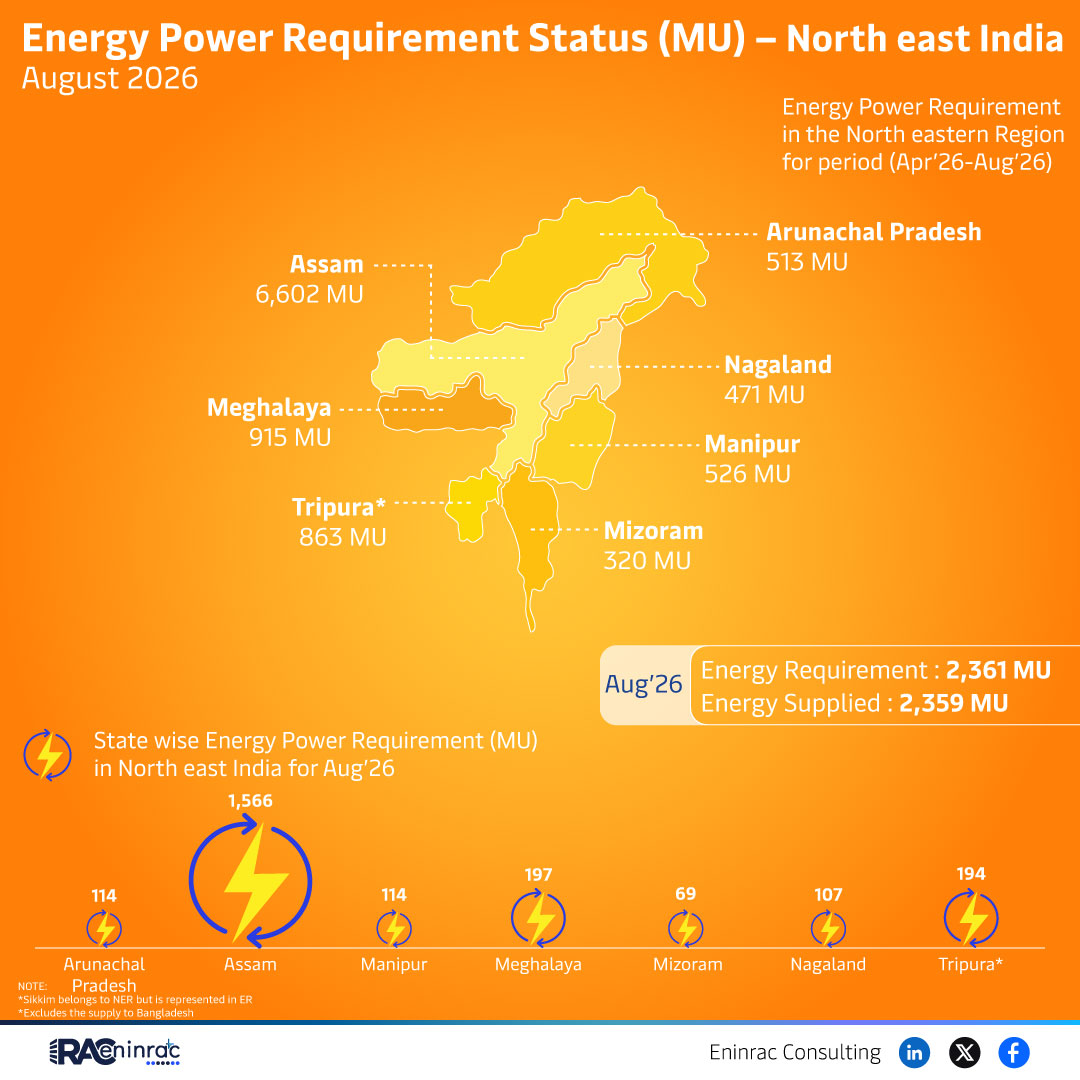
The data shows that the overall demand for the region stands at 2,361 MU while the supplied amount is 2,359 MU, leaving a marginal gap. Individually, Arunachal Pradesh records a requirement of 1,566 MU, Assam leads with 6,602 MU, Manipur reports 197 MU, Meghalaya 915 MU, Mizoram 194 MU, Nagaland 197 MU and Tripura 2,361 MU. The figures indicate that Assam’s requirement dominates the regional profile, while the supply almost matches the total demand, signaling a tightly balanced market. The near‑parity between demand and supply suggests that existing infrastructure is coping, yet the two‑unit deficit underscores the need for contingency planning.
Statewise Energy Demand Comparison
When the numbers are placed side by side, Assam’s 6,602 MU requirement dwarfs the needs of its neighbours, accounting for nearly 60 % of the total demand. Arunachal Pradesh follows with 1,566 MU, reflecting its growing settlement and industrial activity. Smaller states such as Manipur, Mizoram and Nagaland each stay below 200 MU, suggesting limited consumption that may be tied to lower population density and less industrialisation. Meghalaya’s 915 MU positions it in the mid‑range, while Tripura’s demand aligns closely with the overall regional total, indicating a balanced consumption pattern. The disparity also reflects differing levels of electrification, with higher figures in states that have more extensive grid coverage.
Impact on Sectors and Industries
The power requirement insights affect multiple sectors. Energy generators must plan capacity additions to meet Assam’s high demand, while transmission operators need to reinforce grid links to remote areas like Arunachal Pradesh. Industries in the region, particularly in manufacturing and tourism, rely on stable electricity to remain competitive. Policymakers can use the data to prioritise subsidies, renewable integration, and cross‑border power exchanges that could alleviate the slight supply deficit observed. Investors are watching these trends closely, as they signal potential opportunities for private generation and hybrid renewable‑diesel plants in high‑demand zones.
Key Takeaways
- Assam accounts for the majority of power demand in the northeast.
- Overall regional demand of 2,361 MU is nearly fully met by supply.
- Arunachal Pradesh shows significant growth with 1,566 MU required.
- Smaller states each demand under 1,000 MU, indicating lower consumption.
- The supply gap is minimal, highlighting efficient distribution.
- Future planning should focus on expanding capacity in high‑demand states.
FAQs
What is the total power requirement for North East India in August 2026?
The total requirement is 2,361 MU across all seven states.
Which state has the highest electricity demand?
Assam leads with 6,602 MU, the largest demand in the region.
Is the power supply sufficient to meet the demand?
Supply reaches 2,359 MU, leaving a very small gap of 2 MU.
How does Arunachal Pradesh’s demand compare to others?
Arunachal Pradesh requires 1,566 MU, positioning it as the second‑largest consumer.
What are the implications of the slight supply shortfall?
The minor shortfall calls for targeted capacity upgrades to ensure uninterrupted service.