
Introduction
The March 2026 report on electricity consumption by electric vehicle public charging stations (EVPCS) across the North region of India provides a detailed view of how megawatt‑hours (MU) are being utilized for EV charging and heavy‑duty applications. This data set captures state‑level consumption for Delhi, Haryana, Punjab, Rajasthan, Uttar Jammu Kashmir, and Ladakh, as well as the contribution of major distribution companies such as BRPL, BYPL, NDMC, Tata Power, DHBVN and others. Understanding this consumption pattern is essential for policymakers, utilities, investors and EV users who are looking to gauge the growth of electric mobility infrastructure and its impact on the regional power grid.
What Does the Data Reveal About This Topic?
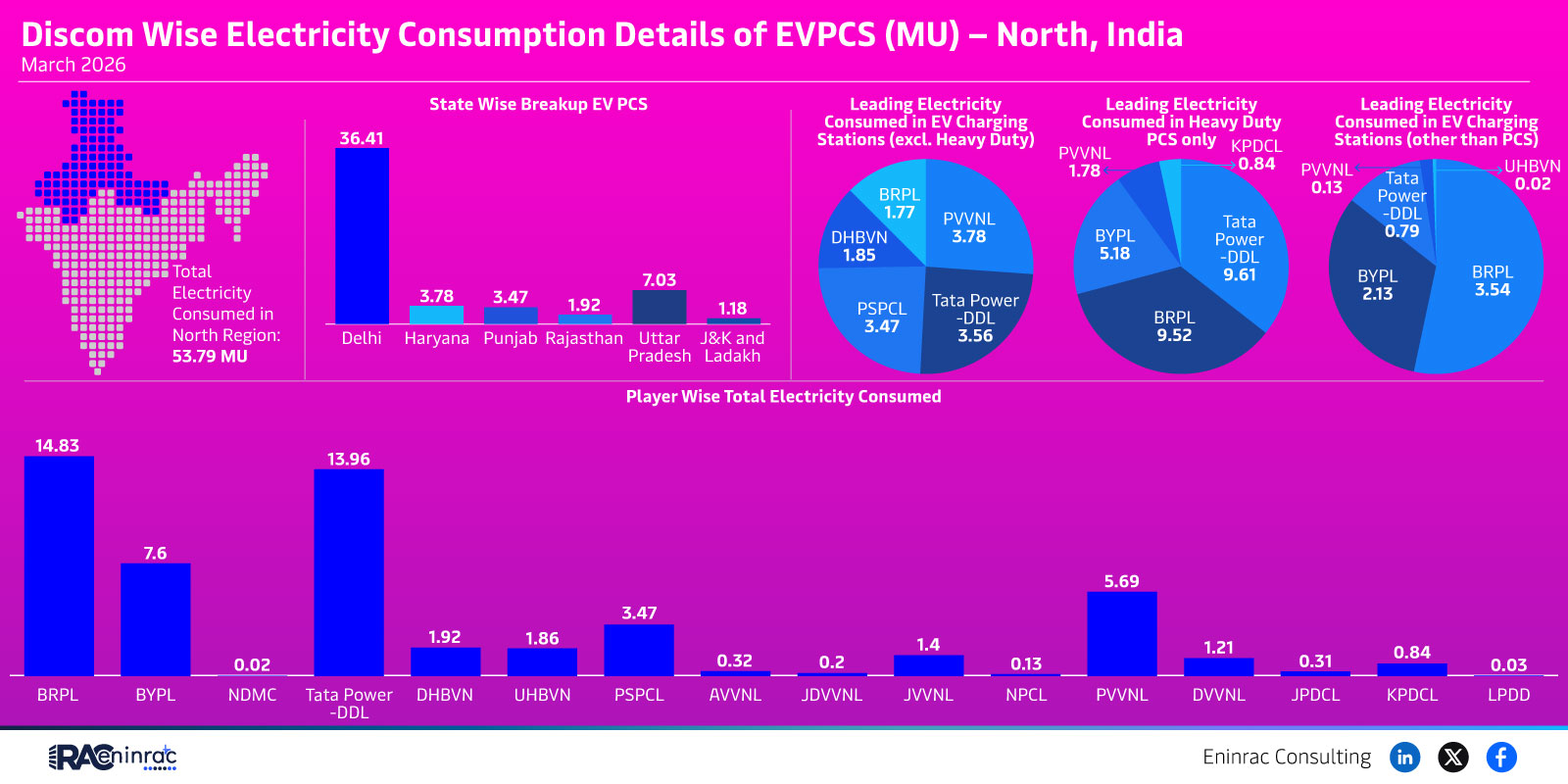
The assembled figures indicate that the North region consumed a total of 53.79 MU in EV charging during March 2026, with a notable share coming from dedicated EV charging stations that exclude heavy‑duty loads. The leading states, including Delhi and Haryana, together account for a sizable portion of this demand, while the distribution companies listed contribute varying levels of electricity, the highest being 14.83 MU from BRPL. The data therefore shows a clear concentration of EV charging electricity consumption in the more urbanised and industrialised northern states and highlights the role of specific discoms in supporting the EV ecosystem.
State and Discom Performance in EV Charging Consumption
When the numbers are broken down by state, Delhi emerges as a primary consumer, followed closely by Haryana and Punjab. Rajasthan and the Union Territories of Jammu and Kashmir and Ladakh register lower but still significant usage, reflecting the expanding reach of public charging infrastructure into less densely populated areas. On the discom side, BRPL leads with 14.83 MU, while BYPL and NDMC follow with 13.96 MU and 3.47 MU respectively. Smaller players such as AVVNL, JDVVNL and others contribute fractions of a megawatt unit, indicating a diversified supply landscape where larger utilities dominate the EV charging market.
Impact on Sectors and Industries
The rising demand for electricity in EV charging stations influences several key sectors. Utility companies must plan capacity upgrades, grid reinforcement and renewable integration to meet peak loads without compromising reliability. Automotive manufacturers and EV service providers benefit from clearer visibility into charging demand, guiding station placement and service pricing. Investors see emerging opportunities in ancillary services such as battery management, smart charging software and renewable power purchase agreements. Policymakers can use this data to shape incentives, set emission targets and develop standards that align EV growth with broader energy transition goals.
Key Takeaways
- North India consumed 53.79 MU for EV charging in March 2026.
- Delhi and Haryana are the top state consumers of EV charging electricity.
- BRPL supplies the highest amount of electricity to EV charging stations at 14.83 MU.
- Heavy‑duty EV charging accounts for a smaller share of total consumption.
- Distribution company contributions vary widely, indicating a mixed supply ecosystem.
- Growth in EV charging demand impacts grid planning, renewable integration and investment strategies.
FAQs
What was the total EV charging electricity consumption in North India for March 2026?
The region consumed 53.79 megawatt‑hours (MU) of electricity for EV charging during that month.
Which state recorded the highest EV charging electricity usage?
Delhi recorded the highest usage, followed closely by Haryana.
Which distribution company provided the most electricity to EV charging stations?
BRPL led the list with 14.83 MU supplied to EV charging infrastructure.
How does heavy‑duty EV charging compare to regular EV charging?
Heavy‑duty EV charging represents a smaller portion of total consumption, with most electricity allocated to standard public charging stations.
Why is this consumption data important for policymakers?
It helps shape grid investment decisions, renewable integration plans, and incentive programs to support sustainable electric mobility growth.