
Introduction
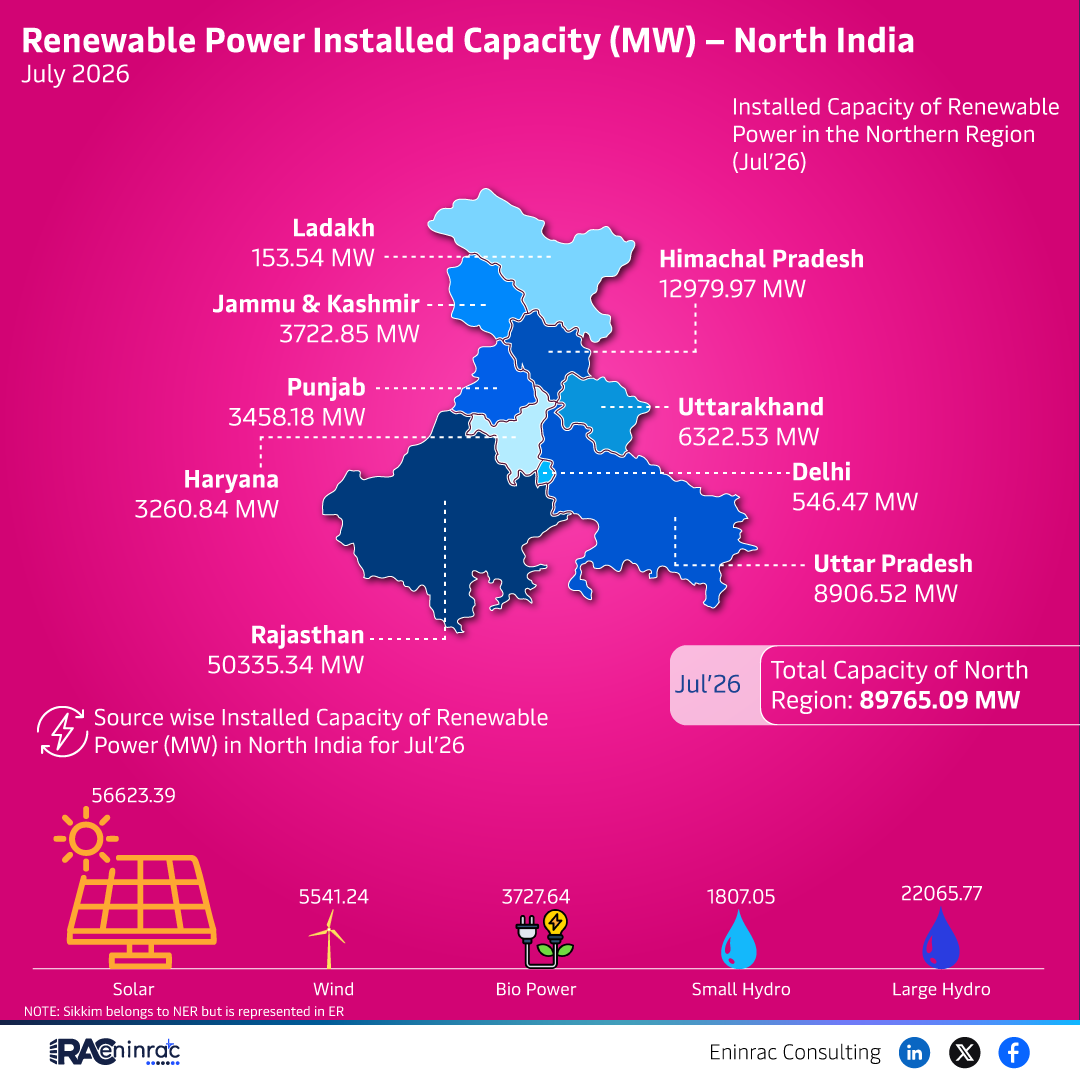
North India’s renewable power landscape reached a new milestone in July 2026, with a total installed capacity of 56,623.39 megawatts (MW). This figure reflects the combined output of solar, wind, bio‑power, small hydro and large hydro projects across the region’s key states. The growth is driven by aggressive state‑level targets, central government incentives and a falling cost curve for clean‑energy technologies. Understanding how this capacity is distributed helps investors, policymakers and industry analysts gauge the pace of clean‑energy adoption, identify growth hotspots and plan future investments. The data below breaks down state‑wise contributions, source‑wise shares and the broader implications for the northern power market, offering a snapshot of where the clean‑energy transition is most pronounced.
What Does the Data Reveal About This Topic?
What does the data reveal about renewable power growth in North India? The answer is that Rajasthan dominates the region, contributing more than 50,335 MW—roughly 89 % of the total installed capacity. By contrast, smaller states such as Ladakh and Himachal Pradesh add only 153 MW and 3,723 MW respectively, highlighting a stark concentration of installations in the desert and plains zones. Solar accounts for about 5,540 MW and wind roughly 3,730 MW, together supplying nearly 17 % of the installed base, while hydro and bio‑power fill the remaining share. This composition shows that non‑hydro renewables are accelerating faster than traditional hydro projects, aligning with national goals to increase the renewable share to 40 % of overall generation by 2030.
Statewise Capacity Comparison in North India
Rajasthan’s 50,335 MW dwarfs the next largest state, Uttar Pradesh, which stands at 8,906 MW, accounting for about 16 % of the northern total. Haryana follows with 3,260 MW, while Uttarakhand contributes 6,322 MW, showing a stronger hydro‑friendly profile due to its mountainous terrain and multiple small‑hydro schemes. Jammu & Kashmir’s reported figure is ambiguous in the source, but the region traditionally relies on small hydro and emerging solar farms that are expected to rise as grid connectivity improves. Ladakh’s modest 154 MW reflects early‑stage projects in a high‑altitude environment, whereas Himachal Pradesh’s 3,723 MW is primarily hydro‑driven, reinforcing its reputation as a green‑energy corridor. The aggregate of solar (≈5,540 MW) and wind (≈3,730 MW) indicates that non‑hydro renewables are still a secondary share, yet they are the fastest‑growing segments in the north, with solar installations expanding by an estimated 12 % year‑on‑year.
Impact on Sectors and Industries
The surge in installed renewable capacity reshapes several sectors. Utilities in North India must integrate increasing solar and wind outputs into the grid, prompting upgrades in transmission lines, smart‑grid controls and storage infrastructure such as battery farms. Investors see Rajasthan’s scale as a signal for large‑scale solar‑park financing, while hydro‑rich states like Uttarakhand attract interest for pumped‑storage projects that can balance intermittent generation. Manufacturers of photovoltaic modules, wind turbine components and bio‑power equipment benefit from rising demand across the region, creating jobs and stimulating local supply chains. Policymakers can leverage the detailed statewise data to fine‑tune incentive schemes, land‑allocation policies and grid‑access rules, advancing India’s commitment to a low‑carbon economy. The increased renewable footprint also contributes to India's climate targets, reducing emissions by an estimated 25 million tonnes of CO₂ annually. It improves energy security by diversifying supply away from fossil fuels.
Key Takeaways
- Rajasthan alone supplies roughly 89 % of North India’s renewable capacity.
- Solar and wind together represent about 17 % of total installed capacity.
- Hydro power remains dominant in Uttarakhand and Himachal Pradesh.
- Statewise data highlights concentration of projects in desert and plain regions.
- Renewable growth supports India’s 2030 climate and energy‑security goals.
- Investors eye large‑scale solar parks and pumped‑storage projects for future expansion.
FAQs
Which state leads renewable power capacity in North India?
Rajasthan leads with over 50,335 MW, accounting for about 89 % of the region’s total.
How much solar capacity is installed in North India?
Approximately 5,540 MW of solar capacity is installed across the northern states.
What is the role of hydro power in Uttarakhand?
Uttarakhand contributes about 6,322 MW, primarily from hydro projects leveraging its mountainous terrain.
Are renewable installations growing year on year?
Yes, solar installations are growing at an estimated 12 % annually, making non‑hydro renewables the fastest‑growing segment.
How does this capacity boost India’s climate targets?
The increased renewable footprint helps reduce CO₂ emissions by roughly 25 million tonnes annually and supports the goal of 40 % renewable electricity by 2030.