
Introduction
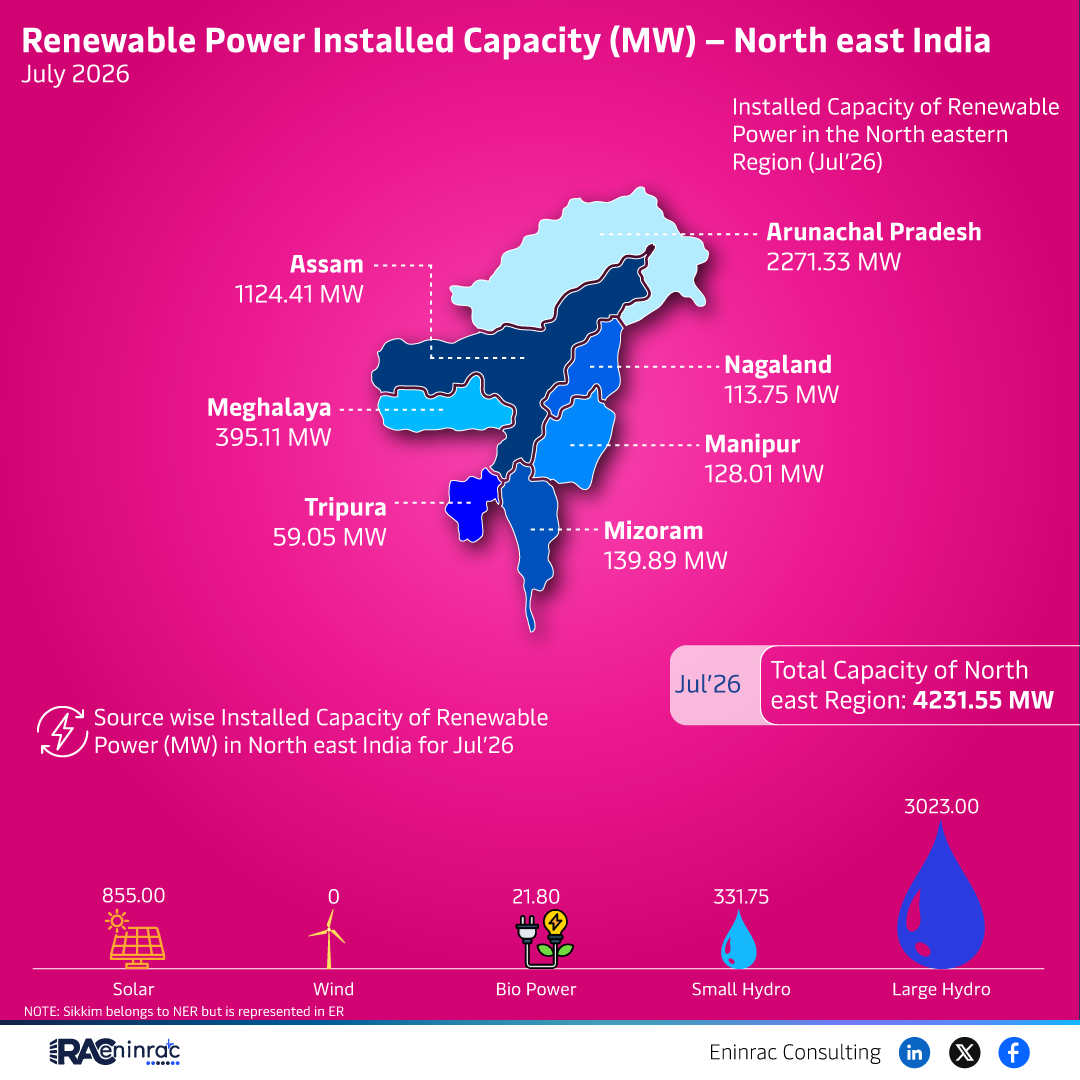
The renewable power installed capacity in North East India as of July 2026 provides a clear snapshot of how the region is advancing its clean energy agenda. With a combined capacity of over 3,000 MW, the eight states contribute through solar, wind, bio‑power, small hydro and large hydro projects. Understanding this data helps investors, policymakers and citizens see where growth is strongest, which technologies dominate, and how the energy mix supports regional development and national climate targets. The dataset also highlights the varying contributions of each state, offering insights into regional disparities and opportunities for future expansion.
What Does the Data Reveal About This Topic?
The July 2026 figures reveal that Assam dominates the renewable landscape with 2,271 MW, accounting for roughly three‑quarters of the total installed capacity. Meghalaya follows with 395 MW, while smaller states such as Manipur and Tripura contribute under 130 MW each. Solar accounts for the largest share at 3,023 MW, wind adds 855 MW, and bio‑power, small hydro and large hydro together provide the remaining capacity.
State‑wise Renewable Power Mix in North East India
A closer look at the state‑wise breakdown shows stark contrasts. Assam’s 2,271 MW is driven primarily by solar farms, supplemented by wind and hydro installations. Meghalaya’s 395 MW stems from a blend of small hydro and solar projects, reflecting its hilly terrain. Arunachal Pradesh contributes 1,124 MW, a mix of large hydro and emerging solar capacity. Nagaland’s modest 113.75 MW is largely bio‑power, whereas Manipur’s 128 MW and Tripura’s 59 MW rely heavily on small hydro. Mizoram’s 139.89 MW combines solar and wind, indicating a diversified approach across the region.
Impact on Sectors and Industries
The expanding renewable power installed capacity reshapes several sectors. Power generation companies gain new project pipelines, while transmission operators must upgrade grids to accommodate intermittent sources. Investors see clearer returns in solar and wind, especially in high‑potential states like Assam. Policymakers can leverage the data to design state‑specific incentives, and local industries benefit from reduced electricity costs and greener supply chains. Consumers experience increased reliability and lower carbon footprints as the region moves toward a sustainable energy future.
Key Takeaways
- Assam leads with 2,271 MW, about 75% of total capacity.
- Solar power provides the largest share at 3,023 MW.
- Wind contributes 855 MW, highlighting growing wind potential.
- Bio‑power, small hydro and large hydro fill the remaining capacity.
- North East India's total renewable capacity exceeds 3,000 MW.
- State‑wise disparities point to targeted growth opportunities.
FAQs
Which state has the highest renewable power capacity in North East India?
Assam tops the list with 2,271 MW of installed renewable capacity as of July 2026.
What is the total renewable power installed capacity for the region?
The combined installed capacity across all eight states reaches approximately 3,023 MW.
How much solar capacity is installed in North East India?
Solar installations account for about 3,023 MW, making it the dominant renewable source.
What share does wind energy hold in the region’s renewable mix?
Wind energy contributes roughly 855 MW to the overall renewable capacity.
Are there any significant bio‑power or hydro projects?
Yes, bio‑power, small hydro and large hydro together provide the remaining capacity beyond solar and wind, supporting a balanced energy mix.