
Introduction
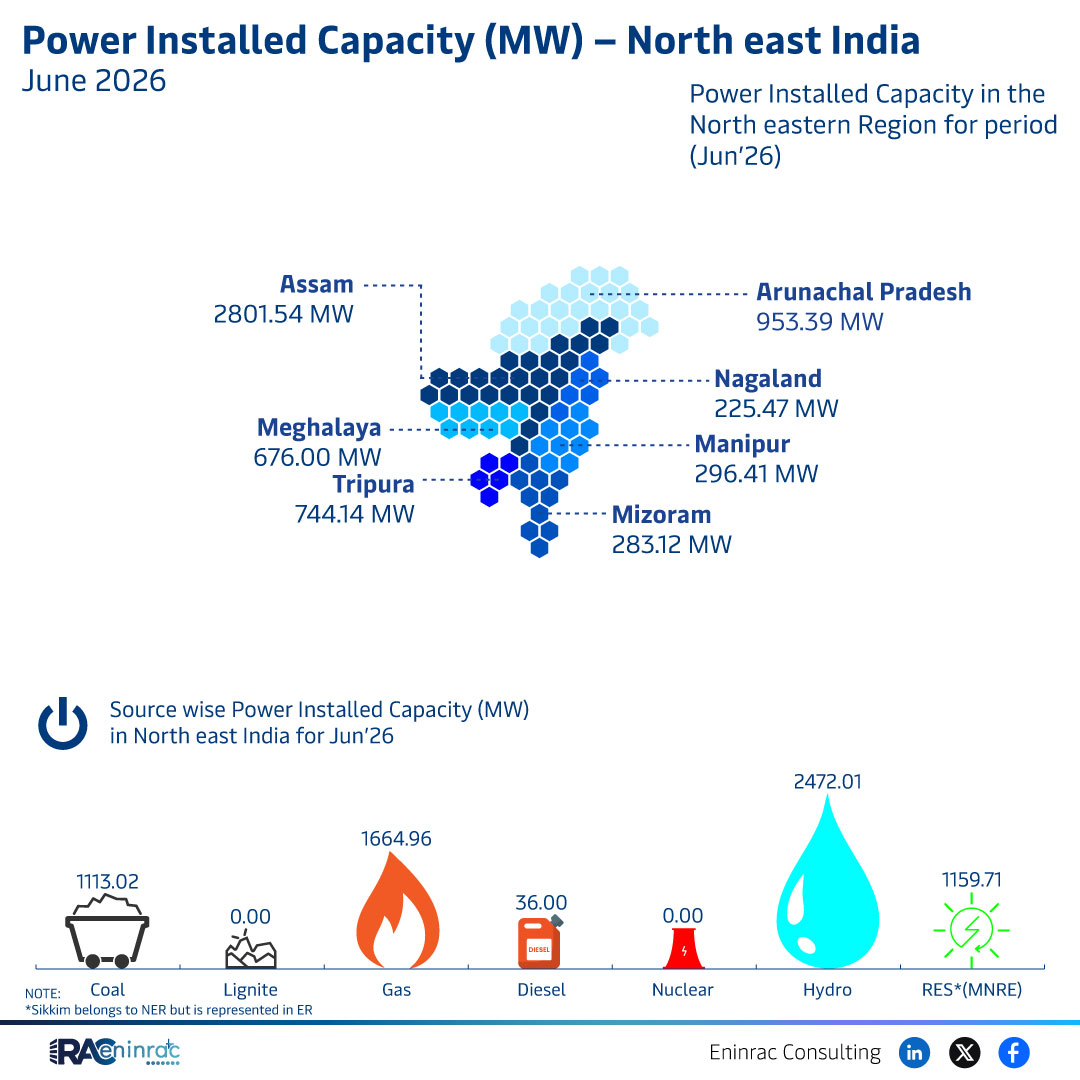
The June 2026 snapshot of power installed capacity in Northeast India provides a clear picture of how each state contributes to the region’s electricity landscape. Assam dominates with more than 2,800 MW, while Arunachal Pradesh supplies close to 950 MW. Smaller states such as Nagaland, Meghalaya, Tripura and Mizoram each hold between 200 MW and 700 MW. Understanding these figures is essential for policymakers, investors, and energy planners who need to balance demand, grid stability, and renewable integration across a geographically diverse area. This article analyses the data, highlights key trends, and discusses implications for the broader power sector.
What Does the Data Reveal About This Topic?
The data shows a pronounced concentration of installed capacity in Assam, accounting for nearly 40% of the total regional figure, while the remaining states contribute modestly. This disparity prompts the question: why does Assam hold such a large share and how can the other states close the gap? The answer lies in a mix of historical hydro projects, larger population centers, and greater transmission infrastructure that have enabled higher development in Assam compared with its neighbours.
State‑wise Capacity Comparison and Trends
When comparing the states, Assam’s 2,801.54 MW stands out against Arunachal Pradesh’s 953.39 MW, indicating a nearly three‑fold difference. Meghalaya’s reported 676 MW and Tripura’s 296.41 MW illustrate moderate growth, whereas Nagaland (225.47 MW) and Mizoram (283.12 MW) remain at lower levels. The trend suggests that states with more pronounced river systems and existing hydro schemes have expanded capacity faster, while those with limited infrastructure lag behind. Over the past few years, incremental additions in Arunachal Pradesh and Meghalaya hint at a gradual shift toward exploiting untapped hydro potential.
Impact on Sectors and Industries
The distribution of installed capacity directly influences industrial development, investment attractiveness, and energy security in the region. Higher capacity in Assam supports larger manufacturing hubs and reduces reliance on imported power, whereas the lower figures in Nagaland and Mizoram may constrain industrial expansion and increase dependence on external grids. For renewable energy developers, the data highlights opportunities in under‑served states where new hydro, solar, or wind projects could fill capacity gaps and promote sustainable growth. Policymakers can use these insights to prioritize transmission upgrades and incentivize balanced regional development.
Key Takeaways
- Assam leads with 2,801.54 MW, representing the largest share of Northeast India power installed capacity.
- Arunachal Pradesh is the second‑largest contributor with 953.39 MW.
- Smaller states such as Nagaland, Meghalaya, Tripura and Mizoram each hold under 700 MW, highlighting regional imbalances.
- Hydro potential drives capacity growth in states with abundant water resources.
- Investors may find opportunities in under‑served states to develop new renewable projects.
- Targeted policy and transmission investments are needed to equalize power access across the region.
FAQs
Which state has the highest power installed capacity in June 2026?
Assam, with approximately 2,801.54 MW.
How does Arunachal Pradesh compare to other states?
It ranks second with about 953.39 MW, far above Nagaland and Mizoram but below Assam.
What are the main sources of power in Northeast India?
Hydropower dominates, supplemented by thermal and emerging renewable sources such as solar.
Why is the capacity in Nagaland relatively low?
Limited hydro resources, less developed transmission infrastructure, and lower industrial demand contribute to its modest figure.
What opportunities exist for investors?
Developing new hydro, solar, or wind projects in under‑served states offers growth potential and helps balance regional capacity.