
Introduction
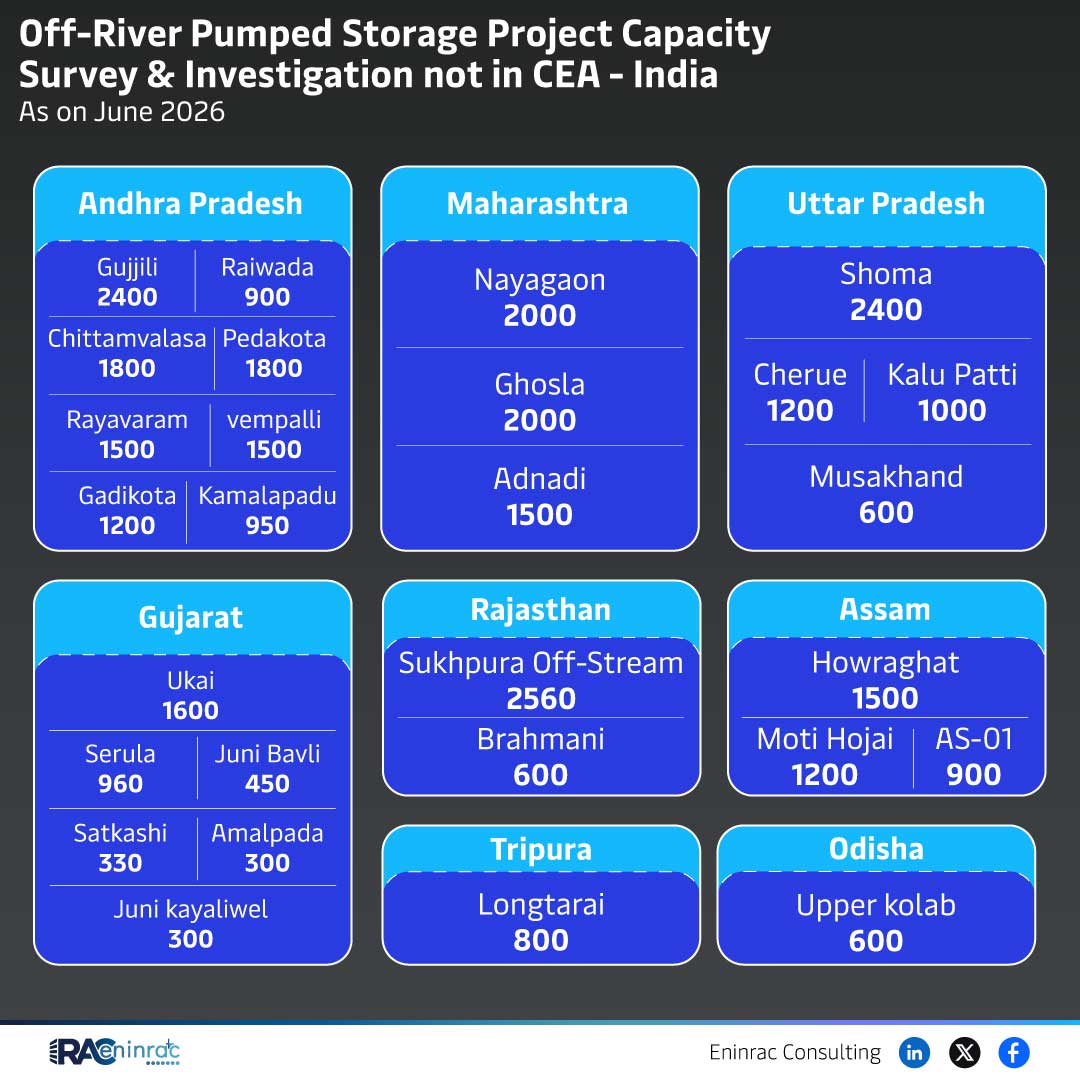
In June 2026 a comprehensive survey of off‑river pumped storage projects across India was compiled, revealing the installed capacity of individual sites and the aggregate potential in each state. Pumped storage, a mature technology that stores excess electricity by moving water between reservoirs, is increasingly recognised as a vital partner to intermittent renewable sources such as wind and solar. The dataset lists capacities for projects in Andhra Pradesh, Maharashtra, Uttar Pradesh, Gujarat, Rajasthan, Assam and several smaller sites in Odisha and Karnataka. By examining these numbers readers can understand where the largest reservoirs are located, how capacity is distributed regionally, and what this means for future energy planning.
What Does the Data Reveal About This Topic?
What does the June 2026 data tell us about off‑river pumped storage capacity in India? The figures show that Gujarat leads with 2,560 MW of reported capacity, followed closely by Andhra Pradesh at 2,400 MW and Uttar Pradesh at 2,000 MW. Maharashtra records a modest 900 MW, while Rajasthan and Assam each report around 1,500 MW. Smaller projects in Odisha, Karnataka and other states contribute additional capacities ranging from 300 MW to 1,200 MW. Overall the dataset highlights a clear concentration of large‑scale pumped storage in western and central states, suggesting regional priorities for grid balancing and renewable integration.
Regional Capacity Comparison Across Indian States
The comparative interpretation of the raw numbers underscores several trends. Gujarat’s 2,560 MW outpaces the next highest capacity by more than 1,000 MW, reflecting aggressive state‑level investment and favourable topography for off‑river schemes. Andhra Pradesh’s 2,400 MW and Uttar Pradesh’s 2,000 MW together account for a substantial share of total capacity, indicating that both southern and northern regions are positioning pumped storage as a cornerstone for energy security. Maharashtra’s 900 MW and Rajasthan’s 1,500 MW illustrate moderate development, while Assam’s 1,500 MW signals the northeast’s growing interest despite challenging terrain. The smaller sites—such as the 300 MW project in Upper Kolab (Odisha) and the 800 MW facility in Sukhpura—demonstrate that even states with limited water resources are exploring off‑river options.
Impact on Energy Generation and Grid Stability
Off‑river pumped storage directly supports renewable energy generation by providing fast‑response dispatchable power that can offset the variability of wind and solar farms. The large capacities identified in Gujarat and Andhra Pradesh enable utilities to store surplus generation during peak solar hours and release it during evening demand spikes, thereby flattening load curves. For grid operators, the geographic spread of projects reduces transmission congestion and enhances regional reliability. Investors view the sizable capacities as a signal of long‑term policy commitment, encouraging further financing of storage‑linked renewable projects. Policymakers can leverage this data to target subsidies, streamline permitting, and align pumped storage expansion with national clean‑energy targets.
Key Takeaways
- Gujarat holds the highest off‑river pumped storage capacity at 2,560 MW.
- Andhra Pradesh and Uttar Pradesh rank second and third with 2,400 MW and 2,000 MW respectively.
- Capacity is concentrated in western and central states, reflecting strategic grid‑balancing priorities.
- Smaller projects in Odisha, Karnataka and other regions demonstrate nationwide interest.
- Pumped storage enhances renewable integration by providing fast, dispatchable power.
- Data supports targeted policy measures and investment incentives for storage expansion.
FAQs
What is off‑river pumped storage?
Off‑river pumped storage uses man‑made reservoirs located away from natural rivers to store energy by moving water between elevation levels.
Why is pumped storage important for renewable energy?
It supplies quick‑response power that balances the intermittency of wind and solar, improving grid reliability.
Which Indian state has the largest pumped storage capacity?
Gujarat leads with an estimated 2,560 MW of off‑river pumped storage capacity as of June 2026.
How does pumped storage affect electricity prices?
By storing cheap surplus power and releasing it during peak demand, pumped storage helps lower overall electricity market prices.
Are there plans to increase pumped storage in India?
Yes, government reports and state‑level initiatives indicate ongoing projects that will expand capacity beyond the 2026 baseline.