
Introduction
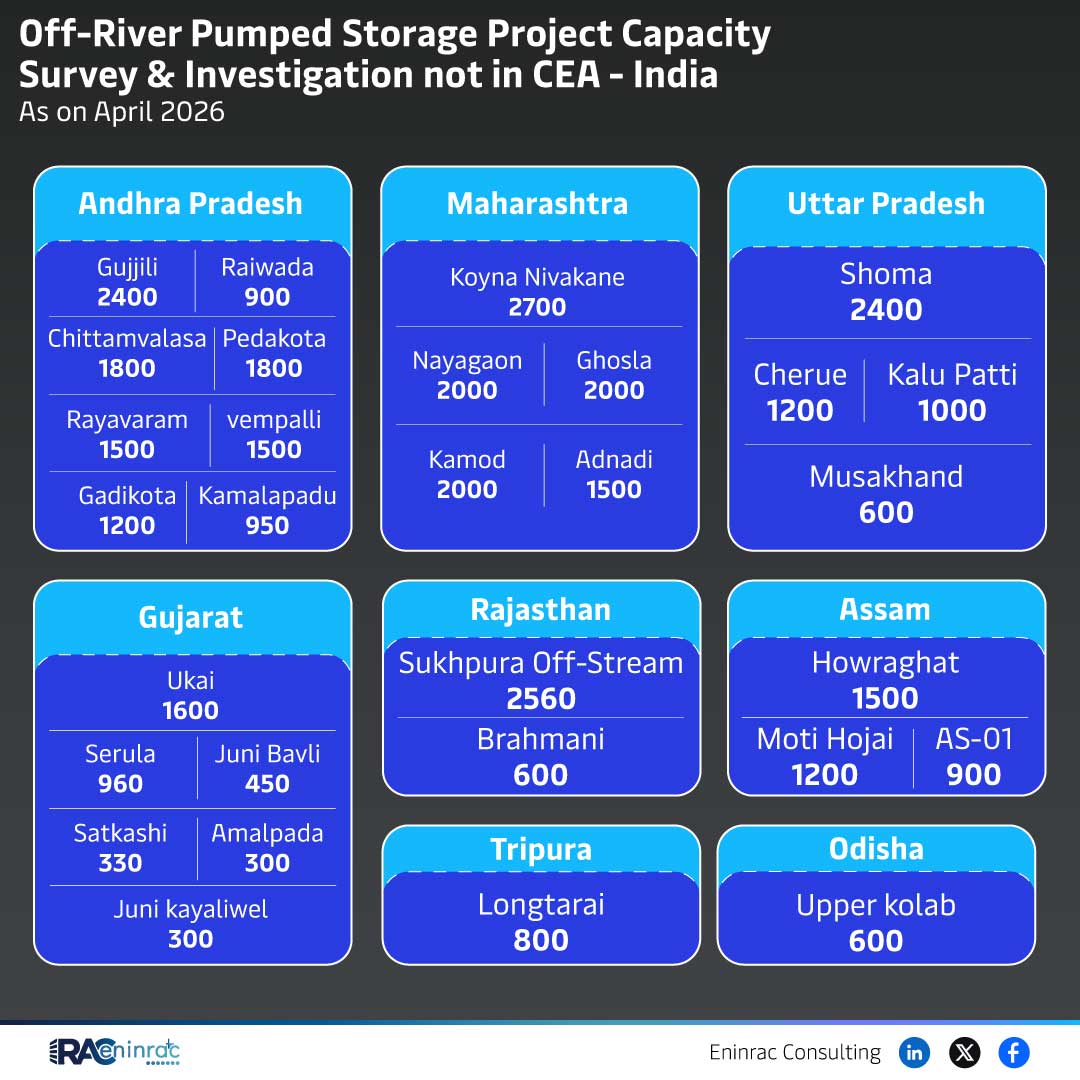
The off‑river pumped storage landscape in India is evolving rapidly as states explore flexible, large‑scale energy solutions. Data compiled up to April 2026 shows the planned or operational capacities of several projects across Andhra Pradesh, Maharashtra, Gujarat, Odisha and other regions. Understanding these capacities helps investors, policymakers and energy analysts gauge the role of pumped storage in balancing renewable generation and enhancing grid stability.
What Does the Data Reveal About This Topic?
Which states host the highest off‑river pumped storage capacities and how do their project sizes compare? The data indicates that Maharashtra and Gujarat lead with projects exceeding 2,500 MW, while smaller initiatives of 1,000‑1,200 MW are visible in Andhra Pradesh and Odisha. This distribution reflects regional water resource availability, existing hydro infrastructure and state‑level renewable targets.
Regional Capacity Comparison and Trends
A closer look shows Maharashtra’s projects such as Koyna and Nivakane collectively approaching 2,700 MW, while Gujarat’s off‑stream initiatives total around 2,560 MW. Andhra Pradesh presents a mix of mid‑size projects ranging from 1,200 MW to 1,800 MW, illustrating a balanced approach between new construction and upgrades of existing sites. Odisha’s entries, including Upper Kolab, are modest at about 950 MW, suggesting early‑stage development. Overall, the trend points toward larger, multi‑hundred megawatt installations in water‑rich states, with smaller but strategically placed projects in emerging markets.
Impact on Sectors and Industries
Off‑river pumped storage directly supports the renewable energy sector by providing rapid response storage that can absorb excess solar and wind output. It also benefits the transmission network by reducing peak load stress and deferring costly upgrades. Investors gain a clearer risk profile as pumped storage projects often receive long‑term power purchase agreements. Policymakers can leverage these capacities to meet national clean‑energy commitments while ensuring reliable supply for industrial consumers.
Key Takeaways
- Maharashtra and Gujarat dominate with the largest planned capacities, each exceeding 2,500 MW.
- Andhra Pradesh hosts several mid‑size projects, highlighting a diversified state strategy.
- Odisha’s smaller projects indicate early adoption and potential for future expansion.
- Off‑river pumped storage enhances grid flexibility, crucial for integrating variable renewable sources.
- Investors view these projects as low‑risk assets due to long‑term contracts and proven technology.
- State‑level policies and water resource management are key drivers of project location decisions.
FAQs
What is off‑river pumped storage?
It is a type of hydroelectric storage where water is pumped to an upper reservoir during low demand and released to generate power during peak demand, without relying on a natural river flow.
Why are Maharashtra and Gujarat leading in capacity?
Both states have abundant water resources, existing hydro infrastructure and strong renewable energy targets, making them ideal for large‑scale pumped storage.
How does pumped storage support renewable integration?
It stores excess solar or wind energy and releases it quickly, smoothing fluctuations and reducing curtailment.
Are these projects already operational?
Some projects are under construction or in advanced planning stages; a few have reached commissioning, while others are still in survey and investigation phases.
What are the main challenges for off‑river pumped storage?
Key challenges include high upfront capital costs, environmental clearances, and the need for suitable topography and water availability.