
Introduction
India is rapidly expanding its off‑river pumped storage capacity to meet growing energy demand and support renewable integration. As of April 2026, several large‑scale projects are under construction, each contributing significant megawatt (MW) capacity. This article examines the current status, compares project sizes, and explains why these developments matter for the power sector.
What Does the Data Reveal About This Topic?
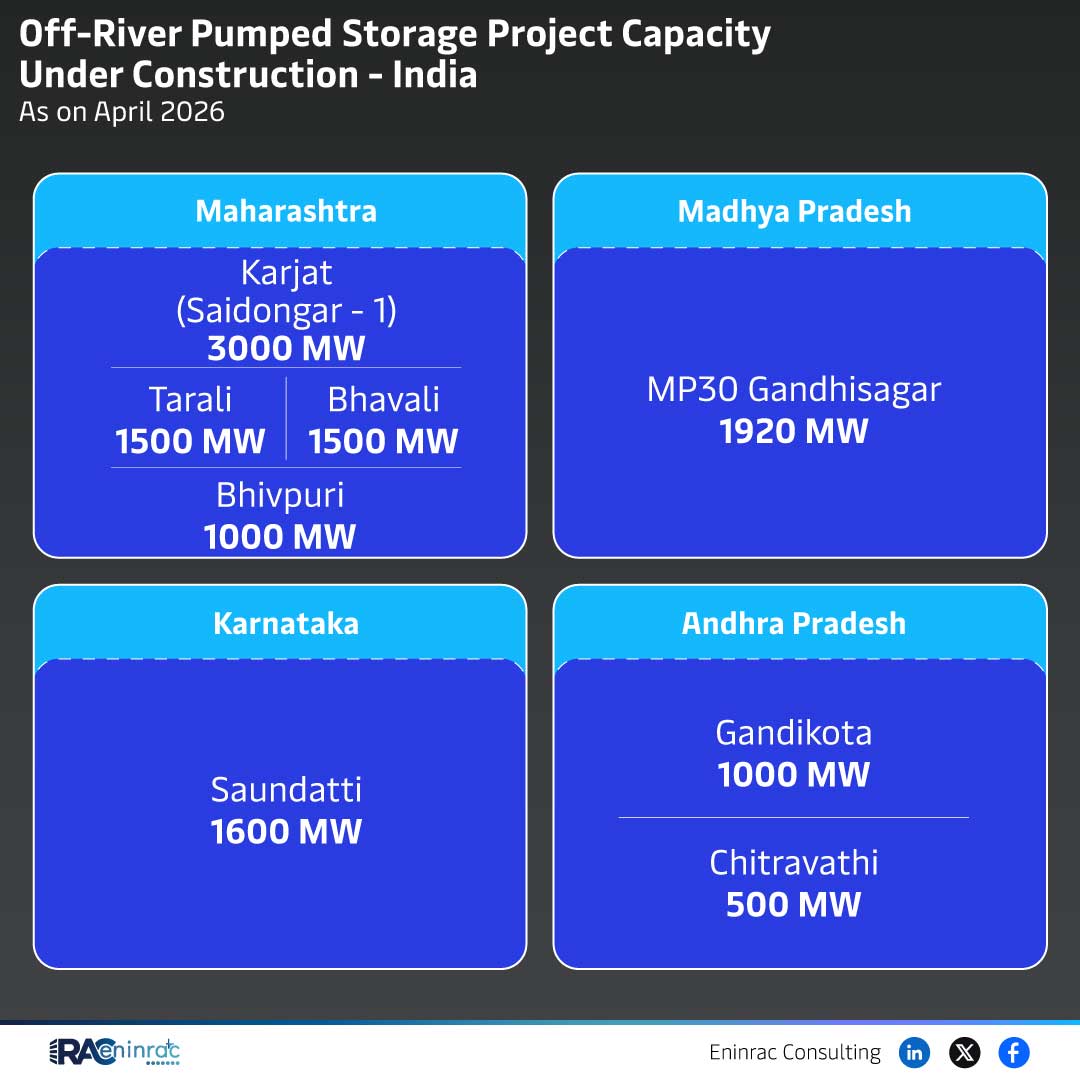
The raw data shows a total of six projects with a combined capacity of 7,020 MW. The largest single project, Gandikota, offers 1,600 MW, while the smallest, Chitravathi, provides 500 MW. The data highlights a clear trend toward multi‑hundred megawatt installations, indicating strong policy support and investor confidence in off‑river pumped storage as a flexible, large‑scale energy storage solution.
Comparative Capacity Analysis of Ongoing Projects
When the capacities are compared, Gandikota leads with 1,600 MW, followed by Saundatti (1,000 MW) and the joint Bhavali‑MP30‑Gandhisagar complex at 1,920 MW. The remaining projects—Saidongar‑1 (800 MW), G (1,000 MW), and Chitravathi (500 MW)—still represent substantial contributions. This distribution shows a balanced approach across regions, reducing reliance on a single site and enhancing grid stability nationwide.
Impact on Sectors and Industries
Off‑river pumped storage directly influences the generation sector by providing fast‑response balancing services, enabling higher penetration of solar and wind power. Transmission networks benefit from smoother load curves, while distribution companies experience fewer peak‑demand spikes. Investors see lower risk profiles due to long‑term power purchase agreements, and policymakers gain a reliable tool to meet climate targets without compromising reliability.
Key Takeaways
- India’s off‑river pumped storage under construction totals 7,020 MW.
- Gandikota is the largest project at 1,600 MW, setting a new benchmark.
- Projects are geographically diversified, enhancing grid resilience.
- Capacity additions support renewable integration and reduce curtailment.
- Large‑scale storage improves financial viability for solar and wind farms.
- Policy momentum suggests further projects will emerge beyond 2026.
FAQs
What is off‑river pumped storage?
It is a type of hydroelectric storage where water is pumped to an upper reservoir during low demand and released to generate power during peak demand, without relying on natural river flow.
Why is India focusing on off‑river projects?
Off‑river sites avoid ecological impacts on river ecosystems, allow placement near load centers, and provide greater flexibility in site selection.
How does pumped storage help renewable energy?
It stores excess solar or wind generation and releases it when production falls, smoothing variability and reducing curtailment.
What are the expected completion dates?
Most projects aim for commercial operation between 2027 and 2030, aligning with India’s 2030 renewable capacity goals.
Will these projects create jobs?
Yes, construction, operation, and maintenance phases generate thousands of skilled and unskilled jobs across the regions.