
Introduction
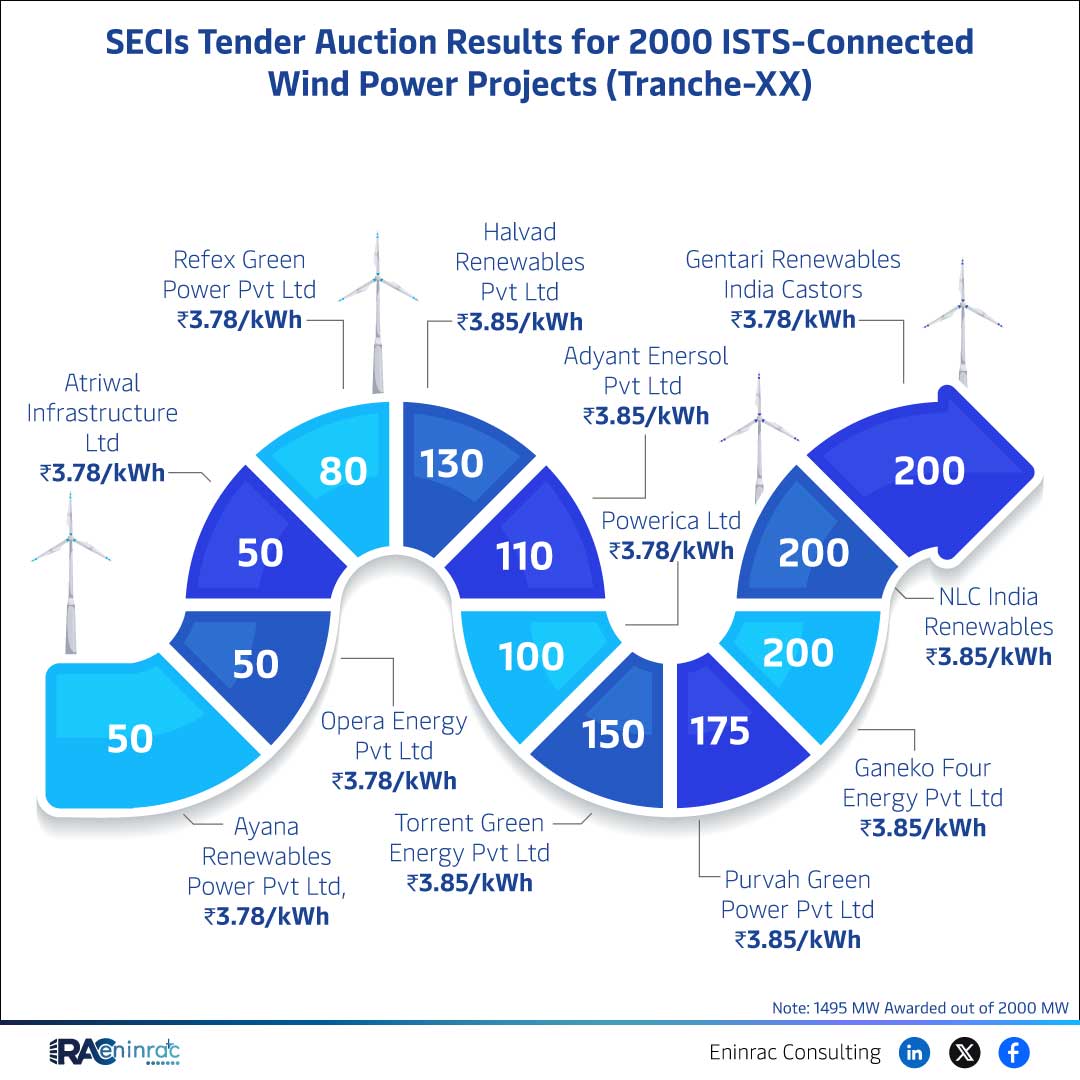
The SECIs tender auction for 2000 MW of ISTS‑connected wind power projects in the Halvad region was announced in early 2024. A total of 1495 MW was awarded to a mix of established renewable developers and new market entrants. Companies such as Refex Green Renewables, Gentari Renewables, Power Pvt Ltd, and NLC India received bids ranging from 23.78 kWh to 23.85 kWh. The auction highlights the growing competition in India’s wind sector and the strategic importance of the Halvad corridor for clean energy expansion. Understanding these results helps investors, policymakers, and industry analysts gauge market dynamics.
What Does the Data Reveal About This Topic?
What does the auction data reveal about pricing trends and developer participation? The winning bid prices clustered tightly between 23.78 kWh and 23.85 kWh, indicating a competitive but uniform cost structure for wind generation in Halvad. The presence of both large firms like Power Pvt Ltd and smaller players such as Ganeko Four shows that the auction attracted a diverse set of bidders. Moreover, the allocation of 1495 MW, which represents roughly 75 % of the total 2000 MW offering, suggests that the remaining capacity may be reserved for future rounds or strategic holds. This pattern reflects confidence in the region’s wind resource potential and the effectiveness of SECIs’ transparent bidding platform.
Comparative Analysis of Bids and Regional Participation
When the bid data is compared across participants, several trends emerge. Companies that submitted the lowest price of 23.78 kWh include Refex Green Renewables and Powerica Ltd, while the highest accepted price of 23.85 kWh was offered by Gentari Renewables and Ayana Torrent Green Energy. The narrow price band suggests limited cost differentiation among developers, likely driven by similar turbine specifications and site conditions. Regional participation is concentrated around the Halvad district, indicating that developers prioritize locations with proven wind corridors. The mix of well‑known utilities and newer private firms also points to an opening market where access to capital and technical expertise are increasingly democratized.
Impact on Sectors and Industries
The outcomes of this wind power tender have ripple effects across multiple sectors. For the power generation industry, the added 1495 MW of contracted capacity strengthens India’s renewable supply and supports national targets for carbon reduction. Equipment manufacturers, especially turbine and blade suppliers, can anticipate increased demand for installations in the coming years. Financial institutions see new investment opportunities in project financing and green bonds linked to these wind assets. Policymakers gain evidence that auction‑based allocation can drive transparent pricing and stimulate competition, which may influence future regulatory frameworks for renewable procurement. Lastly, local economies benefit from construction jobs, land lease revenues, and ancillary services tied to project development.
Key Takeaways
- SECIs awarded 1495 MW out of the 2000 MW wind tender in Halvad.
- Winning bid prices were tightly clustered between 23.78 kWh and 23.85 kWh.
- Both large utilities and smaller private firms secured contracts, showing market diversity.
- The narrow price range indicates limited cost variability among developers.
- Halvad’s wind corridor remains a focal point for renewable expansion.
- Successful auction outcomes support national clean‑energy goals and attract investment.
FAQs
How much capacity was awarded in the Halvad wind tender?
A total of 1495 MW was awarded to participating developers.
What was the price range of the winning bids?
The accepted bids ranged from 23.78 kWh to 23.85 kWh per unit.
Which companies received the lowest bid price?
Refex Green Renewables, Powerica Ltd, and similar firms secured the lowest accepted price of 23.78 kWh.
Why was only 1495 MW awarded out of 2000 MW?
The remaining capacity may be held for future tender rounds or strategic allocation.
What does this tender mean for India’s renewable energy targets?
The contracted capacity adds significant wind power, helping India move toward its clean‑energy and emissions goals.